How Often Does PQAI Surface Prior Art in Invalidity Searches? A Benchmarking Study
In one of our earlier articles, we shared how PQAI can be used for invalidity searches. A little before that, we had also conducted a


Generative AI tools like ChatGPT, Claude, Gemini, and Perplexity are getting more powerful with every new model release. With upgraded capabilities, they are helping users brainstorm novel invention ideas, draft stronger invention disclosures, and even conduct patent searches.
For instance, Perplexity Patents offers a simple proposition: describe an invention in plain English, get cited patent results, and keep asking follow-up questions without leaving the same interface.
For inventors and researchers, that sounds almost ideal. While there are already several specialized AI patent search tools in the market, most of them are commercial. Plus, there is a certain appeal to use patent search capabilities inside the generative AI tools they already work with.
But prior art search is not just about receiving a neat answer. The real test is whether the tool can find the closest patent, surface meaningful near matches, and help users understand the larger landscape around an idea.
We have previously tested how ChatGPT performs in prior art search. This time, we wanted to see how Perplexity Patents fares against PQAI.
The goal was to find whether Perplexity Patents could support the kind of deeper prior art exploration that inventors, researchers, and IP teams actually need. Let’s find out.
To gauge how both platforms performed, we did not start with random invention ideas. Instead, we picked three existing patents across different technology areas, extracted the core idea behind each patent, and turned that idea into a plain-English query.
The idea was that if a platform claims to support natural-language patent search, it should be able to take a simple invention description and surface the original patent or closely related patent family members.
We evaluated both PQAI and Perplexity Patents on these four questions:
Now, let’s look at the queries and what both tools found.
The first query focused on a system that converts regular TV or streaming commercials into interactive mini-games. It was an interesting idea we noticed in an Engadget post that was covered by US8246454B2.
Here’s the query we used:
| A system that converts a regular TV or streaming commercial into an interactive mini-game that viewers can play during the ad break. |
At its core, this query is about an ad that the viewer can interact with. The system may overlay game elements on the commercial, accept player input, and even allow multiple viewers to participate in a networked experience.
When we ran this query on PQAI, it returned 91 results.
The first result was the exact patent we were hoping to see: US8246454B2 – System for converting television commercials into interactive networked video games.
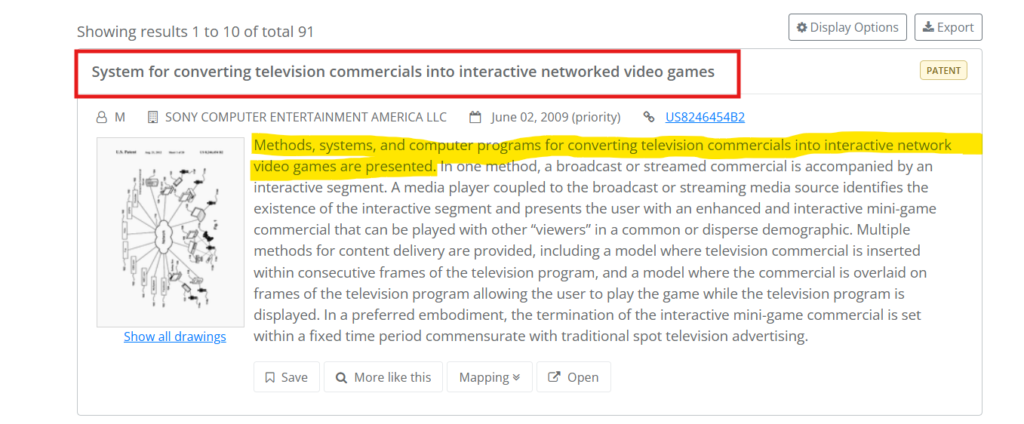
Source – PQAI
This patent, assigned to Sony Computer Entertainment America LLC, describes methods and systems for converting television commercials into interactive network video games.
That was a strong start.
But PQAI did not stop at the exact match. It also surfaced a few interesting patents around the same broader idea of making ads more interactive or harder to ignore.
For instance, it surfaced patent applications like KR20180099448A, which describes a mobile advertisement system where a mini-game is overlaid on top of the ad. The user interacts with the mini-game while the ad is playing, and the system judges success or assigns a score based on the user’s actions.
Another result was US20050076359A1. This was adjacent prior art that deals with changing how commercials behave during playback. If a viewer fast-forwards during an ad break, the system detects it and serves alternate content instead of simply letting the viewer skip the commercial.
There were several other patents around interactive ads, ad engagement, and systems designed to keep viewers involved during commercial playback. For someone researching around the idea, the broader result set matters. It does not just show whether the exact invention exists. It also reveals nearby approaches, giving inventors more context to refine, adapt, or rethink their idea before moving toward a patent filing.
Perplexity Patents also found the Sony patent family.
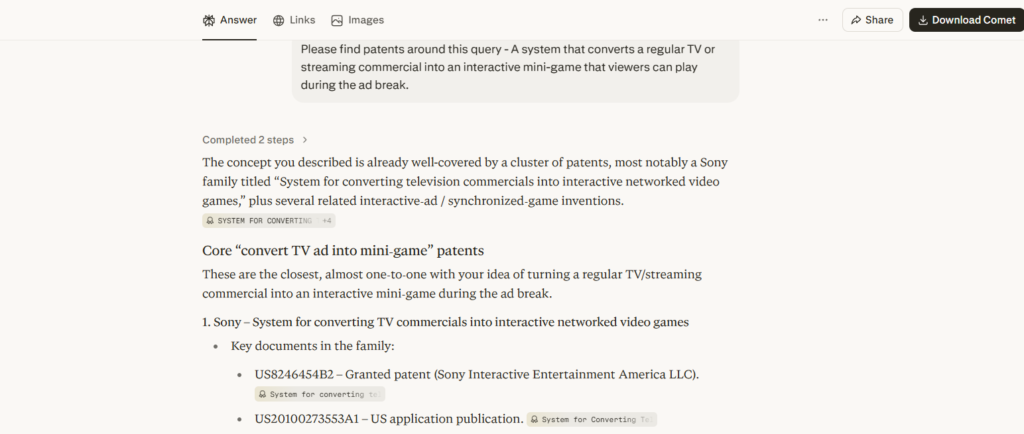
Source – Perplexity
Within the first result, it identified US8246454B2, along with related family members such as the US application publication, PCT publication, and European counterparts.
In fact, Perplexity explained why the Sony patent was directly relevant. It summarized how the system works, including how a regular TV or streamed commercial is transmitted with an interactive package, how a media player detects the interactive segment, and how viewers can play the mini-game while the commercial is displayed.
That makes Perplexity helpful for someone who wants a quick explanation of the closest patent. But that was not it. It also surfaced a few other patents around interactive ads and game-like advertising experiences.
For example, it surfaced US11166064B2, which covers a system for triggering interactive social games or applications in sync with TV commercials. It also surfaced WO2001082614A1, which focuses on integrating Internet-based interactive advertising with TV commercials. Though neither is a direct match, both are useful prior art references for anyone thinking about adding an interactive layer on top of a regular TV commercial.
When we compare both outputs, there was a difference in the workflow. Perplexity gave a curated answer, whereas PQAI gave a ranked landscape.
With Perplexity, the user sees what the assistant chooses to summarize. With PQAI, the user can inspect a broader result set, review titles and abstracts, compare relevance with mapping, and decide which patents deserve deeper review.
For this example, both tools found the right patent. But PQAI gave more search depth. Now let’s look at the next query to see whether the pattern holds.
The second example came from one of the more unusual patents we have explored to understand the patent landscape before: US8967029B1
This patent stands out because of its unusual premise. At a high level, it describes a UAV-based system for releasing toxin-fed mosquitoes from an onboard container through a controlled release mechanism in outdoor environments.
Here’s the query we used:
| Drone-based system for remotely releasing toxin-fed mosquitoes using onboard breeding, controlled valves, and optional gas-assisted dispersal into outdoor environments. |
This was a useful test case because the idea sits inside a strange but surprisingly active patent and research landscape. In our earlier article, we had uncovered related patents and research around UAV-based mosquito control, from systems that identify potential breeding sites to patents around release mechanisms powered by propeller airflow.
You can read the detailed prior art breakdown here.
Perplexity also found US8967029B1 as the closest match in the result. It explained that the patent was the best fit because the query included the same combination of UAV, mosquito container, controlled release, and dispersal elements.
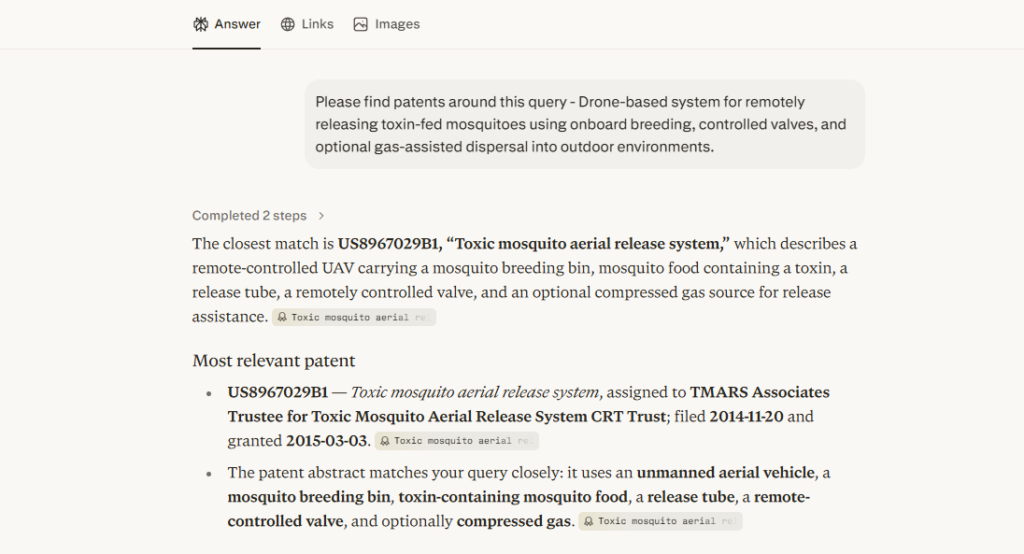
It also surfaced a few patents, including:
When we asked Perplexity to find more results around the same subject, it shared a few additional references. One of them was a reference from PQAI’s analysis around the landscape of this patent.
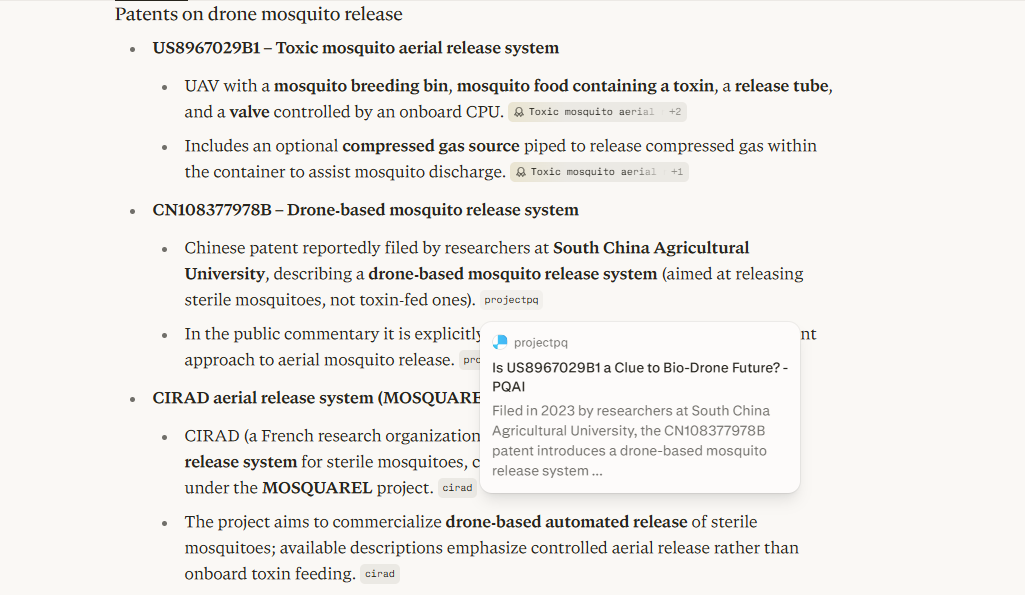
That was an interesting observation. Since Perplexity is a generative AI search tool, it can pull relevant references from different sources and explain why they matter. That’s what happened here, as it picked the Chinese patent as a reference.
But the output still felt limited. While Perplexity was good at identifying the closest patent, the results were thinner than the patent landscape that PQAI uncovered.
That difference matters even more in interdisciplinary areas. In cases like these, the best tool is not just the one that finds the exact patent. It is the one that helps you see the adjacent fields where relevant prior art may be hiding.
Now let’s get to our third query.
This example was based on the idea of remote real estate inspection. Starting from US9852487B1, we wanted to see whether the tools could find patents where a buyer can inspect a property through a live audio-video remote connection.
We turned that idea into a natural-language query:
| A remote property inspection system where a buyer uses a mobile or head-mounted device to tour a property through a live audio-video connection with a remote agent. |
When we ran this query on PQAI, it returned 90 results.

The top result was US11521279B1, “Method and system for interactive remote inspection service. This is a continuation from the same USAA invention family as US9852487B1, the patent we used as the starting reference.
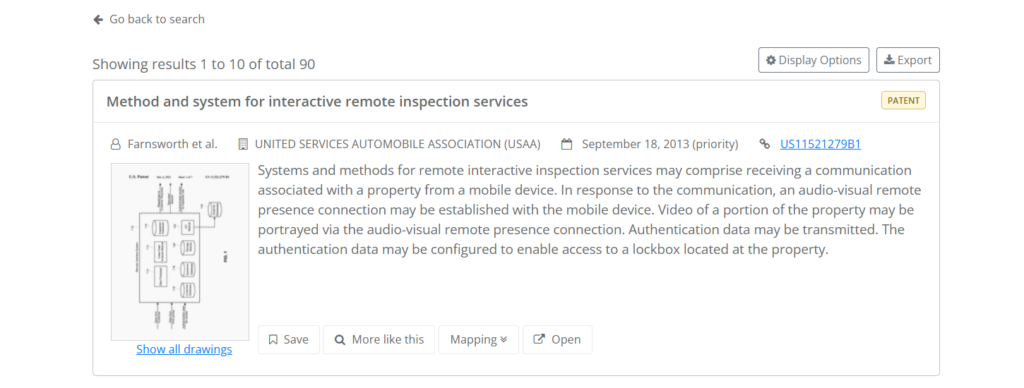
That was a strong result. In patent search, family-level discovery matters because the same invention can appear across multiple publications, continuations, and related applications. A search tool should help users land on relevant prior art around the idea, not just one exact patent number.
PQAI also surfaced adjacent patents that were relevant to the broader remote inspection workflow, such as:
PQAI also showed broader search insights, including companies with related patents, CPC classes, and publication trends. This helps users see who is active in the space and how the patent activity around remote inspection has evolved over time.
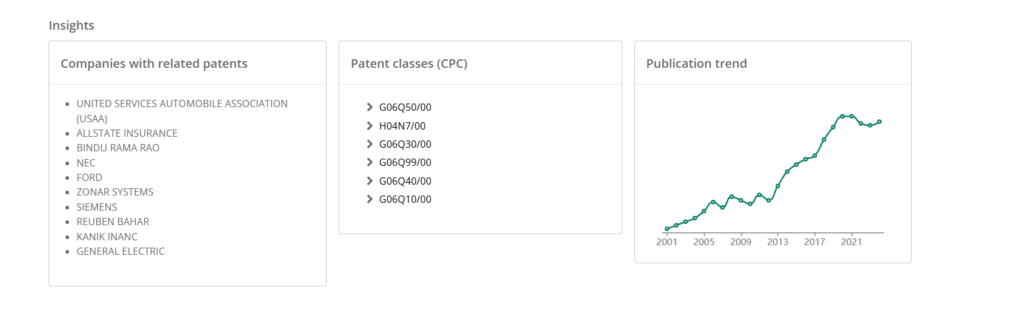
For someone researching a new remote property inspection idea, this broader view matters. It shows the surrounding approaches that could affect novelty, claim strategy, or product direction.
When we shared this query with Perplexity, it did very well too. It found the USAA patent family and grouped US9852487B1, US10713739B1, and US11521279B1 together.
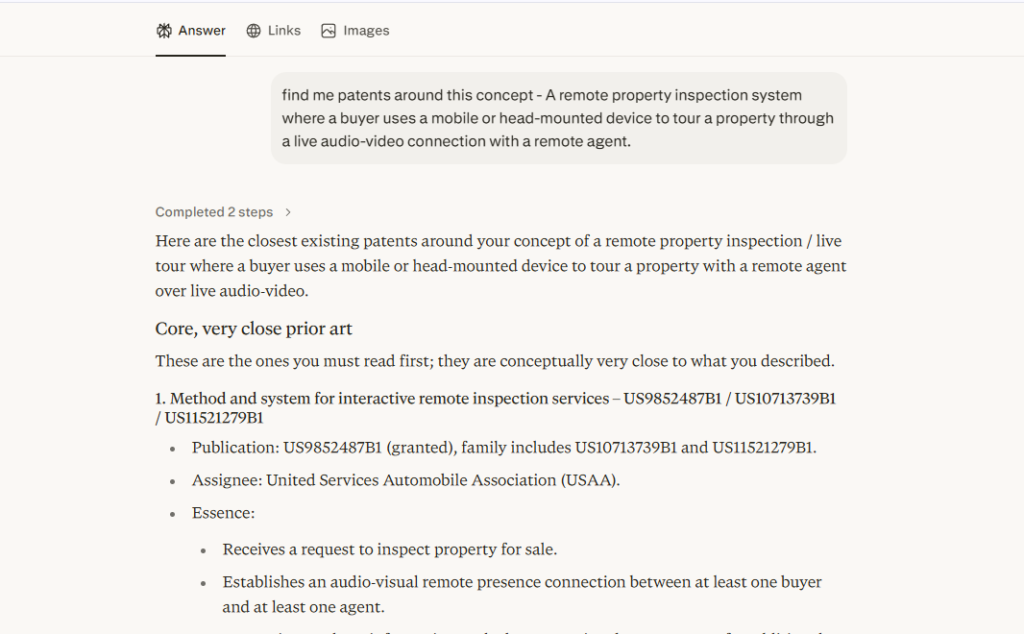
Perplexity also surfaced a few highly relevant adjacent references, including:
There were other patents too, which it covered and added in a table, as depicted below.
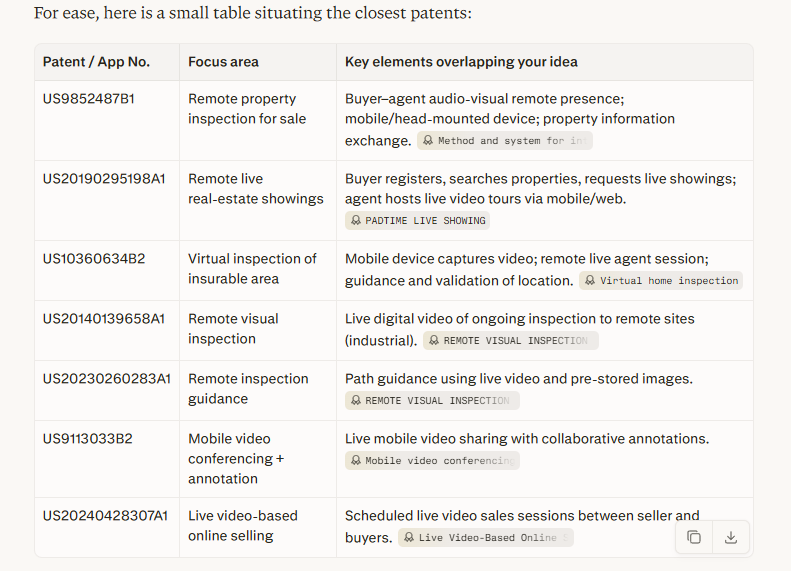
This was a highly curated answer. But there is still a key difference.
Perplexity gave us a readable shortlist around adjacent areas. PQAI gave us a searchable result set. If the goal is to understand whether any patents exist around an idea, Perplexity helps. If the goal is to continue reviewing, refining, saving, comparing, and expanding the search, PQAI gives a better starting workflow.
That itself is an important lesson. Good patent search is not one prompt and done. It is an iterative process. You start with a plain-English idea, inspect the results, then refine the query based on what the tool surfaces.
PQAI supports that kind of exploration well.
The right choice depends on the job you want the tool to do. For instance, Perplexity Patents is useful when you want to quickly understand whether any patents exist around an idea. It explains results well, groups related patents, and turns the search into a readable answer.
PQAI is stronger when you want to keep exploring the prior art yourself. It gives you a ranked result set, adjacent matches, and search insights that help you inspect the landscape more deeply.
Here’s a clearer view of how the two tools compare:
| Evaluation Criteria | Perplexity Patents | PQAI |
| Search experience | Conversational answer-first experience | Search-led exploration experience |
| First-pass understanding | Strong for quick summaries and plain-language explanations | Offers mapping features, which can help users inspect relevance of particular result |
| Closest patent discovery | Good at identifying and explaining the closest patent or patent family | Strong at surfacing the exact or closely related anchor result near the top |
| Adjacent prior art | Shows a useful curated shortlist | Shows a broader ranked landscape of close and adjacent results |
| Result format | Collated answer with selected patents, explanations, and references from different sources | Searchable result set with titles, abstracts, assignees, patent classes, and related results |
| Follow-up workflow | Works well for conversational follow-up questions when the user wants the answer expanded or explained further | Works well for iterative search because users can edit the query, rerun searches, compare results, and keep exploring the landscape |
| Best fit | Quick patent understanding and early curiosity checks | Deeper prior art exploration and invention refinement |
Now that the comparison is clear, you would agree that PQAI is the right fit when you are looking for a semantic prior art search engine. It gave users a broader result set they could inspect, compare, and build on a broader result set.
That difference matters because a good patent search is rarely about testing one quick prompt and stopping there. If you are exploring an idea before moving toward a patent application, you need to inspect the results, notice adjacent patterns, and refine your search strategy based on what you find.
PQAI supports that kind of exploration better. Now, let’s look at 5 quick reasons why you should choose PQAI for your next patent search.
Once you move beyond quick patent summaries, prior art search becomes a deeper workflow. You need to test the idea, inspect close and adjacent results, refine the search, and understand what already exists across patents and research literature.
That is where PQAI is useful. It offers:
The best part is that inventors do not need to start with a paid plan just to explore an idea. They can use PQAI to run quick prior art searches and surface relevant patents or research papers before deciding what to do next.
So, what’s the wait? If you have an invention idea in mind, try PQAI here and start exploring the prior art around it.

At PQAI, we bring clarity to the world of patents. Through storytelling and insight, we simplify inventions so innovators, researchers, and businesses can learn from the past and build the future.
In one of our earlier articles, we shared how PQAI can be used for invalidity searches. A little before that, we had also conducted a

PQAI is a popular tool among inventors for conducting novelty searches. You can describe an invention in plain language, and its semantic search capabilities can
People ask us a version of the same question all the time. How good is PQAI, really? It is a fair question, and a hard