How Often Does PQAI Surface Prior Art in Invalidity Searches? A Benchmarking Study
In one of our earlier articles, we shared how PQAI can be used for invalidity searches. A little before that, we had also conducted a

Most large organizations running innovation programs receive dozens of invention disclosures a month. The challenge is not only collecting those ideas. Every disclosure eventually needs to be reviewed by the IP team to understand whether it is new and worth pursuing. But when the first broad prior art search happens only after the disclosure reaches IP counsel, valuable review time has already been spent.
Given how easy it has become to integrate patent search capabilities, an API can help solve this problem. When a prior art search API is embedded inside the invention disclosure system, an initial novelty or patentability search can happen while the disclosure is being submitted. This gives inventors and the IP team early context about the idea’s patentability and any similar inventions that already exist.
Plus, having an API in the internal system has another advantage. It prevents confidential pre-filing information from leaving your organization’s environment, even briefly. That’s a risk most companies would rather avoid.
That’s why, in this article, we will cover the top prior art search APIs that can be embedded in invention disclosure software or used during idea intake. First, let’s look at what to consider when evaluating these APIs.
Before comparing tools, it helps to know what actually matters once the API has to live inside a disclosure workflow. The right prior art search API needs to balance search quality with integration, security, and cost. Here are the main factors to weigh:
The thing is, not every prior art search API scores well on all of these, and that’s fine. The right choice depends on which of them your workflow cares about most. With these factors in mind, let’s look at the APIs worth considering for prior art search at intake.
Once you apply the factors above, the list gets much shorter. Many patent APIs can give you access to patent data, but far fewer can fit inside an invention disclosure workflow and support prior art screening at intake.
Based on that, these are the five APIs worth considering:
Now, let’s look at what each one offers, where it fits, and which option stands out for invention disclosure intake.
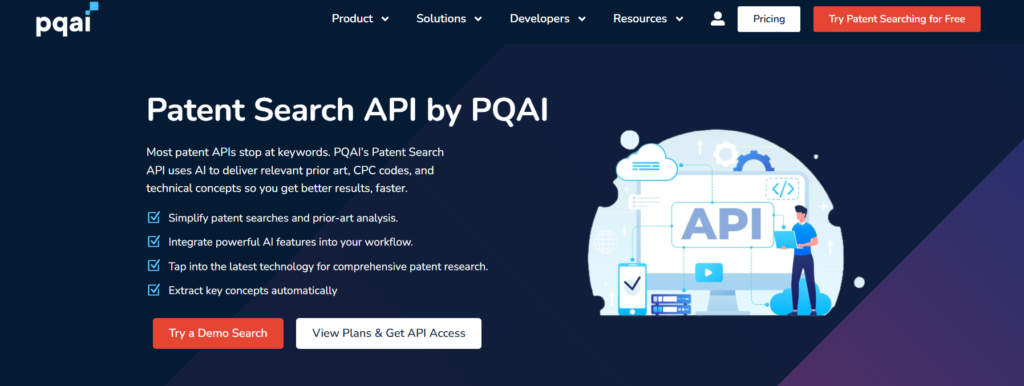
PQAI’s Patent Search API is designed to bring semantic prior art search directly into invention disclosure software.
Typically, invention disclosures are written in plain technical language. That is, inventors explain what they have built in their own words, leaving IP counsel to conduct the novelty search using traditional patent search tools.
PQAI API can take that plain-language invention description and return conceptually similar prior art ranked by relevance. This allows an initial novelty or patentability search to happen while the disclosure is still being submitted.
Instead of waiting for the disclosure to reach the IP team before beginning a broad search, the system can provide useful prior art context at intake.
The results by no means replace a detailed patentability search by IP counsel. However, they help inventors and IP teams understand much earlier whether similar inventions may already exist and which disclosures need to be reviewed sooner to improve speed to file.
Source – PQAI
Here are the features that set PQAI apart from other APIs:
Semantic prior art search: PQAI API allows the invention disclosure system to send the inventor’s plain-language description directly to the search endpoint. The inventor or IP team does not have to convert the disclosure into keywords or Boolean search strings first.
This is useful because disclosure language is often incomplete, informal, or different from the terminology used in existing patents. Semantic search helps identify conceptually similar prior art even when the wording is not an exact match.
CPC classification and concept extraction: PQAI can identify relevant CPC classifications and technical concepts from the invention description.
Within an invention disclosure system, this information can help categorize the disclosure, identify its technology area, and route it to the right IP reviewer. It can also help the IP team refine the initial search without manually analyzing every disclosure from scratch.
Similar-document and combinational prior art search: PQAI includes endpoints for similar-document retrieval and combinational prior art.
This allows the disclosure workflow to go beyond a basic list of patent results. The system can surface closely related documents and references that may need to be considered together when reviewing the invention.
Patent data, drawings, and family information: The API can also retrieve patent data, drawings, thumbnails, vectors, and related patent information.
This means the invention disclosure system can show more than a patent title and link. Reviewers can access relevant patent details and visual information within the same workflow, without moving between multiple tools.
Structured responses for easier integration: Most PQAI API responses are returned in JSON. This makes the results easier to display inside the invention disclosure form, an IP review dashboard, or an internal screening system. The prior art search becomes part of the existing intake process instead of another standalone platform that inventors and IP teams must open separately.
Security and confidentiality: PQAI does not use search queries to train external models. For organizations, this is a crucial criterion because the invention descriptions being searched are confidential and have not yet been filed.
Implementation support: Organizations that need help fitting the API into an existing invention disclosure system can also work with the PQAI team on a separately scoped integration.
PQAI currently offers three API plans:
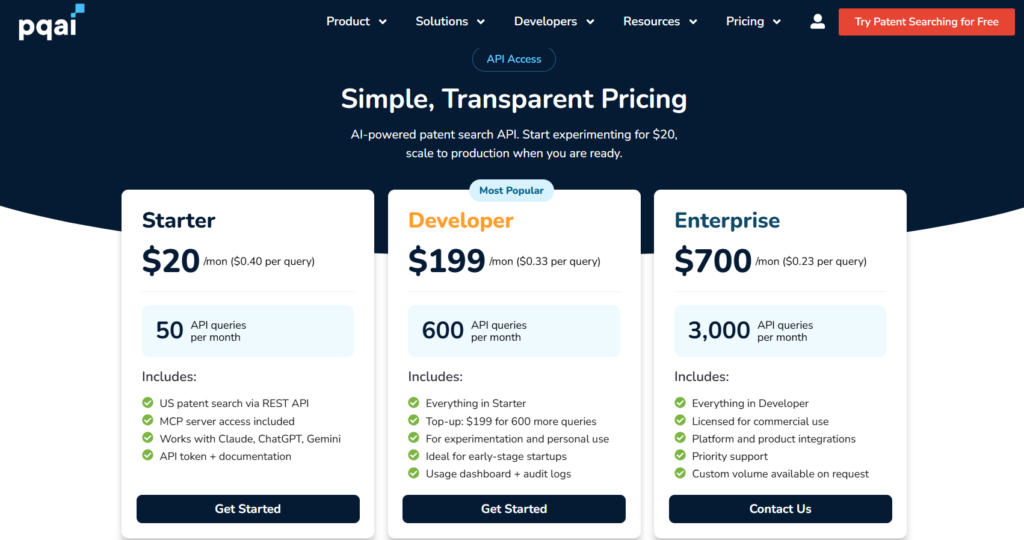
MCP server access is also included with the plans. Moreover, the Enterprise plan also includes commercial-use licensing, platform integration, priority support, and custom volume options.
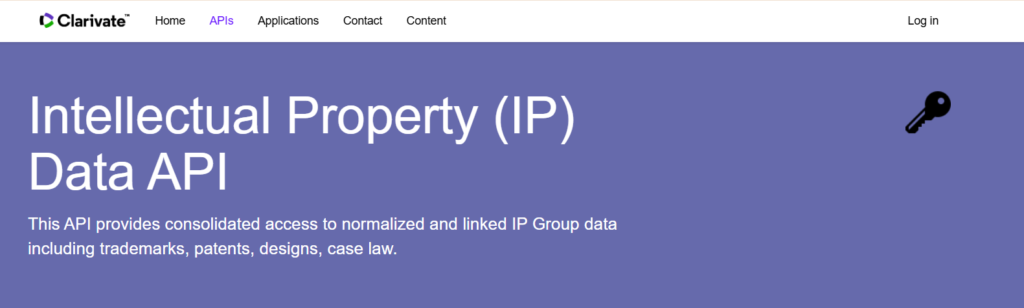
Clarivate’s IP Data API can help organizations bring normalized patent data into an existing invention disclosure workflow.
The API provides access to patent search, analytics, document retrieval, patent images, PDFs, and Derwent data. This API can come in handy when an organization wants its disclosure system to pull patent records, retrieve supporting documents, or connect invention reviews with a wider IP data environment.
Source – Clarivate
Its biggest strength is the depth and structure of the underlying data. Clarivate also covers trademarks, designs, and case law, making it relevant for organizations already using its broader IP ecosystem.
Clarivate’s Derwent platform also offers AI Search, which can use a natural-language invention description for first-pass patentability and prior art searches. However, organizations should confirm whether this capability is available through their specific IP Data API contract and how it can be integrated into their disclosure workflow.
The biggest trade-off is access. Clarivate reviews API requests against the organization’s contract and intended use case. This makes Clarivate a stronger fit for established enterprise IP programs than teams looking for a simple API they can quickly add to a disclosure form.
Pricing: You can contact Clarivate’s team for more information on pricing.
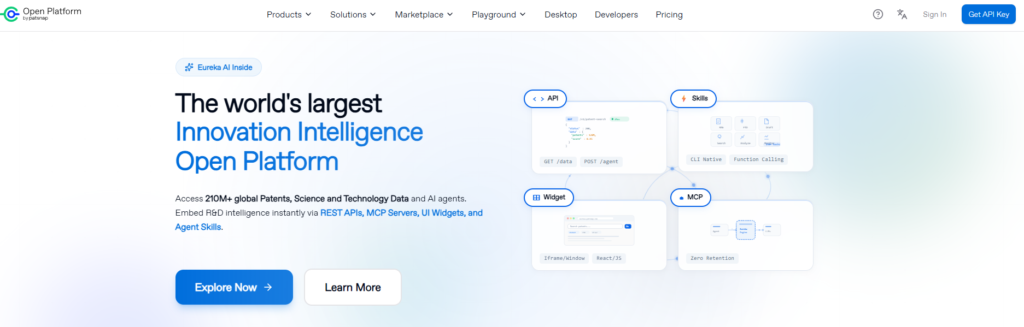
PatSnap Open Platform gives developers access to a broad range of patent, R&D, and innovation intelligence capabilities.
Its similar-patent search accepts a technical description and returns patents ranked by similarity. Within an invention disclosure workflow, this capability could be used to surface potentially relevant patents from an inventor’s submission during intake.
Source – PatSnap
PatSnap also provides access to more than 210 million patent records from over 170 patent authorities. Beyond search, organizations can retrieve patent families, citations, legal status, images, translations, and valuation data.
One feature that may simplify integration is its range of delivery options. Organizations can use REST APIs, MCP servers, or embeddable UI widgets, depending on how they want patent search to appear inside the disclosure system.
PatSnap also states that customer data and queries are not used to train foundation models. This is important when the system is processing confidential, pre-filing invention information.
The trade-off is that PatSnap is built for much more than invention disclosure screening. Its platform also covers R&D intelligence, freedom-to-operate analysis, monitoring, valuation, and technology landscapes. Organizations only looking to add a focused novelty check at intake may therefore need to evaluate more capabilities and integration options than they actually require.
Pricing: PatSnap now uses credit-based pricing. Its Starter tier includes 10,000 free credits for 90 days, Pro starts at $100, and Enterprise pricing is customized. The number of credits used depends on the APIs and capabilities included in the workflow.
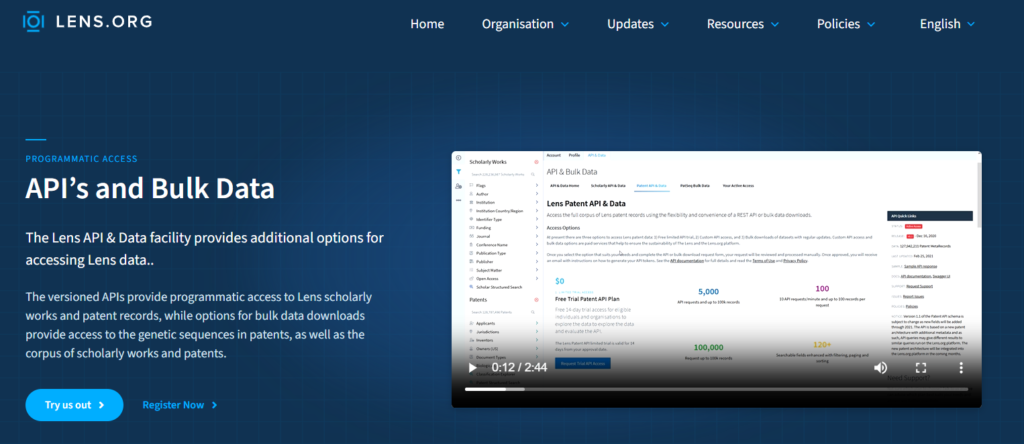
The Lens is a good option when prior art research needs to connect patent records with scholarly literature.
It offers separate API access for patent data and scholarly works. That makes it useful in technical fields where relevant disclosures may appear in academic papers before or alongside patent filings.
Source – Lens
The REST APIs provide access to the Lens patent and scholarly corpora. They support search, filtering, sorting, pagination, and aggregation across more than 120 searchable fields.
The important distinction is that Lens primarily gives you access to the underlying data. Its public API information focuses on structured, field-based search rather than a ready-made semantic novelty check for invention disclosure intake.
Your developers would therefore need to build the semantic search, relevance-ranking, and disclosure-review experience on top of the available data.
Pricing: Lens offers a 14-day trial for users who want to explore the data and evaluate the API. Staff and students at subscribing institutions may also be eligible for Institutional User Access.
However, commercial integrations or use cases requiring higher volumes and faster access are available through custom plans. Pricing depends on the use case, institution type, access volume, and rate requirements. You can contact their team for more information.
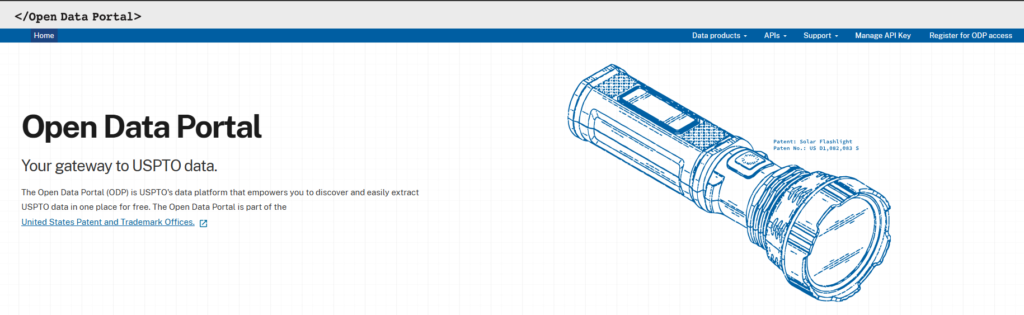
The USPTO Open Data Portal API gives developers free access to official US patent and patent application data.
It also offers rich search capabilities through REST APIs. Developers can use GET and POST requests to search and combine different application fields, then retrieve the results in JSON format. The available data includes patent applications, continuity information, documents, patent term adjustment data, and other Patent File Wrapper records.
Source – USPTO
Inside an invention disclosure workflow, organizations can use the API to search official USPTO records and retrieve relevant application data or documents without paying commercial patent-data licensing fees.
The trade-off is the type of search it provides. The ODP API supports structured queries and filters across patent application fields. However, the documentation does not describe a semantic search that can take an inventor’s complete plain-language disclosure and automatically return conceptually similar prior art ranked by relevance.
Teams would therefore need to design how the disclosure text is converted into suitable search queries and how the returned records are ranked and presented during intake.
Moreover, access to the API also requires a USPTO.gov account and a verified and linked ID.me account.
That gets us to the end of our list. After looking at each API individually, the differences become much clearer. Now, let’s see how they compare to each other.
Some of these APIs are designed to work with plain-language invention descriptions, while others primarily provide access to patent data that teams must shape into their own search workflow.
The right option for you depends on whether you need a focused novelty check at intake, access to a broader IP intelligence ecosystem, patent and scholarly literature together, or a free data source for building your own search experience. Let’s have one last look at how they all compare.
| API | Search and Data Strength | How It Fits an Invention Disclosure Workflow | Main Trade-Off | Pricing |
| PQAI API | Semantic prior art search using plain-language invention descriptions, along with CPC classification, concept extraction, similar-document search, patent data, and drawings | Can add an initial novelty or patentability search directly to the disclosure intake process and return structured results inside the existing system | More focused on patent search and disclosure workflows than broader R&D or enterprise intelligence platforms | Starter: $20 for 50 queries; Developer: $199 for 600 queries; Enterprise: $700 for 3,000 queries |
| Clarivate IP Data API | Normalized and linked data across patents, trademarks, designs, and case law, along with access to Derwent data | Can bring patent records, documents, images, and broader IP data into an established enterprise disclosure and review environment | Access depends on the organization’s Clarivate contract and approved use case. Teams must also confirm whether Derwent AI Search can be embedded through their specific API agreement | Custom pricing |
| PatSnap API | Semantic similar-patent search supported by more than 210 million patent records, along with R&D intelligence, legal status, families, citations, valuation, and monitoring | Can use an inventor’s technical description to surface similar patents during intake and connect the results with wider R&D or innovation intelligence | The platform covers much more than disclosure screening, so teams may need to evaluate more products and integration options than they require | 10,000 free credits for 90 days; Pro starts at $100; Enterprise pricing is customized |
| The Lens API | Structured search across patent and scholarly corpora, with more than 120 searchable fields | Useful when invention screening needs to include academic literature alongside patent records, particularly in research-heavy technical fields | Does not provide a ready-made semantic novelty check. Developers must build the semantic search, ranking, and disclosure-review experience | 14-day trial; institutional and commercial access through custom plans |
| USPTO Open Data Portal API | Free structured search across official US patent applications, documents, continuity data, and other Patent File Wrapper records | Can bring authoritative USPTO data into a custom US-focused invention disclosure or patent-review workflow | Does not offer a disclosure-ready semantic search. Teams must design the queries, ranking, and intake experience themselves. Access also requires a USPTO.gov account, ID.me verification, and an API key | Free |
Each API on this list brings valuable patent data or search capabilities to the workflow. However, PQAI is built closest to the specific use case covered in this article: embedding prior art search that supports an initial novelty check while an invention disclosure is still at intake.
PQAI stands out because it addresses the actual gap inside most invention disclosure workflows. It allows an initial prior art search to happen before the disclosure reaches the IP team for a detailed review.
That means organizations can bring useful patentability context into the intake process without asking inventors or reviewers to move to a separate patent search platform.
The integration can also be shaped around the way your invention disclosure system already works. If you need custom search, review, routing, or screening capabilities, the PQAI team can help fit the API into that workflow rather than forcing your team to build everything from scratch.
Plus, MCP server access adds another layer of flexibility. It allows PQAI patent search to connect with MCP-compatible tools such as Claude, ChatGPT, and Gemini, making it easier to build AI-assisted invention intake and review workflows.
If you are looking to add a semantic prior art search API to your invention disclosure software, the PQAI team can help you choose the right plan and build the integration around your existing system.
Ready to bring prior art search into your invention disclosure workflow? Contact our team today!
Disclaimer: This article is based on information available through publicly accessible sources, including official product pages, API documentation, and pricing pages at the time of writing. All product names, company names, and trademarks belong to their respective owners and are used for identification and comparison purposes only. Coverage, features, access conditions, and pricing may change. Confirm current details with each provider before making an integration or purchasing decision.

At PQAI, we bring clarity to the world of patents. Through storytelling and insight, we simplify inventions so innovators, researchers, and businesses can learn from the past and build the future.
In one of our earlier articles, we shared how PQAI can be used for invalidity searches. A little before that, we had also conducted a
PQAI is a popular tool among inventors for conducting novelty searches. You can describe an invention in plain language, and its semantic search capabilities can
People ask us a version of the same question all the time. How good is PQAI, really? It is a fair question, and a hard