How Often Does PQAI Surface Prior Art in Invalidity Searches? A Benchmarking Study
In one of our earlier articles, we shared how PQAI can be used for invalidity searches. A little before that, we had also conducted a

| TL;DR: A prominent US university’s TTO was handling more than 50 invention disclosures each month, but manual early-stage searches were slowing reviews. The team was small, while the university was placing greater emphasis on its innovation program. To reduce review time, the university embedded the PQAI Prior Art Search API into its existing system. This case study explores what changed after the integration, without increasing headcount. |
For university tech transfer offices handling a steady flow of invention disclosures, the real challenge begins after submission.
Each disclosure requires a timely response. Not every submission points to a patentable invention. Some may be better suited to other forms of IP too. Others may need refinement before any meaningful decision can be made.
Yet delaying feedback or letting disclosures sit unanswered creates its own risk. Faculty and students lose confidence in the evaluation process, and inventor momentum drops.
At the same time, running full patentability searches on every disclosure is not realistic. When outsourced to external consultants, costs add up quickly. Relying solely on internal, keyword-based novelty searches can be tedious and add to the review load.
This was the situation one prominent US university’s tech transfer office was dealing with when they reached out to us. The TTO was handling 50+ invention disclosures every month across several technical fields. However, the office had a relatively small internal team. They needed a way to screen disclosures earlier, assess novelty, and decide what merited deeper external review, without slowing the process or losing momentum.
The university had been encouraging greater participation in its innovation program. That effort was working. More faculty members and researchers were submitting ideas. But the process used to evaluate those ideas had not changed at the same pace.
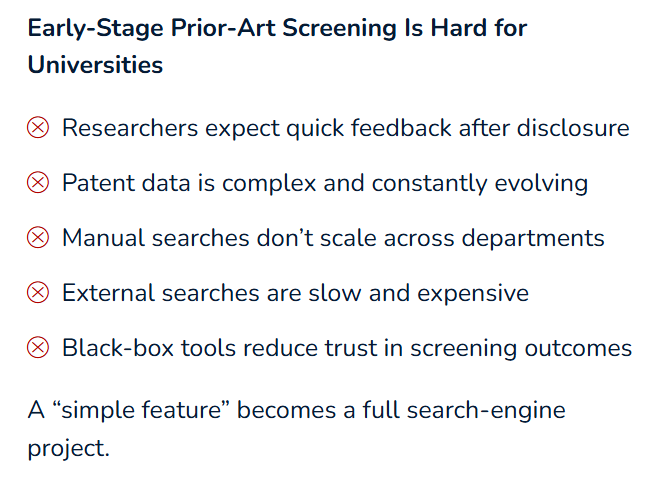
The TTO still had to review inventions across unrelated technical domains. Each submission required the team to understand the underlying concept, conduct an initial search, and decide whether further investigation was justified. The search volume was creating much of the friction.
Moreover, manual or keyword-based searches increased review time per disclosure, and the backlog continued to grow. This also affected inventor engagement, as feedback cycles became longer and less predictable.
During this period, the university explored newer AI-based patent search tools and tested several options, including PQAI. While these patent search tools proved useful, the underlying issue remained. Reviewers still had to leave the disclosure system, enter the invention details elsewhere, and bring the findings back into the original record.
The university was not looking to replace its existing invention disclosure system. That system already contained the submission, inventor information, supporting documents, internal notes, and review history. Moving the entire process to another platform would have created unnecessary disruption.
The team wanted its existing system to do more once a disclosure entered review. For instance, a licensing officer should be able to initiate an early prior-art check from the same record. The technical description already submitted by the inventor should become the search input.
They wanted the findings to also return to that record. This would allow reviewers to assess the disclosure with relevant prior-art context in front of them. Strong submissions could then be forwarded to outside counsel with that context already attached.
The same process could help the TTO explain its decision when an idea required refinement or appeared too close to existing work.
Building a full prior-art search capability internally was not realistic. Maintaining search infrastructure, keeping patent data current, and tuning relevance models would have shifted focus away from the TTO’s actual role: evaluating inventions and guiding next steps.
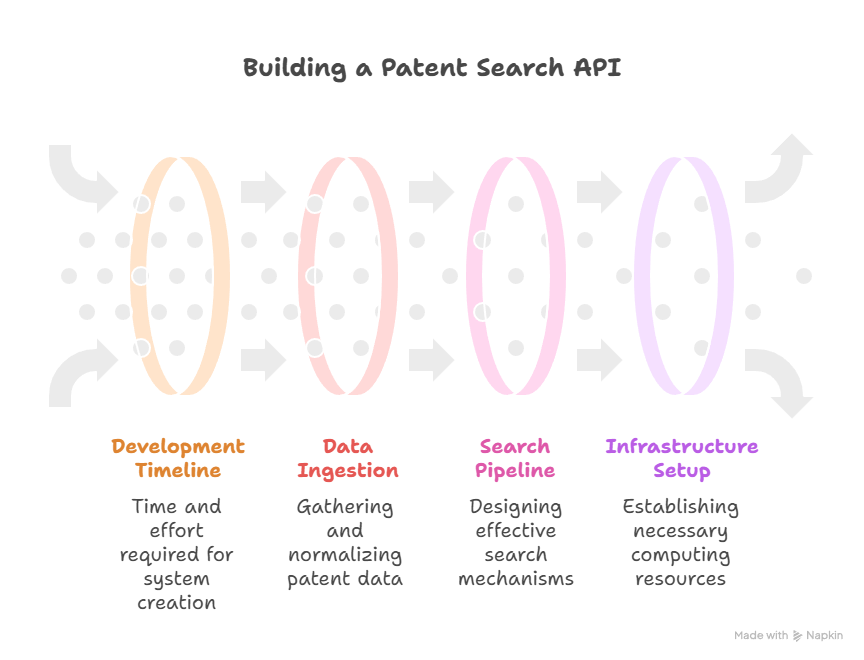
An API-based approach offered a cleaner path.
By integrating a prior-art search API directly into their existing platform, the university could automatically trigger early novelty checks when disclosures entered review. The disclosure text itself could serve as the input, while the results could be returned to the same record. This was the model the TTO needed.
When evaluating existing API options, the university’s team focused on one core question: Would it support early screening decisions inside the workflow without adding friction?
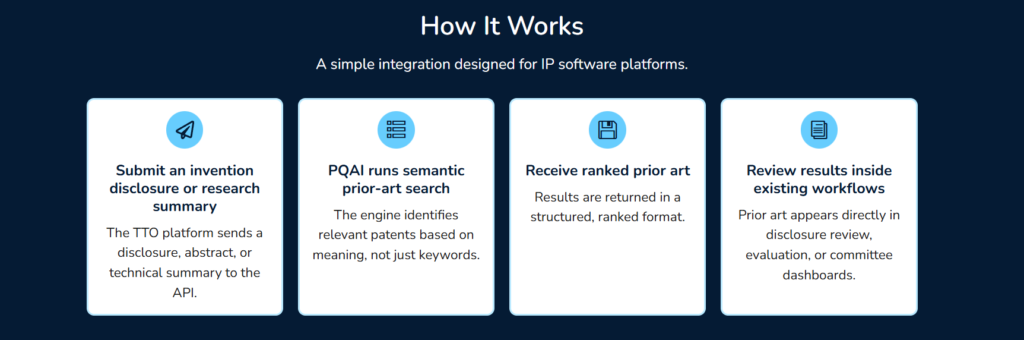
PQAI’s Patent Search API aligned closely with the TTO’s requirement:
With this setup, early screening became a built-in capability rather than an extra step.
Once early prior-art screening became part of the disclosure workflow, the impact was immediate and practical.
The first visible change was speed. Because disclosures could be screened using their existing technical descriptions, review cycles shortened significantly. TTOs were no longer spending time setting up searches or switching contexts. As a result, the team was able to review 30% more invention disclosures within the same timeframe as before. In the first month itself, they were able to review 15 additional disclosures, without adding headcount.
The quality of external handoffs also improved. Prior-art context remained attached to disclosures sent to outside counsel. As early screening became a defined part of evaluation, this made it easy for outside counsel too, who did not need to re-orient from scratch, and fewer clarification cycles were required.
Just as importantly, inventor momentum was preserved. Disclosures no longer sat idle pending review for weeks. When ideas showed promise, next steps were triggered without delay.
Overall, early screening shifted from being a bottleneck to becoming a facilitator. The TTO moved faster, handled higher volume, and maintained consistency, without adding friction to the process.
| Key Outcomes → 30% more invention disclosures reviewed each month → Initial review turnaround reduced from weeks to days → Faster, clearer feedback for faculty and researchers → Better-prepared handoffs to outside counsel |
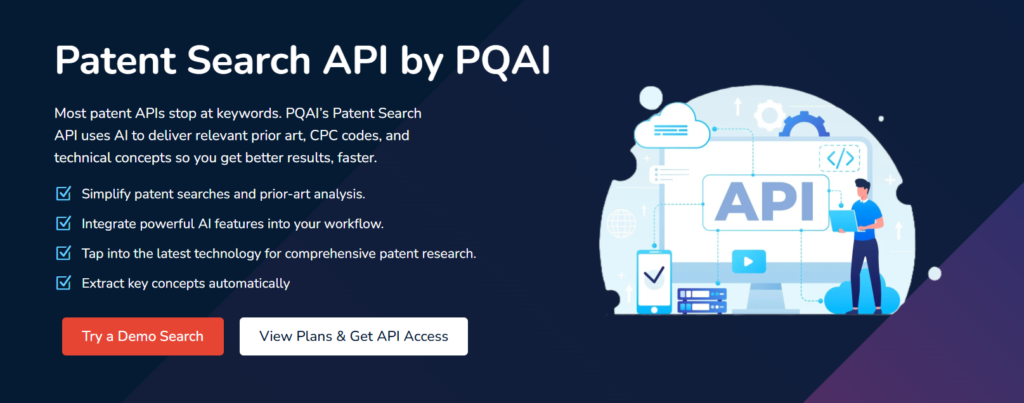
For university TTOs, early screening only works if the underlying system is trusted. The decisions that are made at this stage affect which disclosures move forward, which are refined, and which are paused. That makes transparency and control essential.
PQAI’s Patent Search API is built on an open-source foundation, which means there is no black-box logic behind screening outcomes. Teams can understand what is happening, how results are generated, and how searches behave over time. The API is also designed for confidential, pre-publication research, with strict data handling and no reuse of queries.If your office is evaluating how to embed early prior-art screening into its existing infrastructure, we support implementation as well. You can contact our team to get started.

At PQAI, we bring clarity to the world of patents. Through storytelling and insight, we simplify inventions so innovators, researchers, and businesses can learn from the past and build the future.
In one of our earlier articles, we shared how PQAI can be used for invalidity searches. A little before that, we had also conducted a
PQAI is a popular tool among inventors for conducting novelty searches. You can describe an invention in plain language, and its semantic search capabilities can
People ask us a version of the same question all the time. How good is PQAI, really? It is a fair question, and a hard