How Often Does PQAI Surface Prior Art in Invalidity Searches? A Benchmarking Study
In one of our earlier articles, we shared how PQAI can be used for invalidity searches. A little before that, we had also conducted a

Finding an API for novelty search sounds straightforward until you start comparing the available options.
There are some APIs that are built specifically for semantic prior-art search. Then there are others that focus on patent data, citations, document comparison, or access to non-patent literature. While all of them can support novelty search in some way, they are designed for different workflows and solve different parts of the process.
That is why choosing a novelty search API is about more than comparing feature lists. The right option depends on how you plan to use it, whether for an invention disclosure platform, an IP management system, or an internal R&D workflow.
This guide compares seven APIs based on their capabilities, pricing, limitations, and best-fit use cases. Our goal is to help you identify the option that best matches your novelty-search requirements.
APIs can support different stages of a novelty search. Some focus on prior art retrieval, while others provide data, mappings, or analysis support. The right option depends on the role the API must play and the capabilities already available within your workflow.
To make the decision easier, here are a few factors that can help you shortlist the right novelty search API option:
Evaluating each API across these factors can help you understand where it fits within your novelty-search workflow. Now, let us look at the available options.
Once you know what to evaluate, the next step is to shortlist APIs that can meaningfully support novelty search.
For this list, we included APIs that support one or more parts of the novelty search process. This includes semantic prior art retrieval, access to patent and scholarly literature, classification capabilities, or integration into internal tools. Some options focus on search and analysis, while others provide data for broader novelty-search workflows.
Based on that scope, here are seven APIs worth considering for novelty search in 2026:
Now, let’s dive deeper into each API one by one.
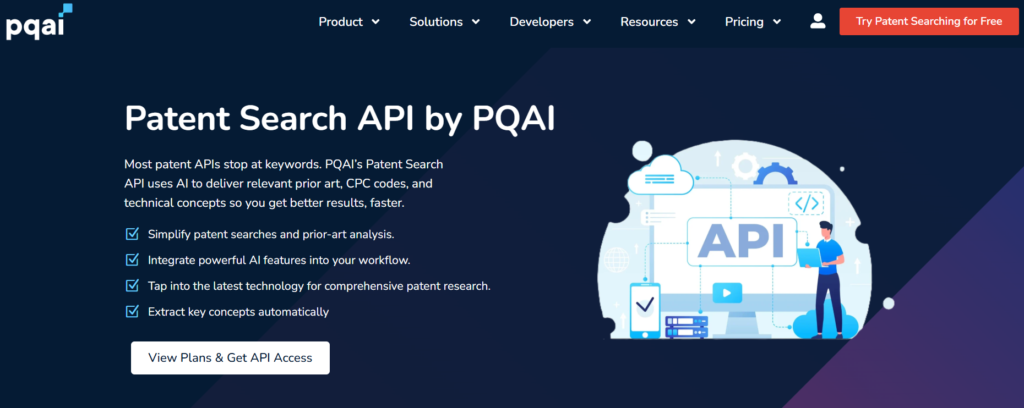
PQAI API helps developers add the power of AI-powered prior art search to their software, platforms, and internal workflows. Users can submit an invention description in plain English, and PQAI returns conceptually related prior art that can help conclude whether or not an idea is novel. This makes the API useful for invention disclosure workflows, preliminary novelty checks, and early screening for inventions.
Since PQAI is currently designed primarily for US-focused patent-search workflows, it is especially effective for organizations working with US patent data and examination patterns. Our AI leverages semantic search to identify relevant prior art. Moreover, the PQAI project has open-source foundations, giving technical teams more accessibility when developing custom patent-search applications.
Now let’s dive into why PQAI API is the right choice for Novelty search APIs.
Source – PQAI
PQAI is best suited for organizations embedding semantic prior art search into their own products or internal workflows.
Relevant use cases include:
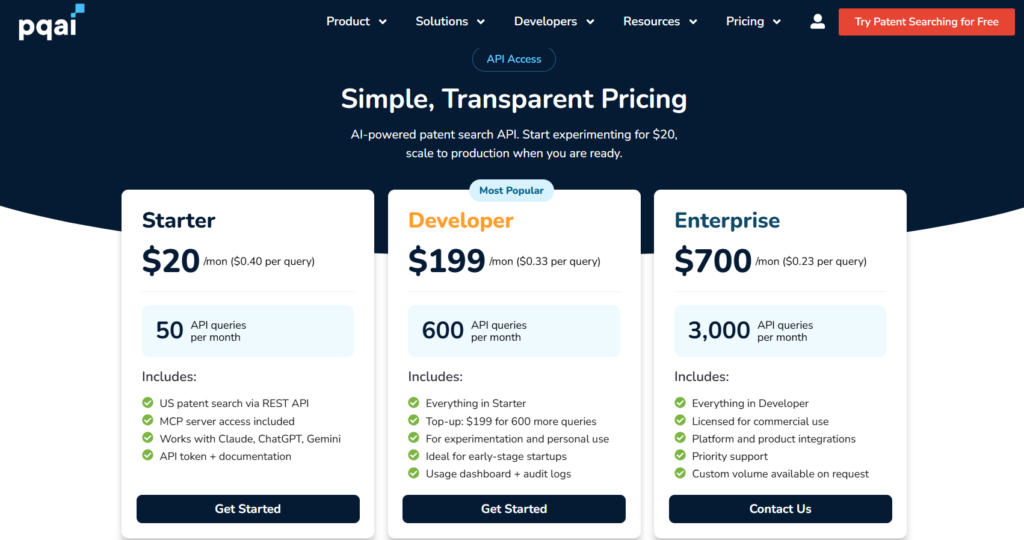
PQAI offers three monthly API plans. Our Starter and Developer plans are designed for experimentation and early-stage development. Whereas the Enterprise plan is intended for commercial products, platform integrations, and higher-volume usage. You can view our plans below:
Source – PQAI
Every plan includes REST API access, MCP server access, and API documentation. The Developer plan adds a usage dashboard, audit logs, and top-ups of 600 additional queries for $199. The Enterprise plan includes commercial-use licensing, product and platform integrations, priority support, and custom volume options.
Read Next: How Enterprises Can Use the PQAI API to Build Novelty Checking Features
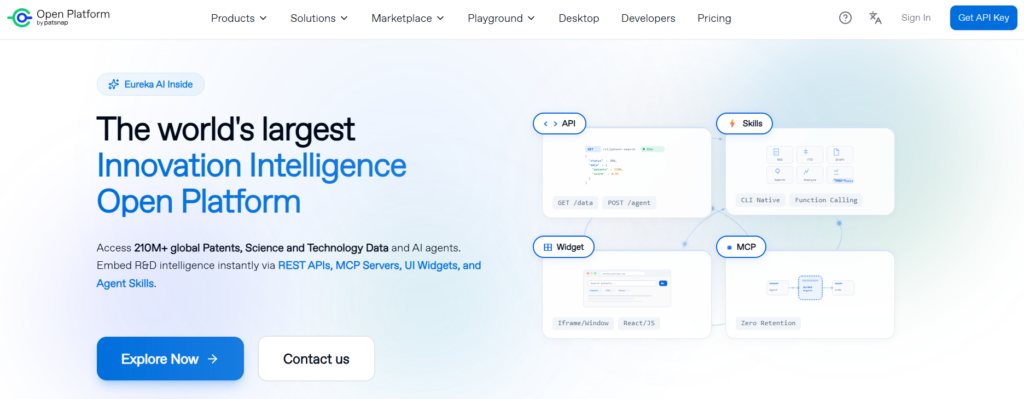
PatSnap Open Platform gives developers access to patent, scientific, and technology intelligence through several integration formats. Its Novelty Search agent accepts a technical description and supports prior-art discovery and patentability evaluation.
The API workflow includes technical feature extraction, search strategy generation, reference retrieval, feature comparison, and novelty-search report generation. Developers can access Novelty Search through REST APIs, MCP servers, UI widgets, and agent skills.
Source – PatSnap Open Platform
PatSnap may suit established R&D and IP teams that want several novelty-search stages available through one provider. It is particularly relevant when an organization wants structured reports and global data without building each workflow component independently.
PatSnap uses credits across its APIs, Model Context Protocol servers, widgets, agent skills, and Eureka AI capabilities.
One credit is valued at $0.01. However, different operations consume different amounts based on their complexity and computing requirements.
Dennemeyer’s Patent Search & Analytics API brings patent intelligence into the IP software an organization already uses. It allows teams to run patent searches, follow publications and legal-status updates, and use patent analytics without moving to a separate platform.
Source – Dennemeyer
The API may suit IP software vendors, law firms, corporations, and research institutions that want patent intelligence inside an existing IP management system.
Dennemeyer provides pricing on request. Organizations must contact the company to arrange a demo and discuss API access and integration requirements.
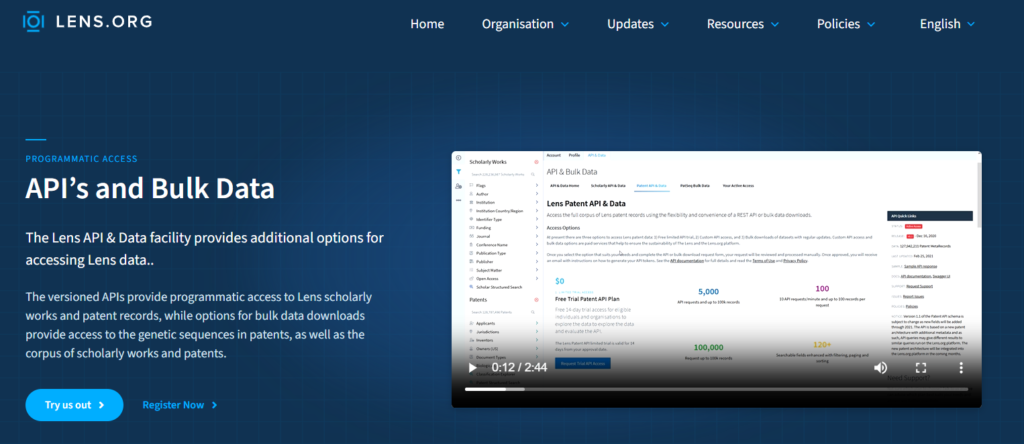
The Lens provides separate REST APIs for patent records and scholarly publications. Together, these APIs can support novelty search h across patent and non-patent sources. This is important because technical details are often found in research papers rather than in patents alone. Developers can then connect the retrieved data to research tools, university systems, or custom applications.
Source – Lens
The Lens API may suit universities, research institutions, and development teams that need both patent and scholarly data. It is most useful for organizations that can build their own search, analysis, and review process.
The Lens offers two API access options:
The Lens does not publish standard prices for its paid API plans. Organizations must request a plan based on their intended use.
EPO Open Patent Services, or OPS, gives developers programmatic access to EPO-maintained patent data for custom novelty-search and prior-art research systems. Organizations can use it to bring patent information into internal applications and build search, analysis, and review workflows around their own requirements.
Source – EPO
OPS is best suited for development teams that need EPO-supplied worldwide patent data for a custom novelty-search system. It is particularly relevant when the workflow requires family, classification, citation, legal event, or available full-text information.
OPS is free for users downloading up to 4 GB of data each week. Organizations requiring more than 4 GB per week can purchase an annual subscription for €2,800. All usage remains subject to the EPO’s fair-use policy.
The USPTO Open Data Portal provides free API access to US patent application and examination data. It can support US-focused novelty-search workflows that need structured patent records, citations, office actions, and related examination information.
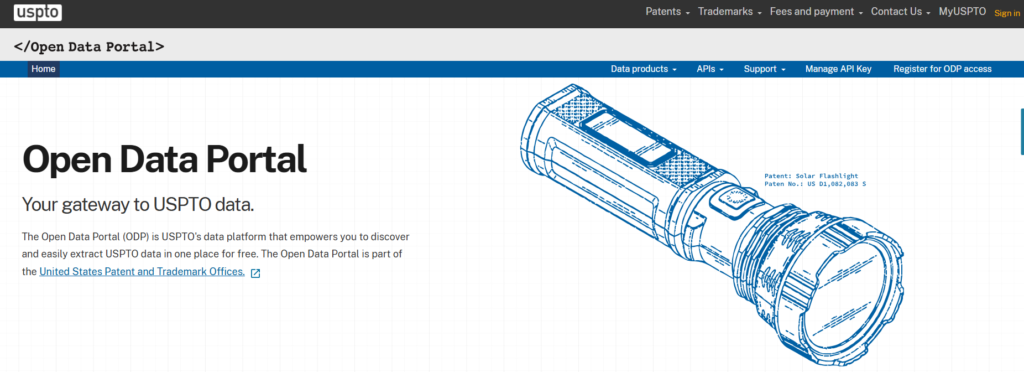
Source – USPTO
The USPTO Open Data Portal API suits developers and researchers building US-focused patent tools. It is especially useful when a workflow needs application records, examination documents, citations, rejections, or continuity data.
The USPTO Open Data Portal API is free to use. Users must create a USPTO.gov account, complete ID.me verification, and request an API key. Since June 18, 2026, access to the portal requires a valid USPTO.gov account.
Minesoft Patent Data API is designed to bring global patent information into the systems where organizations already work. It can support novelty-search and prior-art workflows that form part of a broader data, analytics, or AI environment.
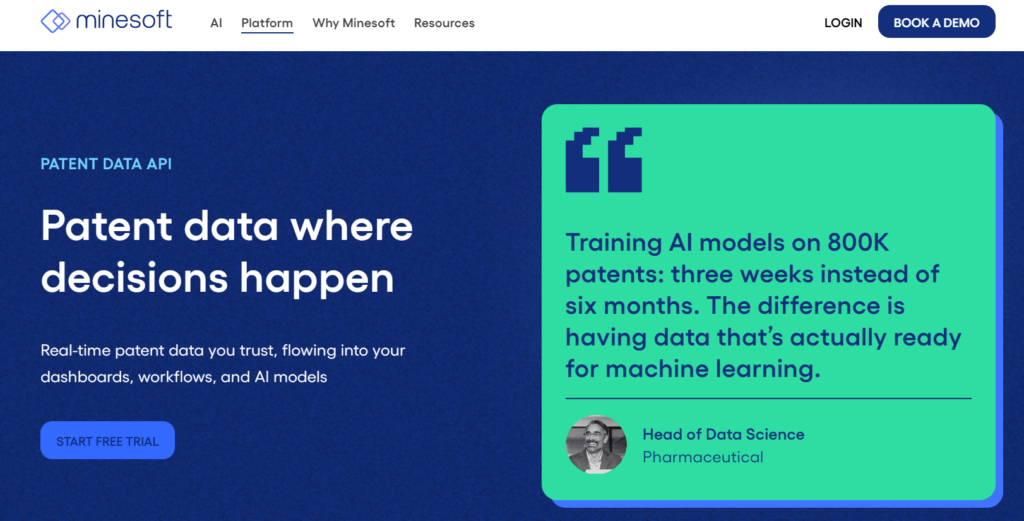
Source – Minesoft
Minesoft may suit enterprises that need global patent data inside dashboards, data lakes, internal applications, or AI pipelines. It is particularly relevant when legal-status, family, citation, chemistry, or life-sciences data is important to the workflow.
Minesoft does not publish fixed pricing for its Patent Data API. The company offers a free-trial option and asks interested organizations to discuss their data, volume, and integration requirements directly.
That brings us to the end of our list. Let’s compare them side by side so you can quickly see which one best fits your novelty-search workflow.
Choosing an API often comes down to three questions: what it offers, how much it costs, and whether it fits your requirements. Some APIs are built around AI-powered prior-art search, while others emphasize patent data, enterprise platforms, or broader IP workflows.
The table below compares the options across these factors to help you evaluate them more quickly.
| API | What it offers | Pricing | Best for |
| PQAI API | Semantic prior-art search using plain-language invention descriptions, with CPC suggestions, snippets, mappings, and structured API access | Starter: $20; Developer: $199; Enterprise: $700 | Organizations that want to adding novelty search to invention disclosure tools, R&D systems, legal technology products, or AI agents |
| PatSnap Open Platform | A structured novelty-search workflow covering feature extraction, prior-art retrieval, comparison, and report generation | Free Starter with 10,000 credits for 90 days; Pro starts at $100; Enterprise pricing is custom | R&D and IP teams that want several novelty-search stages through one developer platform |
| Dennemeyer Patent Search & Analytics API | Patent searching, publication and legal-status tracking, analytics, and structured data integration with existing IP software | Pricing available on request | Organizations that want patent-search and analytics capabilities inside an existing IP management system |
| Lens Patent and Scholar APIs | Programmatic access to patent records and scholarly publications | 14-day approved trial for limited academic or non-commercial use; paid access available on request | Research teams that need both patent and non-patent literature |
| EPO Open Patent Services | Bibliographic, family, classification, citation, legal-event, and available full-text patent data | Free up to 4 GB per week; €2,800 annually for higher usage | Organizations building custom international patent-search applications |
| USPTO Open Data Portal API | US patent application, citation, office action, rejection, and examination data | Free after USPTO.gov registration, ID.me verification, and API-key approval | Developers and researchers building US-focused patent-data tools |
| Minesoft Patent Data API | Global patent data for dashboards, data platforms, monitoring systems, internal applications, and AI workflows | Fixed pricing is not published; a free-trial option is available | Enterprises integrating patent data into existing systems and analytics infrastructure |
While every API on this list has its place, PQAI is particularly relevant for organizations looking to embed semantic prior-art search into custom software or internal workflows.
Let’s take a closer look at what makes it particularly well suited for these use cases.
PQAI is particularly well suited for organizations that want to add semantic prior-art search to their own novelty-search product or internal workflow.
The API can support the early stages of novelty review, where an invention description needs to be matched with technically relevant prior art. This makes it useful for invention disclosure systems, screening tools, legal technology products, and R&D workflows.
PQAI also makes the evaluation process relatively straightforward. Our pricing and usage limits are clearly defined, so organizations can understand the cost before beginning an integration. They can start with a specific use case and move to higher-volume or commercial access as their requirements grow.
If you are comparing APIs for novelty search, PQAI offers a strong balance of focused prior-art capabilities, practical integration, and a clear path from testing to wider use. For organizations with more specific requirements, our team can also help customize the integration and provide support during deployment. Get in touch with us by filling the contact form.
An API can make prior-art discovery faster and more consistent, but it is not a substitute for a formal patentability opinion. A qualified professional may still be needed to review the references, interpret the claims, and assess their legal relevance.
Validation usually involves looking beyond similarity scores or summaries and reviewing the underlying documents. It can also help to check whether a reference predates the invention and whether it clearly discloses the relevant technical features.
A useful description often explains the invention’s purpose, main components, how those components interact, and the steps involved. Further, details about what makes the invention different from existing approaches may also improve the quality of the search.
Disclaimer: This article is based on information available in publicly accessible sources, including official product pages, API documentation, pricing pages, and related public materials available at the time of writing. All product names, company names, logos, trademarks, and brand assets mentioned or shown belong to their respective owners and are used here for identification and comparison purposes only. We do not claim ownership of any third-party brands, images, or trademarks referenced in this article.

At PQAI, we bring clarity to the world of patents. Through storytelling and insight, we simplify inventions so innovators, researchers, and businesses can learn from the past and build the future.
In one of our earlier articles, we shared how PQAI can be used for invalidity searches. A little before that, we had also conducted a
PQAI is a popular tool among inventors for conducting novelty searches. You can describe an invention in plain language, and its semantic search capabilities can
People ask us a version of the same question all the time. How good is PQAI, really? It is a fair question, and a hard