Waste Recycling Innovation Trends: 4 Signals Emerging from Patent Filings
Mention waste recycling, and the first picture that comes to mind is the tricolor dustbins. Segregate your waste based on the category, reuse and recycle


For research-intensive enterprises that constantly innovate, operating in fast-moving technology domains, patenting is not a one-time event. It is an ongoing process that unfolds alongside active research and development.
This was the situation for one of our clients, which operated in a highly competitive and technically dense domain. For them, innovation did not arrive as isolated breakthroughs. Instead, it emerged through a steady stream of refinements, improvements, and follow-on ideas that built on earlier work.
Their patent strategy had gradually shifted too. Rather than focusing solely on initial filings, their emphasis shifted to building strong, layered coverage of core technologies. This included filing continuation and continuation-in-part applications.
To support this approach, the company had already invested in a deeply customized internal IP workflow. Rather than relying on multiple disconnected tools, they operated a single system that allowed multiple teams to collaborate efficiently and keep patent activity aligned with ongoing innovation.
As this organization’s innovation activity grew, management placed a strong emphasis on filing more patents.
Their goal was clear. They wanted to build a dense and defensible patent portfolio around their core products and technology areas.
As a result of this internal push, invention disclosures increased steadily. Many of them were follow-on ideas to earlier patents. Others explored variations or alternative approaches around the same technical concepts.
Even when an initial patent had already been filed, teams were encouraged to keep identifying additional variations that could be protected.
While this was aligned with the company’s goal of building strong patent coverage, it created a practical challenge. The volume of follow-on disclosures placed an increasing load on the IP team. Review cycles started to stretch. Simple exploratory ideas began consuming the same attention as filing-ready disclosures.
To address this challenge, the organization wanted to establish a process that allowed engineers and inventors to explore prior art around an existing idea before escalating it to the IP team.
The organization already had a highly customized IP workflow in place, and they were clear about one thing. They did not want to introduce another standalone tool into the process.
There were plenty of patent search tools available in the market. In addition, newer AI-driven patent search platforms promised faster and more intuitive results.
In theory, using these tools could help close the gap for engineers and researchers exploring follow-on ideas. However, there was one constraint.
The ideas these researchers explored were very sensitive and closely tied to ongoing research. Allowing those ideas to move outside internal systems, even briefly, introduced risk. Any leakage of data could compromise future patentability or expose strategic directions prematurely.
That was not a risk the organization was willing to take.
At the same time, asking engineers to rely on manual searches or route every exploratory question through the IP team was not sustainable either. The capability had to exist internally and under the organization’s control.
Given these constraints, the organization was not looking for a traditional search tool.
What they needed was a capability that could operate quietly inside their existing environment, without changing how teams worked or where sensitive information lived.
An API-based approach fit this requirement naturally. It allowed prior art search to be embedded directly into the already customized internal IP workflow. The searches could run within the same system where invention disclosures were shared.
Just as importantly, this approach made prior art exploration accessible to engineers and inventors. Instead of relying on keyword-heavy tools or escalating every suggestion to the IP team, researchers could explore relevant prior art around new ideas in a lightweight way, using the technical context they already had.
It was during this evaluation that the organization came across the PQAI Patent Search API. The API model aligned with how they wanted to work: internal, controlled, and flexible enough to support exploratory use without fragmenting the workflow.

Once the client decided that prior art search had to live inside its existing IP system, the question shifted from whether to add search capability to what kind of search capability would actually work.
The solution had to respect data sensitivity, fit naturally into a custom workflow, and be usable by engineers without turning prior art search into an IP bottleneck.
This is where the PQAI API fits their requirements.

Open-Source Foundation and Transparency: For this organization, prior art search would directly influence filing decisions, continuation planning, and claim direction. As a result, transparency mattered. PQAI’s open-source core ensured there was no black-box behavior. The IP team could understand how results were generated and trust that search relevance was not driven by opaque logic.
Privacy-First and Secure by Design: The ideas being explored were early and highly sensitive. PQAI’s API is designed so that all queries remain within the customer’s controlled environment. Search inputs are not used to train external models, reused, or shared. This allowed engineers to explore prior art without risking exposure of confidential research or future patent strategy.
Natural-Language Search: PQAI supports semantic, natural-language search. Users do not need expertise in patent classes or complex keyword construction. They could explore prior art by simply sharing their ideas in plain technical language that they used in their invention disclosures.
Flexible and Highly Integratable: PQAI integrates easily and can be embedded into any existing workflow with a few endpoints. Whether the workflow supported invention management, innovation tracking, internal IP review, or research exploration, the API could be integrated where needed.
Moreover, our team also supports deployment and customization so the capability can fit the organization’s process, not the other way around.
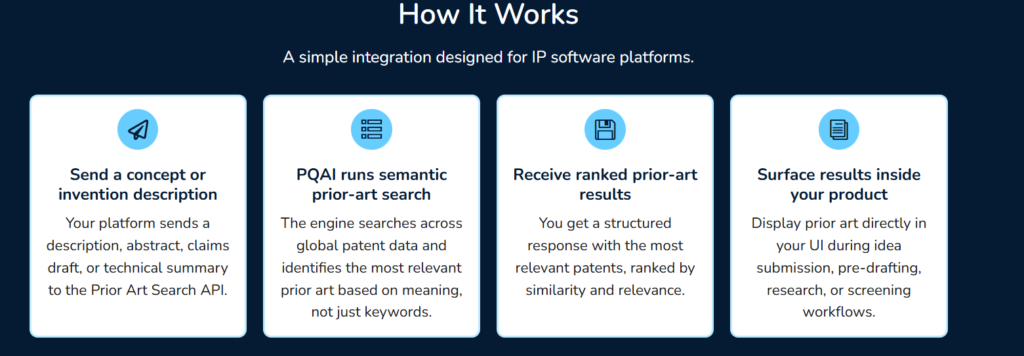
Within eight months of embedding PQAI prior art search API into their internal IP workflow, the client began to see measurable changes across throughput and portfolio outcomes. There were some clear benefits that emerged.
Beyond these metrics, the overall quality of collaboration improved. Engineers were more informed when submitting ideas, and the IP team could focus attention where it mattered most.

The filing volume remained high, but with clearer technical positioning and stronger alignment to long-term patent strategy.
There is a broad shift in how modern IP workflows are being built. Prior art search is no longer a standalone activity performed late in the process. In fact, it works best when it is embedded early in the ideation process, governed centrally, and aligned with how teams already operate.
PQAI is designed for exactly that model. Our API allows IP software teams to add reliable prior art search capability without owning search infrastructure, exposing sensitive data, or forcing users into new tools.
The result is better decisions upstream, lower operational load downstream, and IP workflows that scale with innovation volume.
If you’re building or operating IP software and need prior art search capability in the background, our API is built to support that. Talk to us here to explore integration options.

At PQAI, we bring clarity to the world of patents. Through storytelling and insight, we simplify inventions so innovators, researchers, and businesses can learn from the past and build the future.
Mention waste recycling, and the first picture that comes to mind is the tricolor dustbins. Segregate your waste based on the category, reuse and recycle
A bioprinter can now lay down living material one precise layer at a time, turning a droplet of bioink into something biological: a steak, a

For university tech transfer offices handling a steady flow of invention disclosures, the real challenge begins after submission. Let me elaborate. You see, when disclosures