How do you extract the maximum patentable value from a large volume of invention disclosures without letting costs spiral out of control?
This was the challenge one large enterprise was grappling with when they reached out to us. The organization already had a mature and well-established invention disclosure process in place.
The submissions were coming in regularly, and every disclosure was formally ready for IP review. However, the bottleneck emerged during the triage process.
Not every disclosure required a full patentability search through outside counsel. Some needed refinement. Some inventions were likely not novel. And the strongest ones required quick action to preserve priority.
Holding decisions back meant delayed feedback and growing queues, with disclosures stuck waiting for a clear next step.
The organization’s IP team needed a way to run early novelty checks internally. So that decisions could be made faster, while keeping costs under control, and without affecting inventor momentum.
The Challenge: Making Early Decisions Without Fragmenting the Workflow
The real challenge this client was dealing with was coordination.
Each submitted disclosure triggered a sequence of internal steps. That is, initial review by the IP team. Followed by follow-up questions for inventors. Then internal discussions on technical merit. And, eventually, a decision on whether the disclosure justified escalation to outside counsel. In theory, these steps were straightforward. In practice, they rarely were.
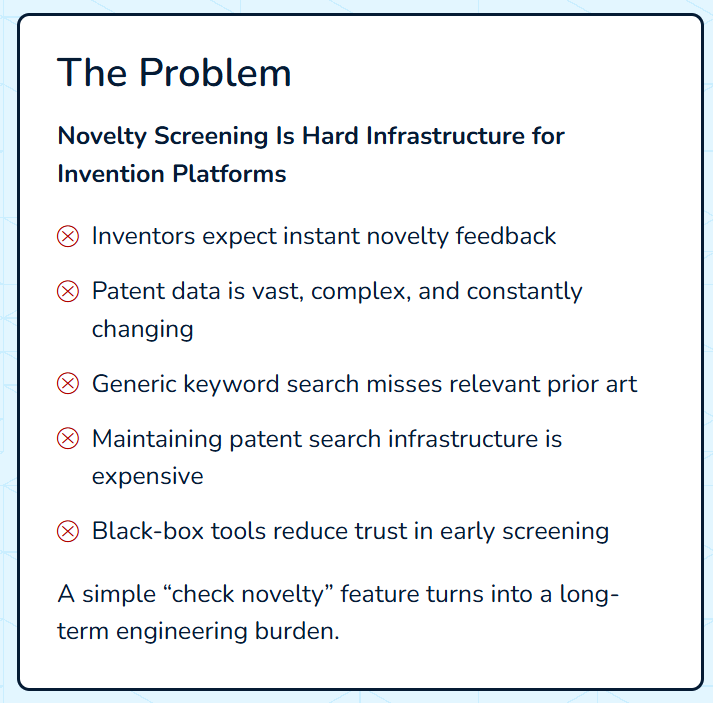
The organization did have internal resources capable of running early novelty checks. However, doing so required switching tools, relying on traditional search methods, and investing time upfront before knowing whether a disclosure was worth deeper analysis.
At the same time, newer natural-language–based search approaches were becoming popular, offering faster ways to surface relevant prior art without complex query construction.
What the team needed was a way to use those capabilities early, both to guide internal decisions and to provide meaningful feedback to inventors. For example:
If a disclosure lacked novelty, references could be shared so inventors could refine their approach rather than lose momentum.
If it showed promise, the path to external review could be triggered quickly.
The problem was that all of this required moving between systems.
Why Embedding Early Novelty Checks Became Necessary
What the IP team really wanted was for the existing invention management system to do more of the work for them.
When a disclosure came in, their expectation was simple.
The IP team should be able to stay within the same system, review the submission, and run an early novelty check without switching platforms or recreating the disclosure context elsewhere.
If an invention showed promise, the IP team needed to move quickly, escalating it for a full patentability search or external review from within the same workflow, without recreating context.
If an invention required refinement, the system should still support a productive outcome. The IP team wanted to pull relevant references from the early search and share them with the inventor as part of the same workflow.
That way, feedback was specific, grounded in prior art, and useful. Inventors could then refine their technical approach, understand existing solutions in the space, and avoid unknowingly working around protected IP, all without losing momentum.
And if an invention was unlikely to progress, that outcome still needed to be communicated clearly and constructively.
Most importantly, this created a single decision channel. Early novelty checks informed what happened next with the inventions: refine, escalate, or pause. Everything flowed forward from that step. For that to work, novelty assessment could not live outside the system. It had to be embedded directly into the invention disclosure workflow itself.
Why an API-Based Approach Made the Most Sense
Once the decision was made to embed early novelty checks into the workflow, the next focus was on execution.
The client was not looking to rebuild its invention management system or introduce heavy infrastructure changes. They already had a well-functioning platform in place, tailored to their internal processes.
What they needed was a way to extend that system’s capabilities without disrupting how disclosures were submitted, reviewed, or tracked.
Building and maintaining a full search capability internally was not a viable option for them either. It would have required ongoing effort, specialized expertise, and long-term ownership of infrastructure that was not core to the invention management platform itself.
More importantly, it would have shifted attention away from what the IP team actually needed: faster, more informed decisions at the point of triage.
An API-based approach offered a cleaner path forward.
With an API-based approach identified as the right path, the team evaluated API options based on their ability to support early novelty checks within the invention management workflow.
PQAI’s API fits the bill because of the specific capabilities it offers:
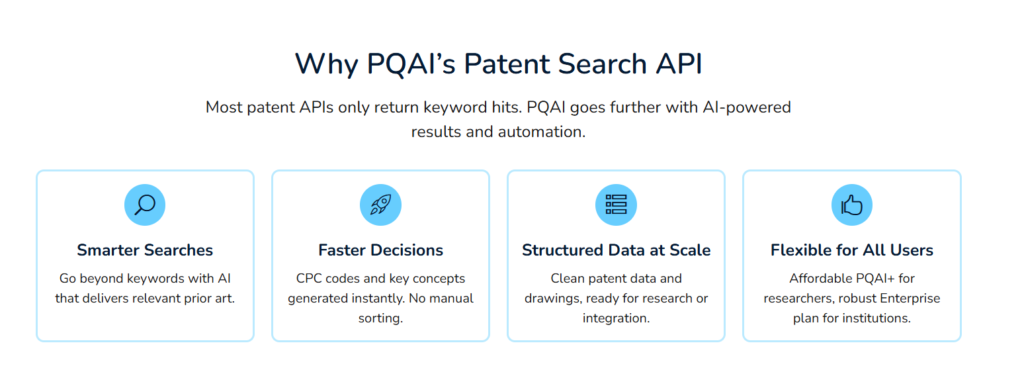
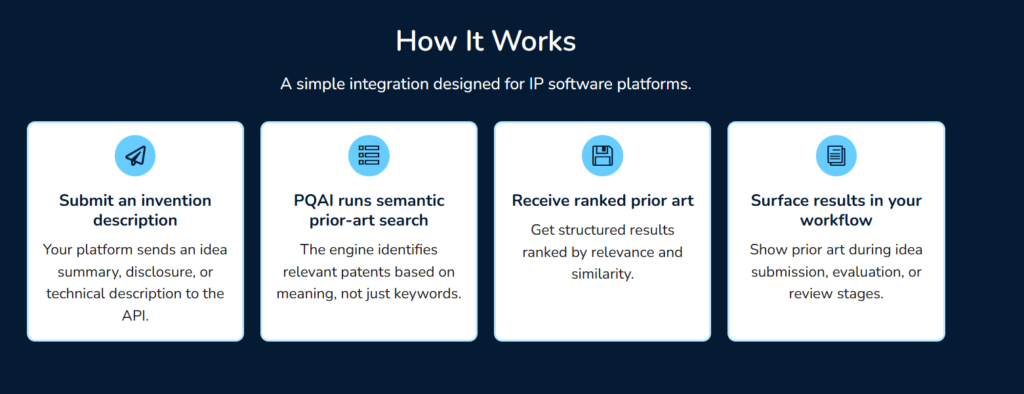
Natural-language prior-art search: The API accepts plain-English technical descriptions as input, allowing invention disclosures to be used directly for early novelty checks. This removed the need for keyword-based query construction during initial triage.
Semantic relevance beyond keywords: Instead of returning simple keyword matches, the API surfaces prior art based on semantic similarity. This could help the IP team identify conceptually related disclosures that may not share obvious terminology.
Associated technical concepts and CPC context: The search results would include relevant CPC codes and technical concepts derived from the input text. This made it easier to understand how an invention mapped to existing technical domains and where similar work already existed.
Structured prior-art results suitable for reuse: The API returns ranked prior art in a structured format, allowing references to be attached back to invention disclosures. These references could then be reused for inventor feedback or carried forward when escalating an invention for external patentability review.
Together, these capabilities allowed early novelty checks to be added to the invention disclosure workflow without introducing a separate search interface for the IP team.
What Changed After Early Novelty Checks Were Embedded
Few months after the novelty checks were embedded as part of the workflow, the impact was visible across speed, risk management, and overall process efficiency.
Faster disclosure review cycles: The time required to review and triage each invention disclosure dropped by approximately 30%. Because the IP team could use the disclosure text directly as input for early searches, they were able to assess more disclosures in less time and move them forward without repeated internal loops.
Higher throughput without added headcount: With less time spent switching tools or reconstructing search context, the IP team could process a larger volume of disclosures within the same review capacity. This allowed stronger ideas to reach the next stage sooner, without increasing operational load.
Earlier detection of closely related work: In one instance, an invention that initially appeared strong was found to be very close to existing work being developed by a competitor. The similarity surfaced through early search results based on conceptual alignment, even though different terminology was being used.
Clearer inventor feedback and sustained momentum: When disclosures required refinement, the IP team could share concrete references as part of their feedback. This helped inventors understand the existing landscape and adjust their technical approach, rather than receiving vague or delayed responses that stalled progress.
Improved quality of external handoffs: For disclosures that moved on to external patentability review, early context was already in place. Outside counsel received better-prepared submissions, with clearer positioning and fewer clarification cycles, improving overall efficiency.
This new addition made the process more efficient, without lowering review standards or increasing costs substantially.
Why PQAI Works Well for Invention Management Workflows
For teams building or operating invention management platforms, trust and transparency matter just as much as capability.
Moreover, novelty checks influence real decisions. That is, what moves forward, what gets refined, and what stops. That makes the underlying technology choice even more important.
That is why many enterprise teams prefer the PQAI API, given its open-source foundation, which avoids black-box decision-making.
Moreover, the API operates independently of interface or workflow assumptions, so you can decide how and where novelty checks appear, based on your requirements.
If you’re exploring the right API to embed novelty checks into your own platform or IP software, PQAI’s Patent Search API is designed to support that kind of integration. To learn more about how it can fit into your system, you can reach out to our team to discuss further.
At PQAI, we bring clarity to the world of patents. Through storytelling and insight, we simplify inventions so innovators, researchers, and businesses can learn from the past and build the future.
“I like to think of synthetic biology as liquid alchemy, only instead of transmuting precious metals, you’re synthesizing new biological functionality inside very small channels.”
Mention waste recycling, and the first picture that comes to mind is the tricolor dustbins. Segregate your waste based on the category, reuse and recycle
We are pleased to express our support for PQAI and its mission to revolutionize patent searching through open-source, AI-driven solutions.
At [COMPANY NAME], we recognize the importance of accessible and efficient patent tools in fostering innovation and empowering inventors from diverse backgrounds. By supporting PQAI, we aim to contribute to the development of transparent, collaborative, and impactful solutions for the intellectual property community.
We kindly request the addition of [COMPANY NAME] to the official List of Supporters of PQAI.
Sincerely,
[CEO or Equivalent Name] [Title] [Company Name] [Signature]