
How Often Does PQAI Surface Prior Art in Invalidity Searches? A Benchmarking Study
In one of our earlier articles, we shared how PQAI can be used for invalidity searches. A little before that, we had also conducted a

Claude has become a popular starting point for research. As it develops more capabilities with every update, users are getting more out of it, They are using Claude to process genomic data, analyze financial information, review risk documents, and work through more complex research tasks. That made us curious about one specific use case: prior art search.
We have already tested how ChatGPT performs in prior art search. This time, we wanted to see how Claude performs when the user starts with a natural-language invention idea.
Before running the test, we asked Claude how it handles prior art search. Its answer was clear. Claude does not have a built-in patent search engine. Unlike Perplexity Patents, which relies on Lens API for prior art search, Claude has no such native patent-search integration. It did mention a Prior Art Search Skill, but that requires users to have access to Claude Code.
However, many inventors may not have access to code. Even if they do, using such workflows requires some setup. Many users will not want to set up a code-based workflow just to run an early prior art check. They might simply describe an idea in plain English and ask Claude what prior art exists around it.
That’s what we did too. We gave Claude and PQAI the same invention descriptions and compared what each tool surfaced.
To ensure we were not testing the tools with a random invention prompt, we started with invention ideas inspired by real patents. Then we turned those ideas into natural-language queries. We did not add patent numbers, titles, assignee names, or claim language because we wanted to see what each tool would surface from the idea alone.
Our goal was to evaluate both tools on three questions:
This is important because prior art search is rarely one prompt and done. A good search workflow should help users see the surrounding approaches and understand where similar ideas already exist.
That broader landscape matters because it can help inventors and researchers refine the idea, change the technical direction, or identify a more specific angle before they move further into drafting.
Our first idea came from industrial flue gas cleaning.
Inspired by US9789465B2, the idea was about a porous lime-based granule that helps remove gases from industrial flue gas.
This was an interesting test case because the value was not in using lime itself. Lime-based materials are already used in flue gas cleaning. The more specific idea was to make the granule work better by helping the gas reach more of the reactive material inside it.
In many gas-cleaning materials, the reaction can happen mostly near the surface. That means the outside of the granule gets used first, while the inner material may not contribute as much. The idea here was to improve that by making the granule porous enough for the gas to move deeper inside.
So we used this query:
| A porous lime-based granule that helps remove harmful gases from industrial flue gas by allowing the gas to pass deeper into the granule instead of reacting only on the outer surface. |
Now let’s see how the tools answer to this query.
When we shared this query with Claude in a new chat using the Pro version, we started with this instruction:
Find prior art around the idea, followed by the query. Instead of searching, a notification popped up.

Given the filters, we removed the word harmful and ran this query again. To be honest, this made the test more interesting. If the query did not directly say “harmful gases,” “acid gases,” or “SOx,” would Claude still understand the gas-treatment context?
It did. Claude’s strongest result was US4387078, titled Process for effecting removal of sulfur oxide gases from stack gases.
That was a useful result because it captured the broad mechanism we were testing. Claude explained that the patent described a porous hydrated lime or quicklime core, where SOx-containing gas could reach the reactive material inside the particle instead of only reacting at the outer surface.
Claude also surfaced US4975257, titled Lin’s flue gas desulfurization process according to reaction mechanism. This was another relevant lead because it also dealt with lime-bearing material, sulfur oxide removal, and a structure where gas could reach unreacted material inside the particle.
So Claude did not miss the idea. It understood that the query was not just about any porous granule. It was about flue gas treatment, lime-based reactive material, and improving gas access inside the particle.
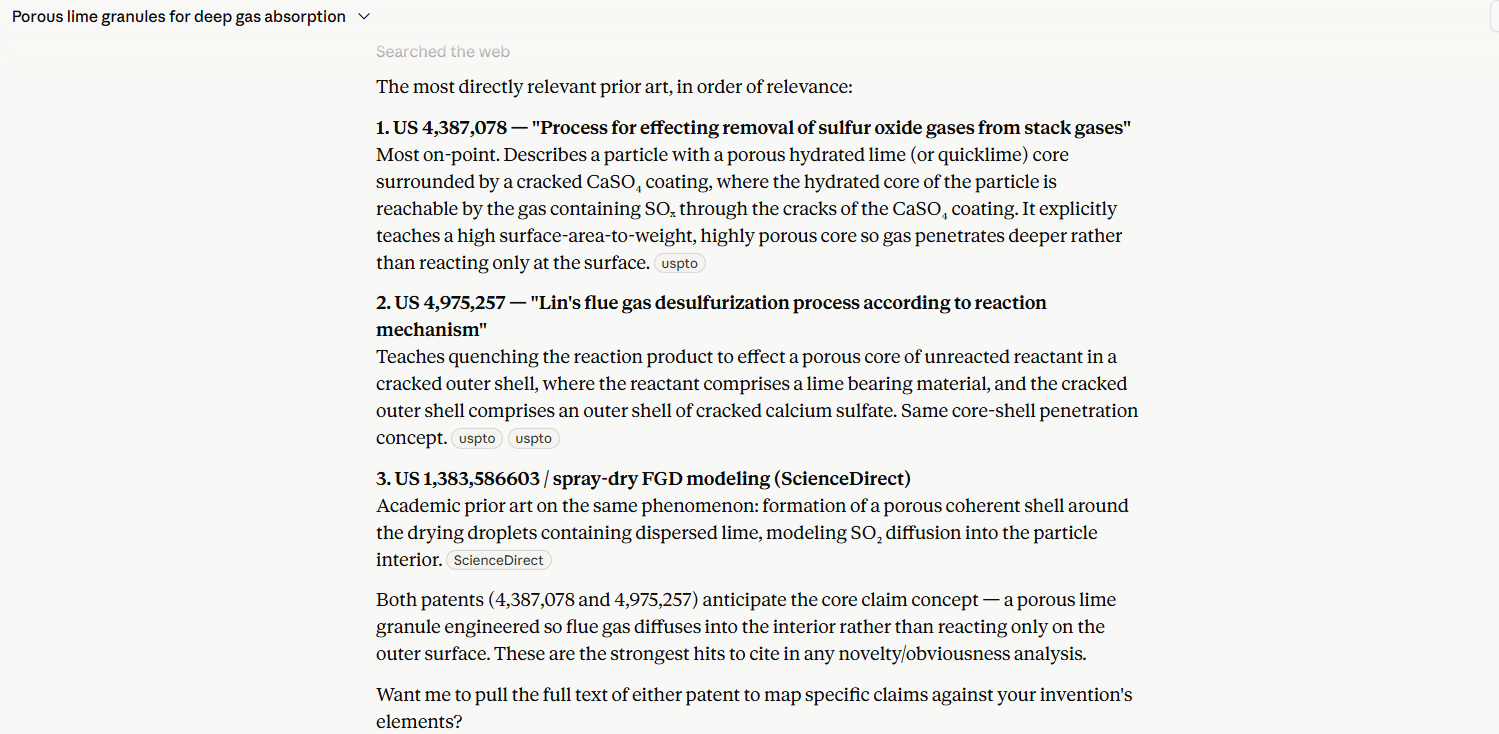
Source – Claude
But Claude’s answer was still a curated shortlist. Also, one of the references needed verification. Claude appeared to present a ScienceDirect article identifier as a patent number. When we clicked the ScienceDirect link, it led to a research paper. This is quite natural as Claude itself claims that it uses AI and can make mistakes.
That said, Claude gave us a few references and explained why they mattered. While useful for a first-pass check, it did not give us a broader patent landscape to inspect, compare, or refine further.
Next, we gave the formulated query to PQAI as it is and waited to see what kind of results it would surface.
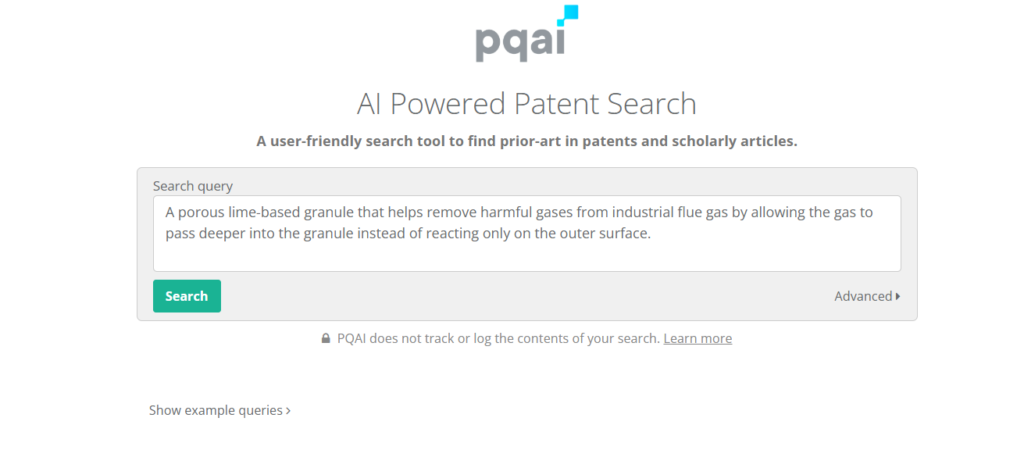
The query returned 96 results and the beauty of it was that the top results moved into the same technical neighborhood as the invention idea, like gas absorption granular materials, porous calcium-based granules, SOx absorption, acid gas treatment, and exhaust gases from thermal processes.
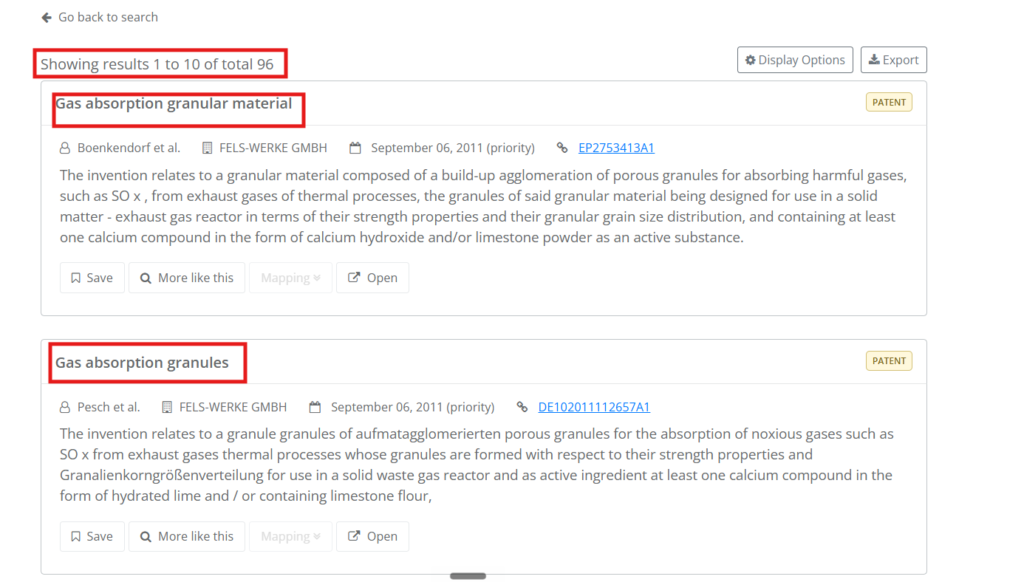
For example, here are some of the patents PQAI surfaced:
EP2753413A1: This European patent describes build-up agglomerated porous granules for absorbing harmful gases such as SOx from exhaust gases of thermal processes. Here, it mentioned calcium hydroxide and/or limestone powder as active substances.
DE102011112657A1: This result was another patent from the same family as the European patent. It covered porous granules for absorbing noxious gases such as SOx from exhaust gases, using hydrated lime and/or limestone flour.
There were many other results that surfaced, including Chinese patents like CN101234288B and CN1913955A, which covered different ways to remove harmful gas components from exhaust gases. The results didn’t stop there. PQAI also surfaced broader adjacent results around porous packing materials, scrubber reactors, aldehyde gas-absorbing porous materials, and other gas treatment agents.
Though not all of them were equally close, that is the point of a search landscape. A user can start with the strongest matches, inspect adjacent references, and fine-tune their invention further.
Now, let’s take a look at another query we shared with both tools to see what kind of results both surface.
This idea came from the world of chemical manufacturing. We were looking at a cleaner process for producing high-purity copper oxide, where leftover materials are recycled back into the production process.
Here’s the query we used:
| A clean process for making high-purity copper oxide where ammonia, carbon dioxide, and leftover copper solution are recycled back into the production process. |
Let’s see what each tool found, starting with Claude.
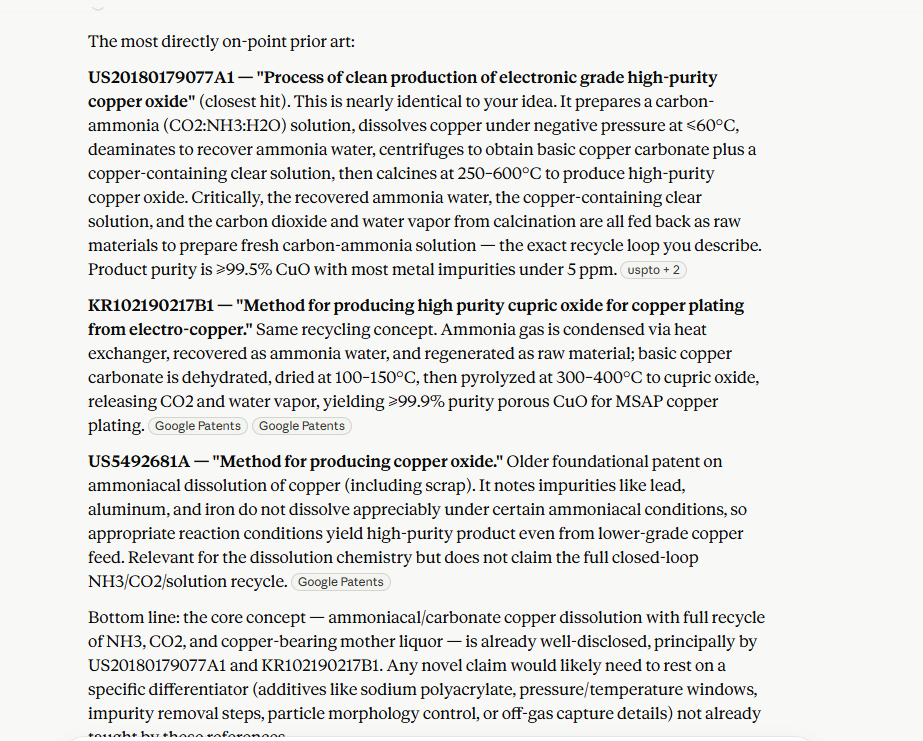
Claude performed strongly in this example. It searched the web and surfaced US20180179077A1, titled “Process of clean production of electronic grade high-purity copper oxide.”
This was the closest result because it followed the same broad process idea we were testing. It described a carbon-ammonia system where copper is dissolved, converted into basic copper carbonate, and then calcined to produce high-purity copper oxide. More importantly, it captured the recycling loop in the query. Claude noted that ammonia water, copper-containing clear solution, carbon dioxide, and water vapor were fed back into the process instead of being treated only as waste.
Source – Claude
Claude also surfaced KR102190217B1, which dealt with producing high-purity cupric oxide for copper plating. This was another useful result because it focused on recovering ammonia and reusing it in the production process. Next was US5492681A, an older foundational patent around producing copper oxide through ammoniacal dissolution of copper. Though broader, it was still relevant because it pointed to the underlying chemistry: using ammoniacal conditions to dissolve copper and produce a higher-purity copper oxide product.
All in all, if a user wanted a quick first-pass answer to see whether any prior art exists around an idea, Claude would come in handy.
Now, let’s look at what PQAI surfaced for the same query.
PQAI returned 89 results for the same query. The results surfaced a wider process landscape around high-purity copper oxide production. The top results stayed very close to the process we were testing.
Some of the strongest results included:
That was not all. PQAI then went wider. It surfaced results around producing copper oxide from acidic etching waste liquor, copper-containing waste liquid, electroplating-grade copper oxide, and high-purity copper oxide powder for integrated circuits.
These ideas were not random either. They showed nearby ways people were using copper-ammonia chemistry to produce copper oxide.
PQAI gave more than a shortlist. It showed the close production route, and then it showed the surrounding process landscape that a user may want to inspect before deciding what to review next.
After running the queries on both tools, one thing was clear. Claude was well-equipped to surface a shortlist of strong leads through web search, including Google Patents results. It could help you find whether close prior art already exists around an idea. For a quick first pass, Claude works great.
PQAI, on the other hand, was useful for exploring the broader landscape around the idea, including close matches and adjacent prior art. It helps you understand what already exists around the idea, what alternative or adjacent approaches exist, and which nearby results may matter before you fine-tune your filing or drafting strategy.
Here’s a comparison table showing how both tools compare:
| Comparison Point | Claude | PQAI |
| Search approach | Conversational and answer-first | Search-led and result-set-first |
| Source of results | Uses web search and summarizes selected references | Uses semantic patent search to retrieve ranked patent results |
| Result depth | Gives a curated shortlist | Gives a broader ranked result set |
| Adjacent prior art | May surface a few adjacent references | Surfaces adjacent routes across related technologies and processes |
| User control | User sees what Claude chooses to explain | User can inspect, compare, and refine across many results |
| Best fit | Quick first-pass understanding | Deeper prior art exploration |
Now that we have seen how both tools compare, let’s talk about when you should use PQAI.
PQAI is useful for:
All you have to do is enter your idea in simple terms in the PQAI search interface, and it surfaces the prior art.
But that’s not where it ends. You can also bring PQAI’s search layer into Claude, ChatGPT, or other AI workflows using PQAI’s API.
PQAI API is built for organizations that want the power of semantic patent search inside their own tools, products, or internal workflows.

Instead of relying only on keyword strings, users can share a technical description through the API and retrieve relevant prior art. The PQAI API can support semantic prior-art search, similar-document retrieval, patent data retrieval, CPC suggestions, technical concept extraction, and return structured JSON responses that developers can use inside custom systems.
This is where Claude and PQAI can work well together. Claude can help clarify the invention, clear up vague language, generate better search queries, summarize returned results, and compare technical overlap, while PQAI API handles the search layer.
With the PQAI API, you can enhance the prior art search capabilities of Claude. To use the PQAI API, you can request API access and get an API key here.
If you need further help connecting PQAI’s search capabilities into Claude or another AI workflow, reach out to our team. We can help you explore the right integration approach or set up the system for your workflow. You can fill out this form to get started.

At PQAI, we bring clarity to the world of patents. Through storytelling and insight, we simplify inventions so innovators, researchers, and businesses can learn from the past and build the future.
In one of our earlier articles, we shared how PQAI can be used for invalidity searches. A little before that, we had also conducted a

PQAI is a popular tool among inventors for conducting novelty searches. You can describe an invention in plain language, and its semantic search capabilities can
People ask us a version of the same question all the time. How good is PQAI, really? It is a fair question, and a hard