
How Often Does PQAI Surface Prior Art in Invalidity Searches? A Benchmarking Study
In one of our earlier articles, we shared how PQAI can be used for invalidity searches. A little before that, we had also conducted a

If you are evaluating a patent search API for enterprise use, you are likely trying to bring patent data closer to where IP decisions already happen.
That could mean an invention disclosure system, a patentability screening assistant, a competitive intelligence dashboard, or an agentic AI workflow that needs access to reliable patent data.
That is where the right patent search API becomes more important than ever.
Given the confidentiality involved, the right API can help you bring patent data into your internal workflows more securely, reduce platform switching, and make search, classification, retrieval, and analysis easier to build into the same workflow.
While there are plenty of patent search APIs in the market, not many are built with these requirements in mind.
That’s why, in this article, we look at the top 6 patent search APIs for enterprises, what each one is best suited for, and how to evaluate them before choosing the right one for your workflow.
For enterprise use cases, a patent search API has to do more than just return relevant patent results. It needs to support high-volume workflows, handle sensitive information, and work reliably once it becomes part of an internal IP or R&D process.
To make the decision easier, here are a few factors that can help you shortlist the right option:
Evaluating each patent search API on these factors can help you shortlist the right one for your use case. Now, let’s look at some of the top patent search APIs for enterprise use.
Once you know what to evaluate, the next step is to shortlist APIs that are actually relevant for enterprise patent search use cases.
For this list, we looked at APIs that can support one or more enterprise needs, including patent data retrieval, prior-art discovery, IP workflow integration, or internal tool development.
Based on that lens, here are 6 patent search APIs enterprises can consider in 2026:
Now, let’s look at each one in detail, starting with PQAI.
PQAI API is an AI-powered patent search API built to bring semantic patent search and prior-art discovery into enterprise IP workflows.
It is especially relevant when confidentiality, deployment flexibility, and structured patent data matter for your workflow. The API supports semantic prior-art search, CPC classification prediction, concept extraction, patent data retrieval, patent drawing retrieval, and patent family information, among other capabilities.
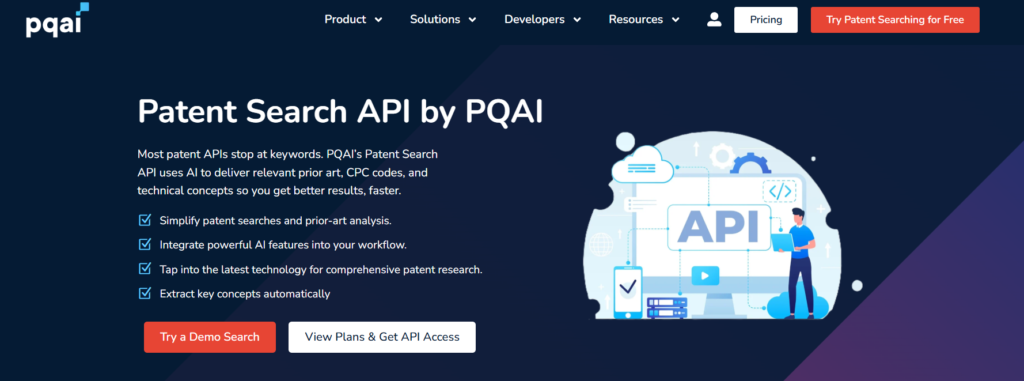
This makes the API useful when the goal is not just to search patents, but to work with patent data in a structured and programmable way.
Now, let’s look at the features that make PQAI a strong choice for enterprise patent search use cases.
For organizations building US patent search into internal tools or AI workflows, PQAI API offers a practical set of search and patent data capabilities through an API.
Here are the key features:
Semantic prior-art search: PQAI API lets users search using natural-language descriptions of inventions or technical ideas instead of relying only on rigid keywords or Boolean strings. This is useful for early patentability checks and invention disclosure workflows where keyword-only search may miss relevant results.
CPC classification prediction: The patent search API can help predict relevant CPC classifications for a technical idea or invention disclosure. This can support patent search refinement, disclosure review, and early-stage IP analysis.
Patent data, drawings, and thumbnails: PQAI API supports patent data retrieval, full-size patent drawing retrieval, patent thumbnails, and drawing lists. This makes it useful when a workflow needs more than a list of patent search results.
Patent vectors: PQAI API can retrieve vectors for selected patent fields, including CPCs and abstracts. This can support similarity, search, and downstream patent analytics workflows.
MCP server access: PQAI API plans include MCP server access, with MCP queries counting against the same monthly API quota. This can help organizations connect PQAI with MCP-compatible clients such as Claude, ChatGPT, Gemini, and other AI workflows.
Implementation support: The PQAI team also supports implementation work for organizations that need help integrating the API into internal systems, at an additional cost. This is separate from the monthly API subscription and can be scoped based on the use case.
PQAI API is best suited for US-focused patent search workflows where patent data needs to be accessed programmatically. It can be a strong fit for:
PQAI is a great fit for organizations that want a practical, secure, deployable patent search API for semantic prior-art discovery, and easy patent data access.
PQAI offers two API pricing tiers based on usage:
Developer: $199/month for 600 API queries per month. This plan is best for experimentation, personal use, and early-stage startups.
Enterprise: $700/month for 3,000 API queries per month. This is best suited for commercial use and platform integrations.
For more details, visit our pricing page.
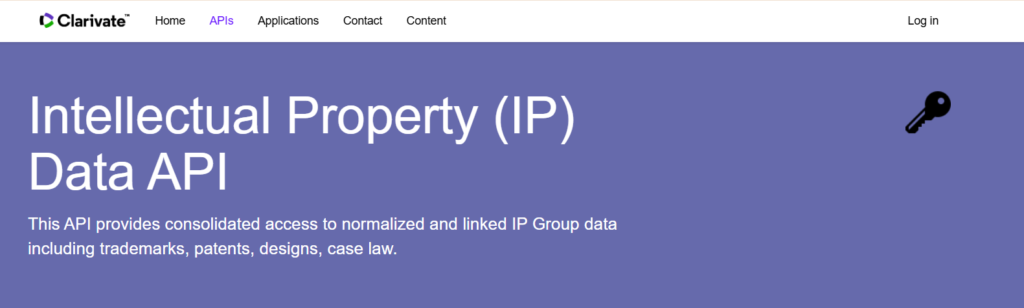
Clarivate IP Data API is a strong fit when patent data needs to connect with a wider IP intelligence system, not just a standalone patent search workflow.
The API provides access to normalized IP data across patents, trademarks, designs, and case law. For patent workflows, it supports search, analytics, document retrieval, PDFs, images, Derwent routes, and DWPI invention search.
Source – Clarivate
Clarivate also offers API access for related products such as Derwent Sequence Search and Web of Science. This can be useful for pharma, biotech, and life sciences IP workflows where patent research needs to connect with biological sequences, scientific literature, citation data, or research intelligence.
Clarivate is a strong option when:
A couple of major limitations of Clarivate’s API are:
Best suited for: Enterprises that want to connect patent data with wider IP intelligence or workflows that need more than patent search alone.
PatSnap API is a strong fit when an enterprise wants patent search to connect with broader R&D and innovation intelligence.
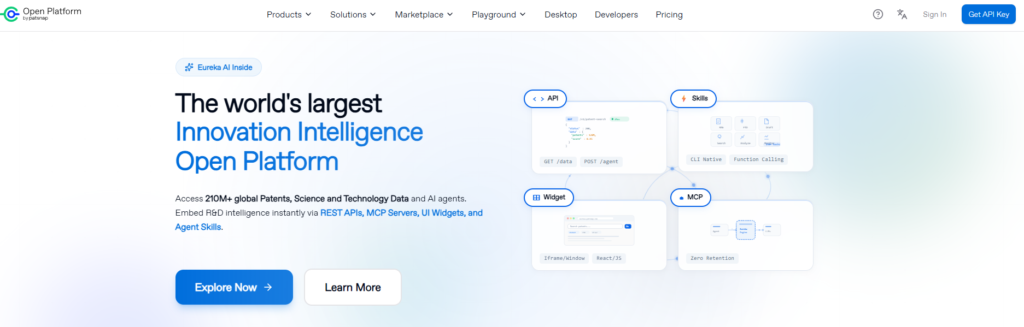
The API layer gives access to 210M+ global patents, science and technology data, and domain-specific datasets. For patent use cases, PatSnap lists 20+ patent APIs, along with infringement APIs, patent lifecycle intelligence, valuation, maintenance, corporate data, and R&D intelligence endpoints.
Source – PatSnap
PatSnap also offers multiple developer options, including REST APIs, MCP servers, UI widgets, and data packages. This is useful when patent data needs to be added into internal tools, AI workflows, dashboards, or customer-facing products.
PatSnap is a strong option when:
A couple of major limitations of PatSnap’s API are:
Best suited for: Enterprises building patent search, R&D intelligence, FTO, monitoring, lifecycle intelligence, or AI-enabled innovation workflows through APIs.
Minesoft Patent Data API is a good fit when patent data needs to move into the systems where business decisions already happen.
With this API, Minesoft focuses on making patent intelligence usable inside BI dashboards, data lakes, internal applications, and AI or machine learning workflows.
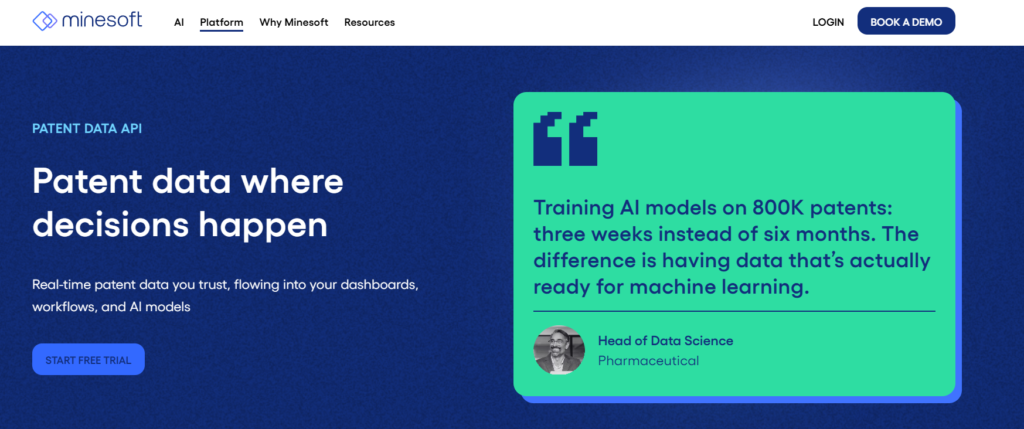
Source – Minesoft
Minesoft highlights real-time patent data, bulk feeds, RESTful integration, and native connectors for Power BI, Tableau, Snowflake, and Databricks. It also covers patent families, legal status, citations, chemical structures, MESH disease data, verified expiry calculations, and live monitoring.
Minesoft is especially useful when:
Minesoft may not be the best choice if:
Best suited for: Enterprises that want to turn patent data into dashboard-ready intelligence for strategy, analytics, competitive monitoring, portfolio management, M&A screening, or AI/ML applications.
Questel Gateway API is useful when an organization wants to connect its internal IP management system with Questel’s IP services.
This is not just a patent search endpoint. It is built for service integration, so users can access Questel’s Services Portal functionality from their own software. That includes prior-art searches, filing, translation, fee management, renewals, and project tracking.
Source – Questel
Questel highlights workflow features such as translation and filing estimates, project creation, real-time project tracking, completed project downloads, and integration with internal docketing or IP management systems.
On the technical side, the Gateway API is RESTful and supports JSON, XML, CSV, and Excel exports. It also uses SSL/TLS encryption, authentication tokens, and access controls.
Questel Gateway API is useful if:
The main limitation is that Questel Gateway API makes the most sense when you already use, or plan to use, Questel’s IP services. It may not be the right choice if you only need a standalone patent search API, semantic prior-art search, or patent data retrieval.
Best suited for: Organizations that want to integrate Questel’s filing, translation, renewal, prior-art search, and project management services into their internal docketing or IP management system.
The LexisNexis IP DataDirect is useful when an enterprise wants reliable patent data from a larger IP platform.
The platform offers multiple IP products across patent search, drafting, prosecution analytics, and portfolio analytics. Among those, IP DataDirect includes a Search API, which is useful when an enterprise wants to build patent search into its own system using LexisNexis patent data.
It supports direct search across the full patent collection, uses LexisNexis TotalPatent One search syntax, and can return result lists along with relevant XML documents, images, and PDFs.
Source – LexisNexis
This makes it a better fit for companies building internal patent search tools, patent data products, or analytics systems than for organizations looking for a ready-made semantic search API.
LexisNexis IP DataDirect Search API is useful when:
LexisNexis IP DataDirect Search API may not be ideal when:
Best suited for: Enterprises building internal patent search systems, patent analytics products, data platforms, or patent management workflows that need reliable global patent data from LexisNexis.
Now that we have reached the end of the list, one thing is clear: each API has its own strength. Some are better for broad IP data access, some for R&D intelligence, and others for patent data delivery into dashboards or internal systems.
But if your priority is US patent search and programmable patent data access through a focused API, PQAI API is the option built closest to that use case.
PQAI API is for organizations that want US patent search capabilities inside the tools they already use or build.
Whether you are adding novelty checks to an invention disclosure system, building a prior-art search module, or giving an AI agent access to patent search, PQAI API gives you a focused starting point.
The PQAI team can also support implementation and customization separately.
Want PQAI API access? Contact us here.
Disclaimer: This article is based on information available in publicly accessible sources, including official product pages, API documentation, pricing pages, and related public materials available at the time of writing. All product names, company names, logos, trademarks, and brand assets mentioned or shown belong to their respective owners and are used here for identification and comparison purposes only. We do not claim ownership over any third-party brands, images, or trademarks referenced in this article.

At PQAI, we bring clarity to the world of patents. Through storytelling and insight, we simplify inventions so innovators, researchers, and businesses can learn from the past and build the future.
In one of our earlier articles, we shared how PQAI can be used for invalidity searches. A little before that, we had also conducted a

PQAI is a popular tool among inventors for conducting novelty searches. You can describe an invention in plain language, and its semantic search capabilities can
People ask us a version of the same question all the time. How good is PQAI, really? It is a fair question, and a hard