
How Often Does PQAI Surface Prior Art in Invalidity Searches? A Benchmarking Study
In one of our earlier articles, we shared how PQAI can be used for invalidity searches. A little before that, we had also conducted a


When you hear the term self-healing materials, the first image that usually comes to mind is a scratched surface or a cracked coating that somehow repairs itself.
And while that is certainly part of the story, it is far from the whole picture.
In recent years, self-healing materials innovation has expanded into areas like construction materials, aerospace tech, and even robotics. It has also found application in areas like biomaterials, where these materials are used to support tissue repair inside the body.
There is clearly a lot happening in this space. But where exactly is innovation heading next?
That question kept us up at night. We wanted to know whether new directions were beginning to emerge in this field. To find answers, we turned to PQAI’s patent search engine. This article uncovers our findings.
To understand where self-healing materials innovation is headed, we first started with one broad query on PQAI.
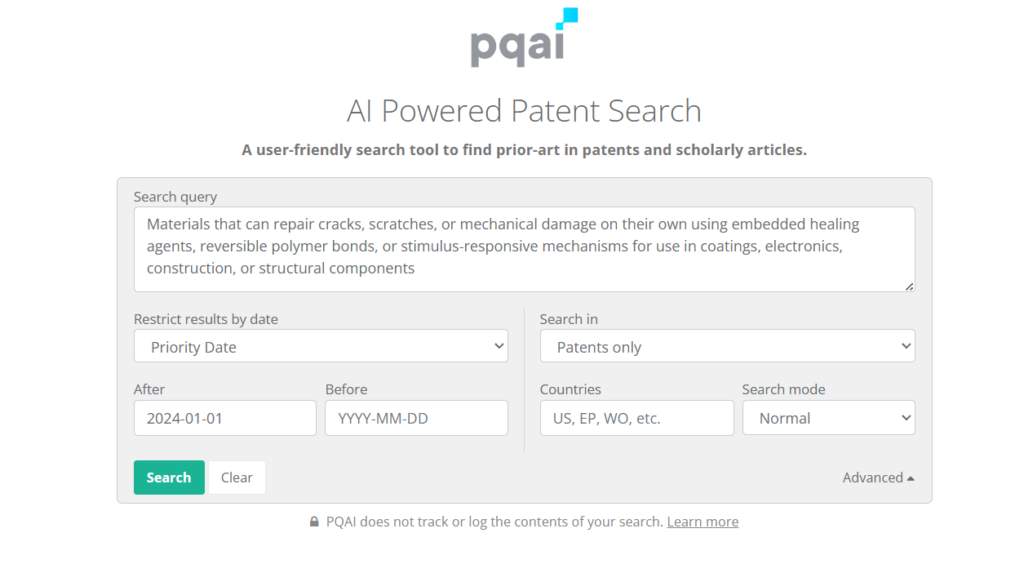
Our idea was to see where recent inventive activity in this space was moving.
However, once we looked at the results, it became clear that one query alone was not enough. Some results leaned heavily toward engineering applications like coatings, construction, and electronics, while others pointed toward biomedical and regenerative directions. It was a mixed bag, with no clear trends emerging.
So instead of forcing the field into one narrow definition, we ran a few more plain-language queries to explore the space from different angles. We also kept the priority date as January 1, 2024, so we could focus only on recent innovation signals.
Once we had the data, we analyzed them to understand which patterns emerged more consistently.
The next section covers the key trends that emerged from this analysis.
When we looked across the patent data, one thing became clear. Self-healing materials innovation is happening across multiple geographies, with a large share of recent filings coming from China. They were followed by the US, and a smaller group from Korea.
What also stood out was the variety of the filings. The innovation in this space was spread across coatings, construction, adhesives, electronics, and biomedical applications. Some of the filings aligned with recent innovation trends observed across market reports. Whereas few were new.
Let’s now look at the five key innovation signals that emerged most clearly from our analysis.
When we looked at the dataset, one idea was consistently present: Microcapsules.
And despite all the excitement around newer chemistries, this architecture still shows up again and again in the patent set.
It belongs here too, as it solves the original self-healing problem in a very direct way. When a material gets damaged and forms a crack, the capsule breaks. The healing agent flows into the damaged area and seals it.
If you want to understand how microcapsules work in self-healing materials, this video by the University of Illinois offers a simple and helpful demonstration of the concept.
That covered, our analysis reveals there have been further advances in these microcapsules.
One example that appears is CN118403580A, which covers pH-responsive self-repairing microcapsules. What makes this patent interesting is that the capsule does not just release a repair agent. It also releases a corrosion inhibitor when the surrounding environment changes.
This helps address a real weakness in older coating systems. Fixing the crack and protecting the metal underneath were often treated as separate problems. The patent addresses both in a single system.
There was another interesting patent filed by Guizhou Power Grid Company. CN119158507A covers the preparation of a microcapsule that is capable of repeated self-repair. This pushes the field from the limitation of one-shot systems to repeated self-repair.
There were other interesting filings too, like CN119241983A, which applies double-layer self-healing microcapsules to asphalt mixtures. Its application is in road engineering, and this patent could point the way for roads that repair themselves.
Whether the cracks are caused by load, weather, or repeated mechanical stress, this is a new direction that is more responsive and application-aware.
While microcapsules are one way to solve damage, they are not the only way. There is also activity happening around materials like polymers and gels that can self-recover after damage.
That may sound technical, but the idea is simple. When the material is cut, stretched, or stressed, its internal bonds are able to reconnect and bring the material back together.
This is where a lot of the recent work is happening. Because one of the biggest problems with early self-healing materials was that they could heal, but they were often too weak or unstable for practical use. However, recent patents suggest inventors are trying to solve that.
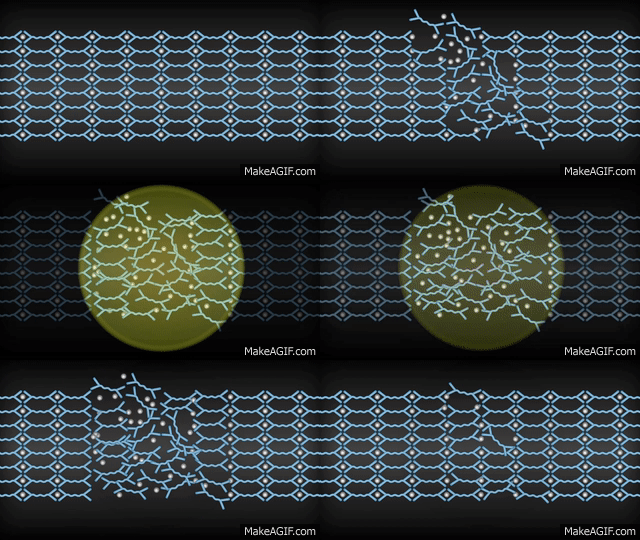
Source – Make a GIF
The Chinese patents are leading the way here too. CN118206755A, for instance, describes a self-healing elastic material for electronic devices. The focus here is not just healing. It is also about maintaining stability and mechanical strength.
CN118374066A is another interesting patent that came up in our analysis. It covers a rubber composition with self-repairing ability using dynamic cross-linking bonds. While rubber itself is stretchable, it loses this property after being stretched beyond a certain limit. However, this patent makes the material itself capable of recovery.
This is one of the biggest shifts in the dataset. The conversation is clearly moving from “can we repair a crack?” to “can we build materials that recover on their own without giving up conductivity, elasticity, durability, or thermal performance?”
We earlier saw how inventors are exploring ways to make roads more self-healing by adding microcapsules into asphalt mixtures.
However, that’s only a snippet of where innovation is heading. There is work underway to develop infrastructure materials with built-in damage-management capabilities.
There are patents like CN118724497A and CN119349921A, which cover approaches to self-repairing concrete and cement. The latter has applications in the mining industry.
Then there is US2025091947A1, which covers the inclusion of biological materials for concrete and/or mortar structural healing.
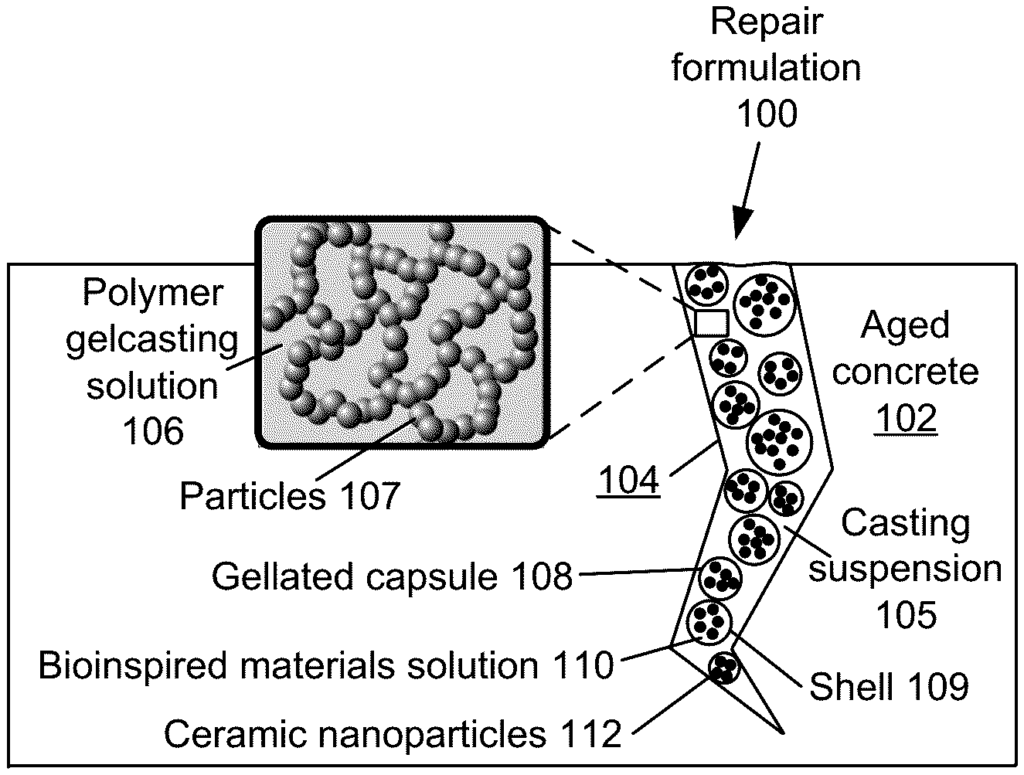
Source – US2025091947A
This filing pushes infrastructure repair into a more bio-integrated direction, where self-healing concrete may not rely only on synthetic chemistry anymore.
The larger pattern here is that infrastructure materials are being asked to do more than bear load. They are being asked to respond to early-stage damage before it becomes catastrophic.
When we broadened the queries, an interesting direction opened up. The self-healing field started opening up into areas like wound care, tissue repair, scaffolds, hydrogels, and regenerative systems.
This is an important shift, because in the biomedical world, self-healing does not just mean a material closing a crack. It often means helping the body repair itself better.
We came across several Chinese patents that point in this direction:
There are US patent applications too. Like US2025235516A1 covers a protein-based advanced wound healing system which reduces the chances of implant rejection. There is also US2025281666A1 which explores biopolymer compositions for repairing soft tissue injuries.
That is a meaningful shift, showing that self-healing is no longer only about synthetic materials closing cracks. It is increasingly about materials that participate in repair, support regeneration, and function inside biological systems.
If you are interested in how biology itself is becoming more engineered, our piece on synthetic biology innovation trends also explores adjacent directions emerging from recent patent filings.
Most of the trends we covered so far align with what you would typically see in broader trend reports. But there was one direction that did not show up as clearly in those summaries, yet appeared consistently in the patent data.
Adhesives.
When you hear the word adhesive, you usually think of a layer that sticks two materials together. Something crucial, but that does not really have much to do with self-healing.
But the patent data suggests otherwise. There are a number of recent filings showing that adhesives are becoming systems that can repair, respond, and even adapt based on where they are used.
We came across several patents that point in this direction, like:
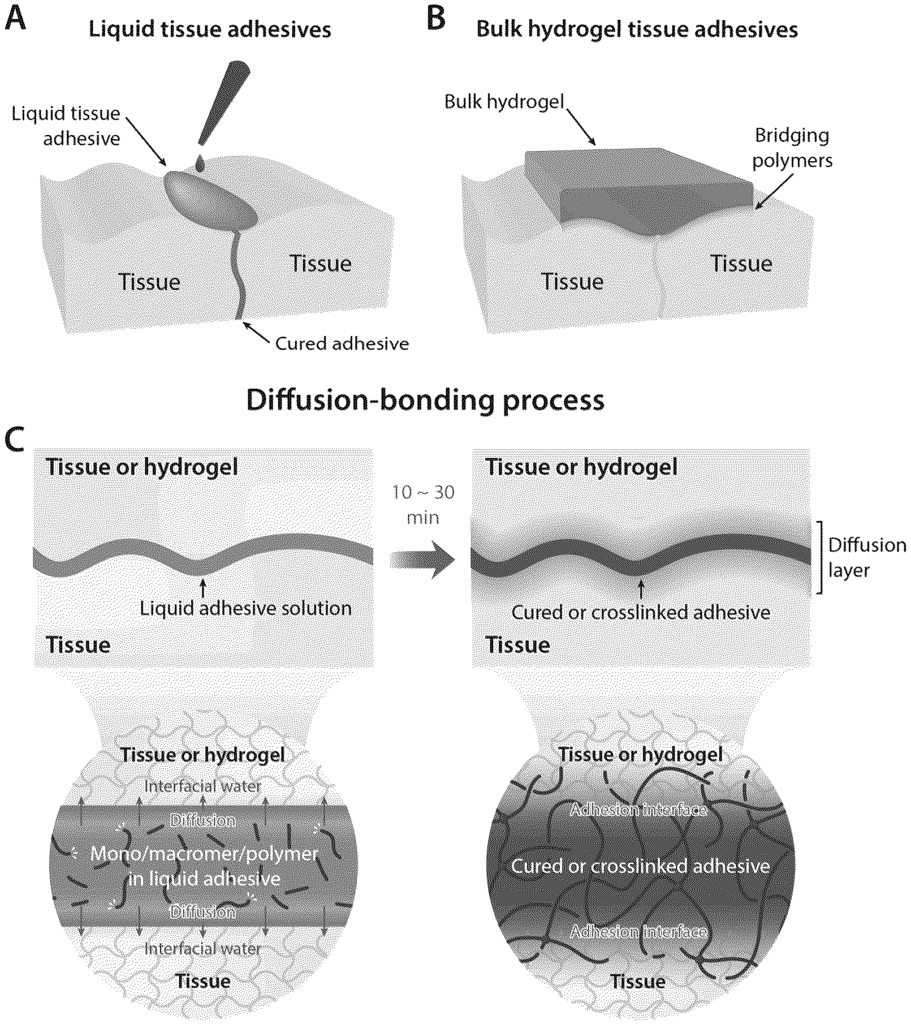
Source – US2025084284A1
What is interesting here is not just the functionality of these adhesives. It is what they enable. This is a subtle bery but important shift.
Adhesives are no longer being treated as simple glue layers. They are becoming engineered interface systems that can heal, respond, detach, and maintain performance over time.
While we covered five of the clearest signals that emerged from the dataset, those were not the only directions visible in the patent filings.
There was a lot more happening around device-facing materials, conductive systems, energy storage layers, repairable interfaces, and other application-specific systems that we did not fully unpack here.
In some cases, the signals were still emerging. In others, they were too scattered to form a clean, standalone trend. But they were present.
That is what makes this space interesting. Self-healing materials innovation is not moving in one straight line. It is spreading across multiple application areas, each with its own problems, constraints, and opportunities.
If you are working in this space, it helps to stay aware of these shifts early. And that is exactly where tools like PQAI become useful.
With PQAI, you need not find all relevant keywords or write complex Boolean queries. You can simply describe what you are looking for in plain English and discover relevant patents and non-patent literature.
For example, you can try or build upon queries like:
PQAI will surface the relevant results. In fact, PQAI was ranked #2 in an independent study evaluating natural language-based patent search systems, which highlights how effectively it can retrieve relevant prior art.
If you are exploring innovation in this space, PQAI can help you understand what others are building and where the next opportunities might lie.
What’s the wait? Try the PQAI tool today!

At PQAI, we bring clarity to the world of patents. Through storytelling and insight, we simplify inventions so innovators, researchers, and businesses can learn from the past and build the future.
In one of our earlier articles, we shared how PQAI can be used for invalidity searches. A little before that, we had also conducted a

PQAI is a popular tool among inventors for conducting novelty searches. You can describe an invention in plain language, and its semantic search capabilities can

People ask us a version of the same question all the time. How good is PQAI, really? It is a fair question, and a hard