
How Often Does PQAI Surface Prior Art in Invalidity Searches? A Benchmarking Study
In one of our earlier articles, we shared how PQAI can be used for invalidity searches. A little before that, we had also conducted a

Mention waste recycling, and the first picture that comes to mind is the tricolor dustbins. Segregate your waste based on the category, reuse and recycle as much as you can, while the rest makes its way to landfills.
However, in recent years, the amount of waste going to landfills has grown exponentially.
Every year, humanity generates anywhere between 2.1 and 2.3 billion tonnes of municipal solid waste, And that number is expected to reach 3.8 billion tonnes by 2050.
At the same time, the equivalent of 2,000 garbage trucks of plastic waste is dumped into water bodies every day, amounting to 19-23 million tonnes of plastic entering aquatic ecosystems annually.
This problem is no longer about waste. It has become a humanity problem.
And when a problem reaches this scale, there is one question whose answer matters more than anything else: what are people actually building to solve this problem?
We knew we would find answers in patent filings. So we turned to PQAI to see where innovation is actually heading in this area. Let’s find out.
We wanted to understand what inventors around the globe are actually building to address this problem. So we constructed a broad query that focused on how waste is being processed, converted, and reused across different streams.
Here’s the query we used:
| Systems and technologies that convert waste materials into high-value outputs such as fuels, construction materials, chemicals, or reusable components, supporting circular economy models and resource recovery |
We ran this query on PQAI’s search interface, keeping the priority date as January 1, 2023, so we could focus on innovation directions that have emerged over the past three years.
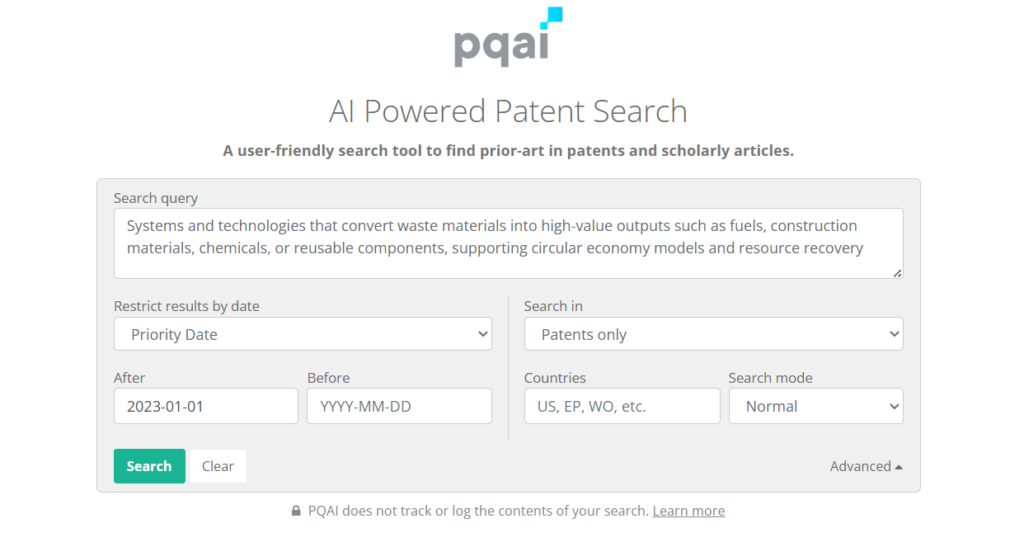
Source – PQAI
We first analyzed the global dataset, where a majority of the filings were from China. We then ran a targeted search using the same query, but limited the jurisdictions to the U.S. and Europe, to see how innovation patterns differ across regions.
In the next section, we break down the key trends that emerged from this analysis.
When we explored the datasets, we did come across familiar themes like plastic recycling and waste-to-energy systems, which are also widely discussed in industry reports. However, the patent data revealed some interesting patterns that could change the way we see trash.
In fact, if you look closely, waste is no longer being treated like something to get rid of. It’s starting to look more like a raw material waiting to be processed.
Did you know that plastic takes anywhere between 20 to 500 years to decompose? In some cases, it can last even longer. And even then, it does not fully disappear. It breaks down into microplastics that continue to persist in the environment.
Now imagine reversing that lifecycle. Instead of letting plastic sit in landfills or water bodies for decades, inventors are starting to treat it as a resource that can be converted back into usable fuels and chemicals.
That’s right. Plastic, which originates from fossil fuels, is being fed back into a usable energy loop. One of the patent applications that captures this is US20250001474A1, which describes a system that converts unrecycled plastic waste into fuels like diesel, gasoline, paraffin, and LPG. What makes this interesting is that the process also generates gas that is reused within the system to power the conversion itself.
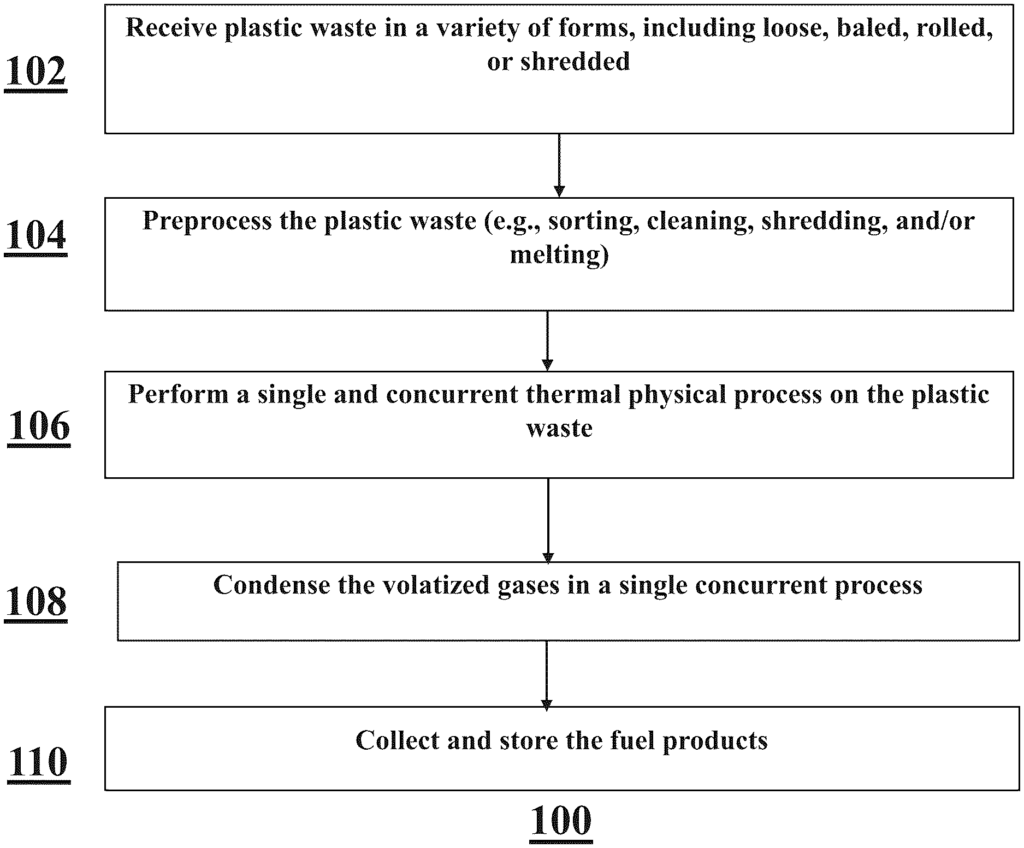
Source – US20250001474A1
However, the direction is not limited to fuel alone.
Another patent, US20250207035A1, focuses on converting plastic waste into higher-value products. This is a shift from simply extracting energy to creating outputs that can re-enter industrial systems, while requiring minimal energy or resources.
That’s not it. There are companies like ExxonMobil going one step further.
For instance, US20250197734A1 describes a chemical recycling facility where plastic waste is converted into hydrocarbon products like ethylene and propylene. FYI, these are core building blocks used across manufacturing.
The focus of the latter two patents here is not just conversion, but also improving energy efficiency and reducing environmental impact during the process.
Landfills are often seen as the end of the waste lifecycle. Once waste goes there, it is usually assumed to be done.
However, a different direction is emerging from the patent data. Instead of treating landfills as final dumping sites, inventors are starting to explore them as sources of recovering materials and energy.
While there has already been some work going in this direction, the patent data suggests that a lot more is now being built on top of it.
This includes:
Some of the patents we came across clearly capture this shift.
These include US20250135686A1, which focuses on converting plastic waste into usable products by effectively working through landfill-derived material. What’s interesting here is how the system is designed. It does not just extract plastic waste. It also uses biomass within the landfill to generate residual heat and exhaust, which are then used to fuel the manufacturing process itself.
On top of that, methane recovered from the landfill is used as a fuel source for heating machinery and even generating electricity.
This direction is further reinforced by another Exotex patent application, US2025099914A1, which focuses on carbon-neutral landfill systems. The setup uses biogas collection wells to capture methane, which is then used to generate electricity. The carbon dioxide produced in the process is injected back into the landfill to improve further gas extraction.
US2025179271A1, which focuses on controlled bio-assimilation of landfill materials to enable more efficient biogas capture, is another interesting example. The system is designed in a way that maximizes gas recovery while minimizing losses, effectively turning landfill waste into a renewable energy source.
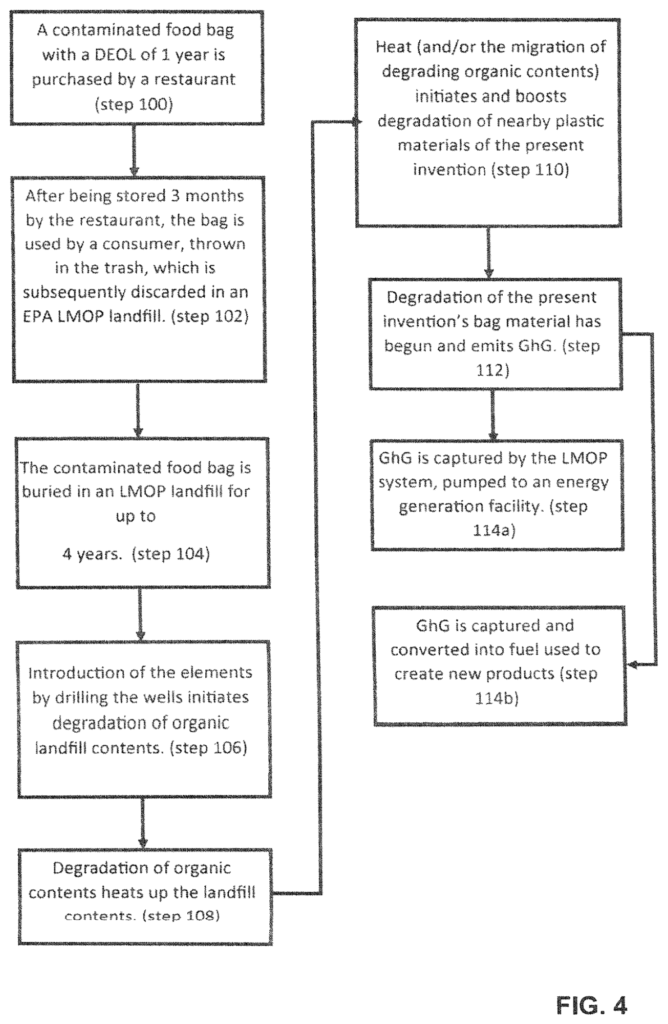
Source – US2025179271A1
The direction is clear. Landfills are no longer just considered dumping yards. They are being explored as systems where value can still be extracted.
When we were analyzing these patents, there was one clear signal emerging: the recovery of high-value materials from waste.
While this is not a completely new domain, with many companies actively working in it, there is still space for innovation. A lot of critical materials end up in landfills, either in the form of battery waste or industrial residue.
Instead of losing them in the process, inventors are now working on ways to extract and reuse them.
Some of the patents that highlight this include:
What stands out here is that recycling is not limited to sustainability alone but is becoming part of the supply chain for critical materials.
When it comes to recycling, there is a lot of focus on extracting high-value materials or turning plastic into fuel. However, organic waste is still largely associated with composting or basic biogas generation. The patent data, however, suggests a different direction.
Instead of letting organic waste break down in its own sweet time, inventors are starting to design structured systems that process it step by step to extract multiple outputs from it.
Some of the patents that highlight this approach include:
There are other patents, too, that are exploring ways to combine biological processes with chemical or thermal conversion to improve efficiency and output quality. However, there is still significant potential here, making it a good whitespace to explore.
That said, these signals are only a part of the picture. The waste-recycling landscape is far broader, with innovation occurring in areas such as system-level optimization, energy integration, and process efficiency.
And this is where things get interesting. Because while much discussion around recycling focuses on what is already visible, the patent landscape often shows what is coming next.
By now, it’s clear that waste recycling is not just about managing waste anymore. There’s a lot more to uncover.
If you are working in this space, it makes sense to look deeper into the patent landscape.
And the good news is, with PQAI, you do not need to create complex queries or understand Boolean logic. You can simply describe what you are looking for, and the PQAI search engine will surface relevant patents.
For example, you can try queries like:
You can also tweak your queries to:
This will give you a much clearer view of where innovation is actually happening, and where there might still be gaps to explore.
You can explore the waste recycling innovation landscape yourself on PQAI. Try the tool for free here.
Recommended Read: The Future of 3D Bioprinting Technology: What Patent Filings Reveal About Emerging Trends

At PQAI, we bring clarity to the world of patents. Through storytelling and insight, we simplify inventions so innovators, researchers, and businesses can learn from the past and build the future.
In one of our earlier articles, we shared how PQAI can be used for invalidity searches. A little before that, we had also conducted a

PQAI is a popular tool among inventors for conducting novelty searches. You can describe an invention in plain language, and its semantic search capabilities can

People ask us a version of the same question all the time. How good is PQAI, really? It is a fair question, and a hard