
How Often Does PQAI Surface Prior Art in Invalidity Searches? A Benchmarking Study
In one of our earlier articles, we shared how PQAI can be used for invalidity searches. A little before that, we had also conducted a


The IP software market has become intensely competitive. Today, users no longer tolerate jumping between five different tools to get five different things done. They expect most of their work to happen inside a single platform, without breaking flow or context.
That expectation now extends to prior art search. If a tool helps manage invention disclosures, users expect to check the novelty of an idea there. If a tool supports patent drafting, they expect surrounding intelligence, such as generating compliant drawings, to be available alongside it.
The exact workflow may differ, but the pattern is the same: your users want more capability, with fewer handoffs.
And AI has only accelerated this shift. With almost every serious platform now offering natural language search capabilities, the bar for what a modern IP tool should offer keeps rising.
So how do you embed natural language patent search capabilities to your IP software? If that question has been keeping you up at night, we have the answers.
Once you decide that prior art search belongs inside your product, the challenge shifts very quickly from what to how.
You see, building prior art search capabilities is not the same as adding another feature.
It is a complex process, involving data ingestion across various patent offices, building semantic relevance, classification logic, and continuously updating your databases as new filings appear. Even with strong engineering talent, this is not something that can be done quickly or maintained casually.
Teams that consider building this capability in-house often underestimate three things.
Buying a standalone tool avoids that burden, but it often introduces friction by pulling users out of the product they are already working in.
This is why many IP software teams look for a third path: adding prior art search as a capability inside their platform, without owning the entire search stack themselves.
How do you make search feel native, without turning your engineering team into maintainers of a full search engine?
That is where API-based embedding becomes the preferred approach. Instead of owning the entire search stack, teams can integrate prior art search API as a capability that runs behind their existing workflows and user interfaces.
Platforms like PQAI are built specifically for this model. Rather than acting as a standalone destination, PQAI exposes its search capabilities, allowing IP software teams to bring natural language prior art search capabilities directly into their own products.

Let’s now look at how PQAI’s Patent Search API works in practice, and why this approach is being adopted by teams building serious IP and R&D software at scale.
PQAI’s Patent Search API is designed for software and enterprise teams that need reliable prior art search inside their products, without having to build and maintain search infrastructure themselves.
Instead of limiting search to keywords, PQAI applies AI to understand technical meaning, surface relevant prior art, and return structured data that software teams can use directly inside their workflows.
The API is designed to be embedded quietly in the background, so users experience search as a native part of the product rather than a separate destination.
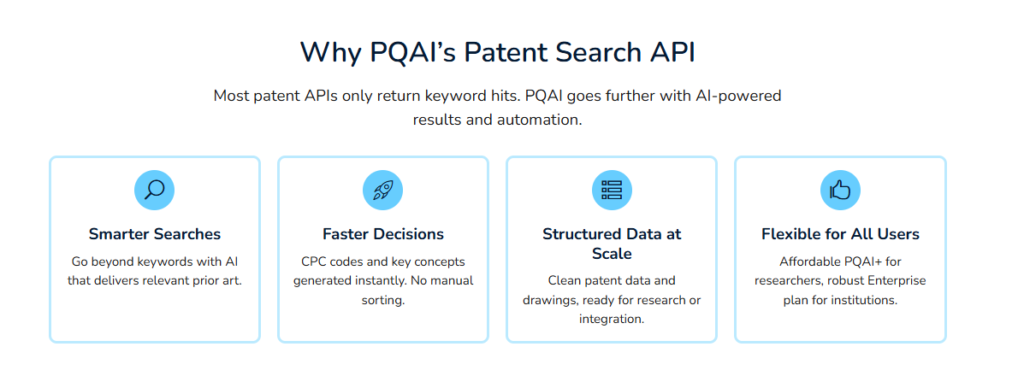
Here are some of the core features of the API:
Last but not least, the patent search API enables advanced search capabilities without the upfront investment or ongoing maintenance costs of building in-house infrastructure.
Prior art search delivers the most value when it is embedded into workflows where ideas are being shaped, evaluated, or contextualized.
Some of the most common areas where this capability can be beneficial include:
Invention disclosure systems: Here prior art search enables early novelty checks. Inventors can quickly understand whether an invention already exists before it moves further into review, evaluation, or drafting.
Idea management platforms: Though not popular, access to prior art in such cases can help contributors and reviewers ground ideas in existing technical reality. It supports refinement, avoids duplication, and helps surface genuinely differentiated concepts.
R&D knowledge tools: Patent search provides engineers and researchers with technical context before design and development decisions are finalized. Understanding prior solutions and constraints early reduces rework later.
Across all of these workflows, prior art search works best when it is embedded and contextual. That is they are available exactly when users need it, without forcing them to switch tools or interrupt their flow.
Today, any IP software does not gain popularity by offering more features. It wins by embedding the right capabilities at the right moments, without adding complexity or friction for users.
Prior art search has become one of those foundational capabilities for many such software. And with PQAI, you need not build and maintain a full search stack.
Built on an open source foundation, PQAI’s Patent Search API is transparent by design. Teams can understand how search works, why results are returned, and how it fits cleanly into their workflows. At the same time, both the tool and API are secure and confidential by design, with authenticated API access and options for private server deployments when required.
Here’s what users have to say about building with PQAI:

If you’re looking to embed prior art search in your IP tool without rebuilding infrastructure from scratch, PQAI provides a proven path forward. Get in touch with our team to explore plans, deployment options, and how the API fits your use case.

At PQAI, we bring clarity to the world of patents. Through storytelling and insight, we simplify inventions so innovators, researchers, and businesses can learn from the past and build the future.
In one of our earlier articles, we shared how PQAI can be used for invalidity searches. A little before that, we had also conducted a

PQAI is a popular tool among inventors for conducting novelty searches. You can describe an invention in plain language, and its semantic search capabilities can
People ask us a version of the same question all the time. How good is PQAI, really? It is a fair question, and a hard