How Often Does PQAI Surface Prior Art in Invalidity Searches? A Benchmarking Study
In one of our earlier articles, we shared how PQAI can be used for invalidity searches. A little before that, we had also conducted a

Are you looking for an alternative to the Clarivate API? That search can get confusing very fast.
You see, Clarivate has APIs across research, life sciences, Web of Science, Derwent, and more. But if your goal is to find the right patent search API for your workflow, you are in the right place.
For patent and IP-related use cases, the relevant Clarivate option is its Intellectual Property Data API. It covers patents, trademarks, designs, and case law, with functionality for search, analytics, and document retrieval.
It is a useful option for enterprise teams that need structured IP data. But it is not always the easiest API to evaluate or build around. The Clarivate IP Data API page highlights that API access is reviewed against your contract and use case before approval.
That may work well for some organizations. However, it may not be the right fit for every team. Sometimes, organizations need more flexibility to test an API and build without waiting for every use case to go through a formal approval path.
If you are looking for a less restrictive API that can support patent search, prior-art discovery, and IP workflow integration, this article lists five options worth considering.
When curating this list, we had one thing clear from the start: the API had to be useful beyond a simple patent lookup. It had to support real patent search use cases and be fit for commercial use.
Here are the main factors we looked at when evaluating options:
That is why this article does not feature every well-known patent search tool.
Now let’s look at the top API alternatives for Clarivate’s IP Data API.
Each API on this list brings a different strength to the table. PatSnap Data API is stronger for teams that want broader innovation intelligence across patents, R&D, and life sciences data.
Questel Gateway API, on the other hand, is better suited for IP operations, including filing, renewals, translations, and service workflow integration.
PQAI API has its moat in custom workflow integration. In short, each API has its own strength. On that note, here are five worthy alternatives to Clarivate’s IP Data API:
Let’s have a look at each one by one.
If you are looking for a Clarivate IP Data API alternative that is easier to integrate into a real patent workflow, PQAI is one of the strongest options on this list.
Unlike broader APIs that cover several asset types and workflows, PQAI API is built around a sharper use case: helping organizations bring the power of semantic patent search and prior-art discovery into their own tools.
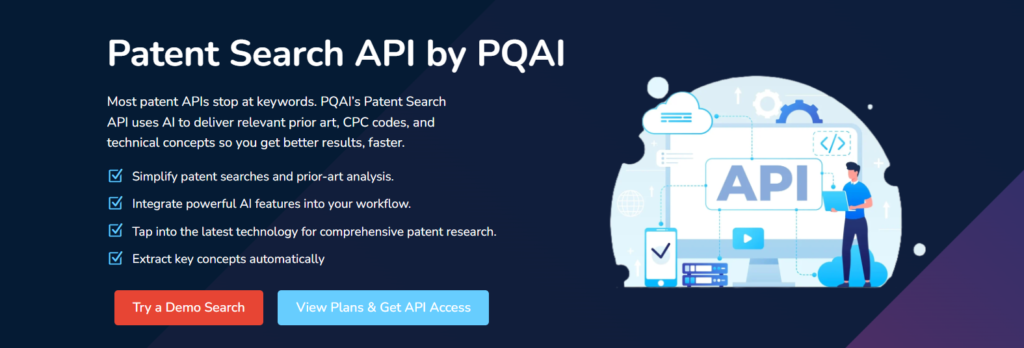
That makes it useful for teams building invention disclosure platforms, legaltech products, internal R&D systems, university TTO workflows, or custom patent review tools.
With the PQAI API, users can search using plain-English technical descriptions instead of relying only on rigid keyword strings. The API can also support CPC classification, technical concept extraction, patent data retrieval, patent drawings, and similar-document search.
Let us look at these features in detail:
This gives developers multiple building blocks for creating custom patent workflows without stitching together too many separate systems. You can view all endpoint-related information in the API documentation.
Users love how the API’s results can easily be integrated into IP tools:
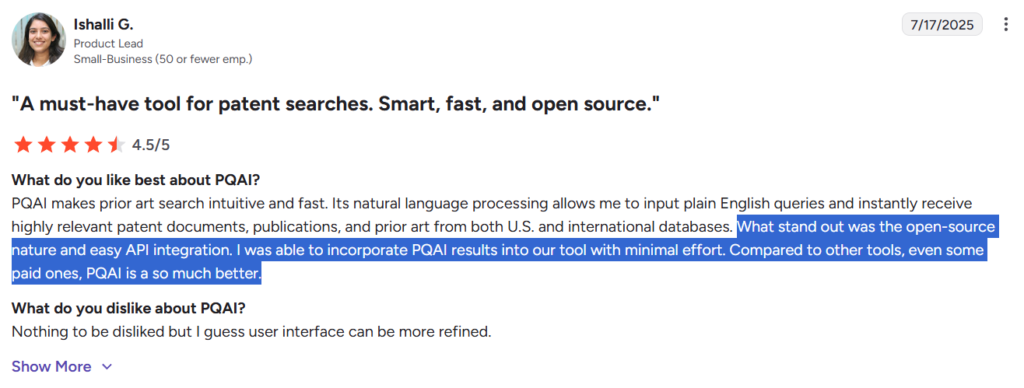
Source – G2
PQAI API works well when a patent search needs to happen inside another workflow or tool.
That could look like:
In short, PQAI is a good fit for organizations that want a practical patent search API for US-based patent searches.
Clarivate’s IP Data API has a strong enterprise data angle. It is useful when teams need access to normalized IP data across patents, trademarks, designs, and case law. PQAI wins in a different area.
It is more focused on semantic patent search and custom workflow integration.
If your team wants to plug prior-art search into an invention intake system, internal R&D tool, legaltech product, or patent review workflow, PQAI API is a better choice. It gives developers a cleaner way to build search and screening features into the tools where patent work is already happening.
PQAI API has two main plans for teams that need higher API usage:
MCP server access is included with both plans. MCP queries use the same monthly API quota.
You can get more information on our pricing page.
PatSnap Data API is a strong alternative to Clarivate IP Data API if you want patent data within a broader innovation intelligence workflow.
There is a certain overlap between the two ecosystems. Clarivate has Web of Science for research data, Cortellis for life sciences intelligence, Derwent for patent intelligence, and IP Data API for patents, trademarks, designs, and case law.
PatSnap also covers patents, legal data, R&D data, and life sciences data. The difference, however, lies in how the two are packaged. Patsnap offers developer-friendly integration through REST APIs, MCP servers, UI widgets, and data packages.
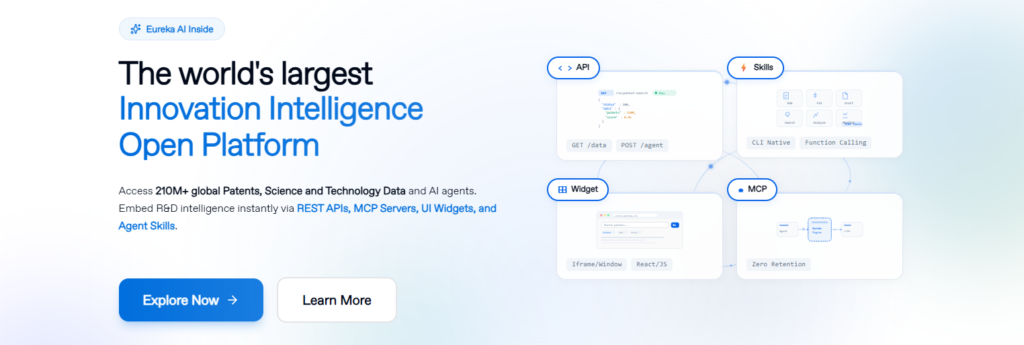
Source – PatSnap
On the patent API side, PatSnap offers modules for semantic similar-patent search, image search, legal status, patent families, citations, translations, valuation, monitoring, and bulk export. It also includes patent mining and technology report APIs for use cases like technology trends, company portfolio analysis, application domains, technical topics, and patent valuation.
That makes PatSnap useful for organizations that want patent data to support R&D strategy, competitive intelligence, monitoring, valuation, and AI-driven innovation workflows.
PatSnap wins when patent data needs to connect with broader innovation, R&D, or AI workflows. It does this by offering:
More developer-friendly formats: Patsnap offers REST APIs, MCP servers, UI widgets, agent skills, and data packages, giving teams more ways to embed intelligence into products or workflows.
Stronger analytics angle: It goes beyond patent retrieval with valuation, technology, market, legal, strategic, and economic indicators.
PatSnap does not list standard API pricing publicly. You can contact the Patsnap team for pricing information.
Recommended Read: Top PatSnap API Alternatives for Enterprise Use in 2026
Questel Gateway API is another good alternative if your API need is less about pulling patent records and more about moving IP work through your own systems. The web-based Questel Gateway API is designed to connect Questel’s IP services to your internal software.
That makes it different from Clarivate’s IP Data API. Clarivate is stronger on IP data access, search, analytics, and document retrieval. Questel, on the other hand, is built around service workflows such as prior-art searches, patent filing, translation, fee management, renewals, and project tracking.
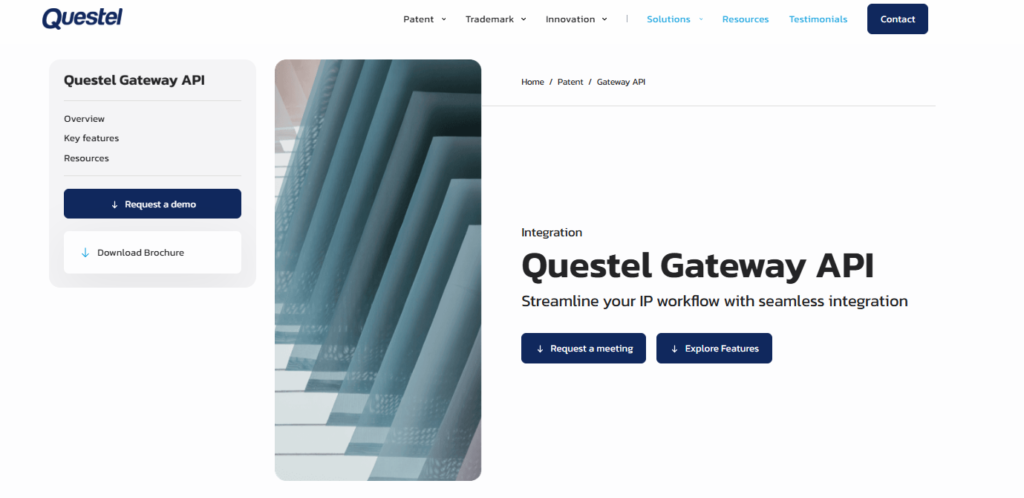
Source – Questel
In addition to prior-art searches, organizations can also leverage services such as filing, translation, fee management, renewals, and project tracking. Questel also mentions RESTful endpoints for translation, filing, and project management, with support for JSON and XML data formats, plus CSV and Excel exports.
This makes Questel useful for organizations seeking to reduce manual handoffs among docketing systems, IP management software, and external service workflows.
Questel wins when the API is expected to help manage IP operations, not just retrieve IP data. It wins by offering:
Better fit for docketing and IPMS workflows: It is designed to integrate with internal docketing and IP management systems, reducing manual data entry and status tracking.
More operational visibility: Teams can create projects, track ongoing work, and download completed project files directly from their own software.
Questel does not list standard Gateway API pricing. You can request a demo or contact the Questel team for pricing information.
Minesoft Patent Data API is designed for situations where you want patent data to move into the systems where decisions are already made. It positions its API around patent data as business intelligence, making it better suited for dashboards, analytics workflows, data lakes, and enterprise reporting systems.
The Minesoft API delivers real-time patent data into these systems, with RESTful integration and connectors for tools like Power BI, Tableau, Snowflake, and Databricks.
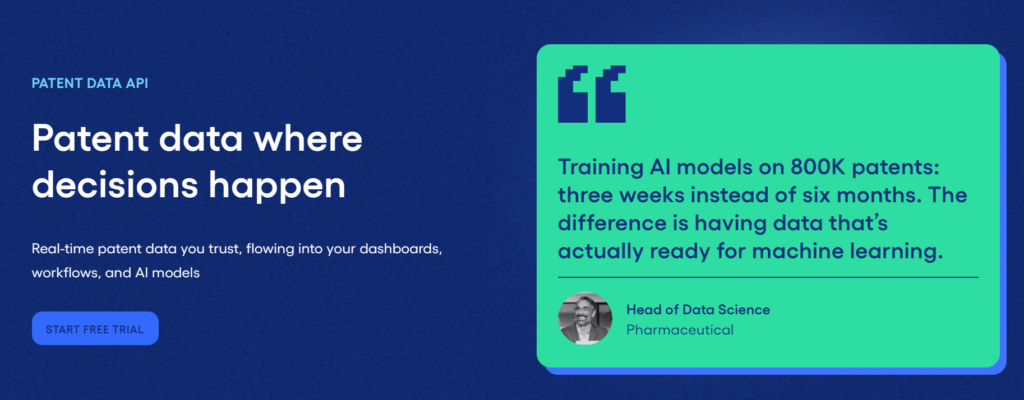
Source – Minesoft
On the patent data side, Minesoft highlights 179 million records, daily updates, 150-country coverage, legal status, citations, patent families, chemical structures, and MESH disease classifications. It also mentions real-time queries, bulk feeds, live monitoring, verified expiry calculations, and accurate family linkages.
That makes Minesoft useful for organizations that want patent intelligence to support competitive intelligence, technology landscape analysis, licensing analysis, M&A screening, investment research, automated prior-art clearance, and portfolio reporting.
Like PQAI API, Minesoft is a better choice when patent data needs to move from search into business intelligence workflows.
Flexible patent data delivery: The API supports real-time queries for live dashboards and bulk feeds for larger patent data workflows.
Patent-data depth: Minesoft brings together patent families, legal status, citations, chemical structures, MESH disease data, daily updates, and live monitoring in one API.
Minesoft does not list standard API pricing publicly. It offers a free trial and also lets users contact the team for more information.
The Lens API is a good alternative to the Clarivate IP Data API if you need access to patent data as well as scholarly research literature.
That matters because prior art does not always appear only in patents. In many technical areas, relevant disclosures may also exist in journal articles, research papers, conference literature, or other scholarly records. That is where The Lens becomes useful. It offers separate API access for Scholarly Data, Patent Data, and PatSeq Bulk Data.
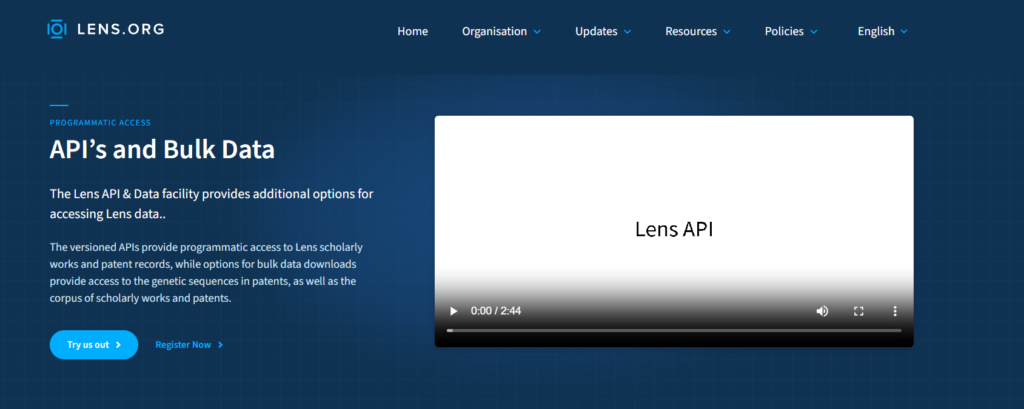
Source – The Lens
On the scholarly side, The Lens provides programmatic access to scholarly works with persistent identifiers such as Lens ID, DOI, PubMed, and OpenAlex, along with 70+ metadata fields. On the patent side, Lens provides access to patent records across 105 jurisdictions, with 120+ metadata fields, simple and extended family data, patent numbers, class-code hierarchies, and Lens IDs.
Their patent API supports search, filtering, sorting, pagination, aggregation, metrics calculation, and bulk downloads. Its patent records include fields such as abstracts, claims, legal status, inventor and applicant details, agent or attorney information, family information, non-patent literature, and forward and backward patent citations.
That makes The Lens useful for organizations that want patent data and scholarly literature to work together for prior-art search, research mapping, and white-space analysis.
The Lens wins when patent research needs to include scholarly and non-patent literature, not just patent records.
Patent and scholarly API access: Lens offers separate access to both scholarly works and patent records, which is useful when relevant technical disclosures may exist outside patent filings.
Flexible patent data access: The Lens offers Patent Search API, Patent Aggregation API, and Patent Bulk Data access, which gives organizations more options depending on whether they need search, metrics, analysis, or large-scale data retrieval.
The Lens offers a free 14-day trial for API evaluation. It also offers institutional access and custom access for commercial use cases or higher volume and speed requirements. Their pricing is based on the use case, attribution plan, institution type, and access volume or rate requirements.
That gets us to the end of our list. But let’s compare these five options side-by-side so you can make the right choice.
Choosing the right API gets easier when you compare each option by use case, ecosystem scope, patent-side capabilities, and delivery format. Each API on this list has its unique strengths. Some shine because of their workflow integration, whereas some providers give you access to a broader range of data beyond patents.
However, the right choice depends on what fits your use case best. The table below can help you compare these options more clearly.
| API | Best for | Broader ecosystem context | Integration flexibility | Delivery format |
| PQAI API | Organizations that want semantic patent search and prior-art discovery inside custom IP workflows | Focused API built around patent search, prior-art discovery, CPC support, and custom workflow integration | Endpoints for prior-art search, combinational prior art, similar-document retrieval, patent data, patent drawings, patent vectors, CPC suggestions, Group Art Unit predictions, and CPC definitions | JSON responses for most endpoints; patent images or thumbnails for drawing routes |
| PatSnap Data API / Open Platform | Organizations that want patent data connected with R&D, life sciences, innovation intelligence, and analytics workflows | Larger open platform with REST APIs, MCP servers, UI widgets, agent skills, and data packages across patents, R&D data, life sciences, corporate data, and innovation intelligence | Patent modules for semantic similar-patent search, image search, legal status, patent families, citations, translations, valuation, monitoring, bulk export, patent mining, and technology reports | API responses, data packages, widgets, monitoring/export outputs, and bulk-style delivery depending on use case |
| Questel Gateway API | Organizations that want to manage IP service workflows from internal software | More focused than the others. It is a gateway into Questel’s IP services rather than a broad patent data API ecosystem | RESTful endpoints for translation, filing, and project management; supports prior-art search, filing, translation, fee management, renewals, and project tracking workflows | JSON and XML data formats, plus CSV and Excel exports |
| Minesoft Patent Data API | Organizations that want patent data inside dashboards, analytics workflows, reporting systems, and data environments | Focused patent data API positioned around real-time patent intelligence for business decision systems | RESTful integration with connectors for Power BI, Tableau, Snowflake, and Databricks; supports real-time queries and bulk feeds | Real-time patent data delivery, bulk feeds, dashboard-ready data |
| The Lens Patent API | Organizations that need patent data along with scholarly and non-patent literature context | Separate API and bulk data access for Scholarly Data, Patent Data, and PatSeq Bulk Data | Patent Search API, Patent Aggregation API, and Patent Bulk Data; supports search, filtering, sorting, pagination, aggregation, metrics calculation, and bulk downloads | API retrieval, aggregation outputs, metrics, and bulk downloads |
At this point, you might have an idea of which API is the right fit for you. However, if you need an API that is easy to integrate into a custom IP workflow, invention disclosure system, or legaltech product, the PQAI API is one of the strongest choices.
Clarivate’s IP Data API remains a strong choice for organizations that need enterprise-grade curated patent data and deep IP intelligence infrastructure. But not every organization needs a large patent data ecosystem to solve a focused workflow problem.
If your goal is to add prior-art search inside your custom innovation workflow, PQAI API is the cleaner fit.
The API allows users to search with natural-language technical descriptions, and returns structured outputs that developers can use inside real products.
Not to mention, PQAI’s open-source roots make it a more flexible option for organizations that want more control over how patent search fits into their own workflows.
So when you want the power of US patent search inside your own workflow, the PQAI API is built for practical integration. And if you need support with deployment or customization, the PQAI team can help you build around your use case.
What’s the wait? Get PQAI API access today.
Disclaimer: This article is based on information available in publicly accessible sources, including official product pages, API documentation, pricing pages, and related public materials available at the time of writing. All product names, company names, logos, trademarks, and brand assets mentioned or shown belong to their respective owners and are used here for identification and comparison purposes only. We do not claim ownership over any third-party brands, images, or trademarks referenced in this article.

At PQAI, we bring clarity to the world of patents. Through storytelling and insight, we simplify inventions so innovators, researchers, and businesses can learn from the past and build the future.
In one of our earlier articles, we shared how PQAI can be used for invalidity searches. A little before that, we had also conducted a

PQAI is a popular tool among inventors for conducting novelty searches. You can describe an invention in plain language, and its semantic search capabilities can
People ask us a version of the same question all the time. How good is PQAI, really? It is a fair question, and a hard