How Often Does PQAI Surface Prior Art in Invalidity Searches? A Benchmarking Study
In one of our earlier articles, we shared how PQAI can be used for invalidity searches. A little before that, we had also conducted a

When you start looking for a patent search API, PatSnap is one of those names that immediately looks impressive. And to be fair, there is a lot to like here.
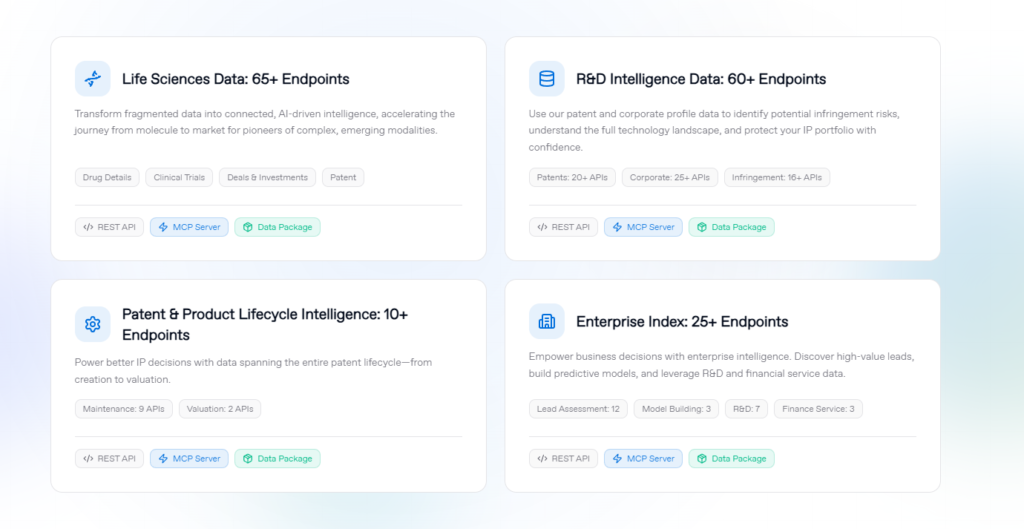
PatSnap’s open platform spans patent, legal, and broader R&D and life sciences data, and its public pages describe coverage across 170+ patent authorities and roughly 200M+ global patent records. It also goes beyond basic patent search, with endpoints across REST APIs, MCP servers, and other integration layers.
That kind of depth is a real advantage for larger teams that want everything from one vendor. But that is also where the friction starts.
If what you actually need is a focused patent search or a patent data API, PatSnap can feel a bit overwhelming, before it feels like the right fit. The way it is divided into multiple API buckets, packages, and product layers can make evaluation slower than it should be.
If you want to make a decision fast and are looking for a PatSnap alternative, this guide will help you narrow down the right options faster.
Here’s how we chose these alternatives.
We did not put this list together by pulling in every patent API we could find.
We started with a much narrower question: if a team is seriously evaluating the PatSnap API for patent search, patent data access, or IP workflow integration, which other APIs are realistic commercial options worth looking at? That meant every option on this list had to offer real API access, not just a web platform.
It also had to support at least one of the core jobs buyers usually care about here: patent search, patent data retrieval, semantic or prior-art style search, or broader IP workflow integration. Just as importantly, it had to be suitable for commercial or enterprise use, with enough public documentation for a meaningful comparison.
That’s not it. We excluded free public APIs such as EPO OPS or USPTO open-data APIs, because our focus is on finding commercial and enterprise-ready alternatives.
Based on those filters, we narrowed the list to five options.
While looking at the options in the market, one thing was clear. Not every patent API is built the same way. Some are more focused and easier to plug into a product. While others are broader and built for larger IP or research workflows.
Tools like PQAI are stronger on natural language search, while Questel Gateway API is better suited for IP workflow integration.
That said, here are 5 APIs worth considering as Patsnap API alternatives:
Now let’s look at them one by one, starting with PQAI.
If you are looking for a PatSnap API alternative that is easier to plug into a real workflow, PQAI is one of the strongest options on this list.
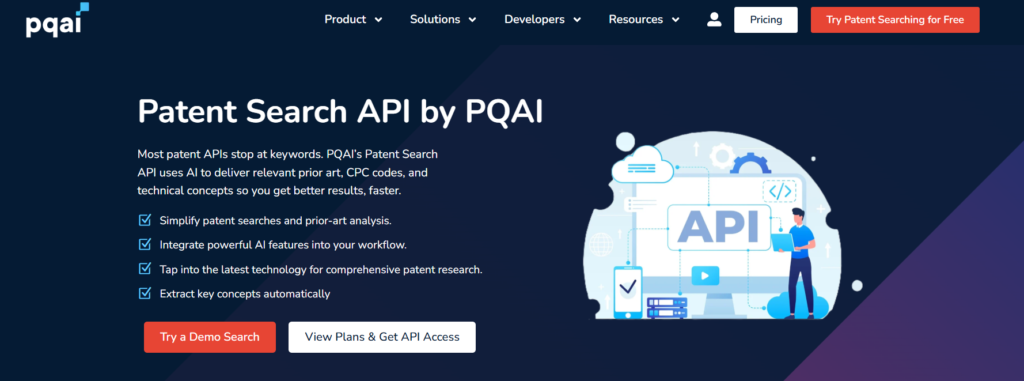
The API is built around a clear use case: helping users run semantic patent search and easily enable patent data retrieval inside real products and internal systems.
You see, a lot of patent APIs stop at keyword retrieval. PQAI leans into semantic search, pulls technical context, and delivers structured outputs that can actually support critical decisions.
Source – PQAI API
Here are a few features that make PQAI’s Patent Search API a stronger alternative to the Patsnap API:
Semantic prior-art search: The API is designed for semantic search. That means a natural-language description can be used as the query instead of relying only on rigid keyword logic. That matters because invention notes, disclosure text, and internal technical writeups are rarely written like patent claims. PQAI’s API is built to turn that kind of input into relevant prior-art results faster.
CPC classification and technical concept extraction: PQAI does more than return similar patents. The API also supports CPC prediction and technical concept extraction, which adds useful technical context around the search results. That makes it useful not just for retrieval, but also for screening, classification, routing, and technical analysis inside larger workflows.
Integration-ready API design: PQAI is built with integration in mind. The API offers routes for semantic search, prior-art combinations, similar-document retrieval, patent data, drawings, vectors, CPC suggestions, and definitions.
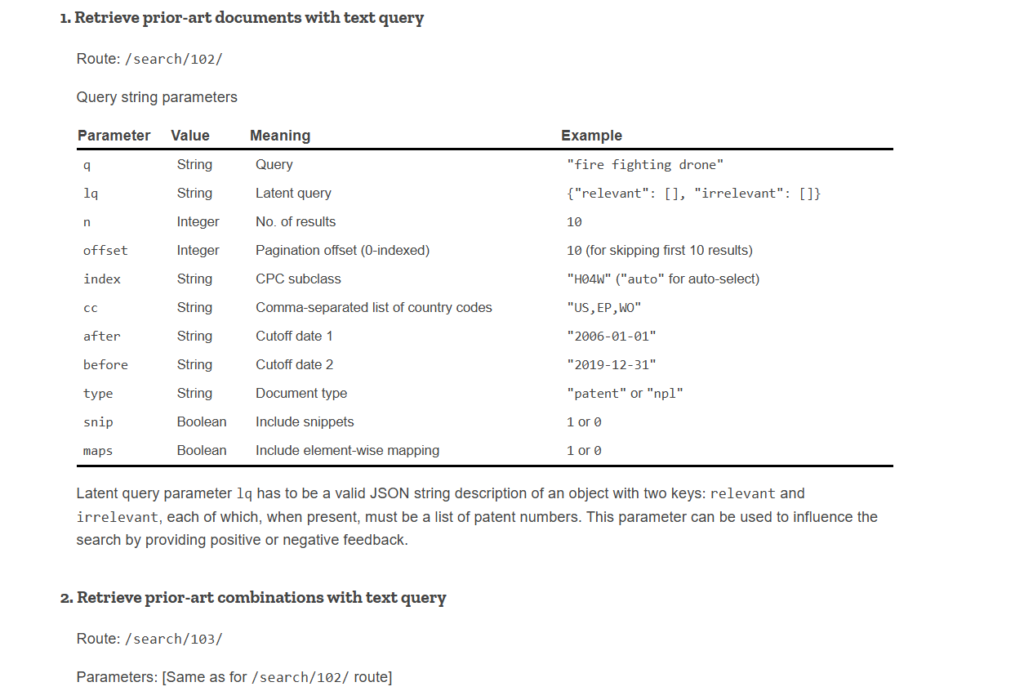
That gives a developer enough flexibility to build novelty checks, invention workflow features, or prior-art search modules without stitching together multiple separate services.
Structured outputs for software products: The API returns patent data and related outputs in JSON format that can move directly into another application or workflow. That is important because a patent API is more useful when the outputs can flow directly into review systems, search layers, or internal IP tools.
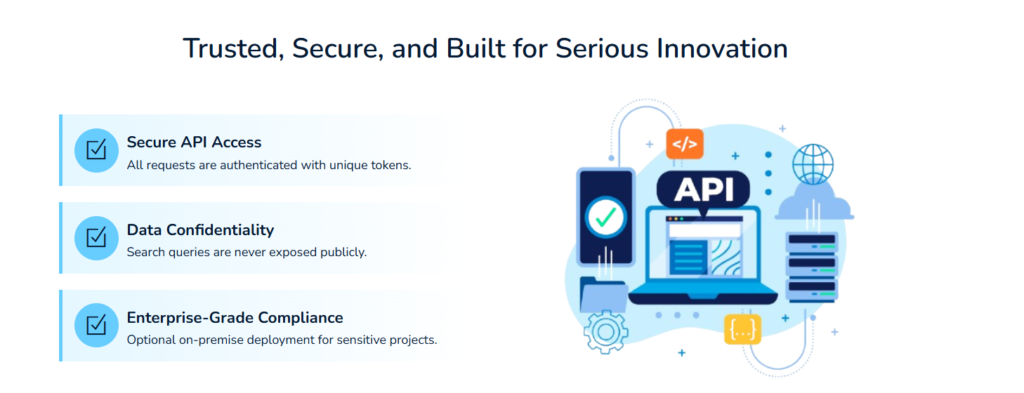
Security and enterprise-readiness: PQAI was built with deployment in mind. It offers secure authentication, industry-standard security measures, enhanced security and compliance on enterprise plans, and optional on-premise deployment for organizations that need more control.
PQAI works especially well in use cases where patent search needs to happen inside another workflow or as a custom integration to existing tools.
That might look like:
In short, it fits organizations that want a practical API they can embed, not just another search interface.
PQAI is best suited for organizations that care about easier integration, faster deployment, and feature depth around prior-art search.
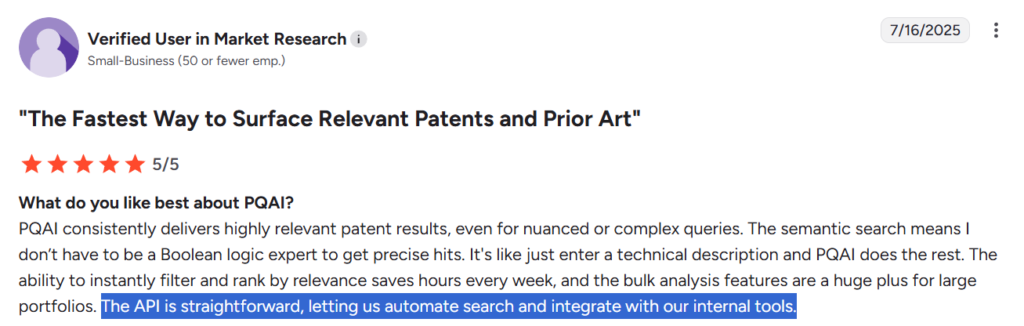
Source – G2
PQAI API offers two main plans for higher API usage:
MCP server access is included across both plans, with MCP queries counted against the same monthly API quota. You can get more information on our pricing page.
If you are looking for the right Patnspap API alternative that is easier to integrate into commercial platforms or your custom workflows, PQAI API is the right choice. You can contact us here to get the API key.
If you are looking for a PatSnap API alternative with a stronger enterprise patent-data angle, Clarivate belongs in the conversation.
Clarivate offers Derwent data feeds and APIs on the patent-data side, while its developer portal exposes access through the Intellectual Property or IP Data API. The latter offers search, analytics, and document retrieval, with contract-based approval before access is granted.
What makes this API stand out is the depth of the underlying Derwent data layer. The Derwent APIs provide access to 162M+ global patent records, 65M+ invention families, and 77 full-text jurisdictions.
They also offer access to DWPI, DPCI, GENESEQ full text, original PDFs, drawings, industry classifications, and bibliographic data. The data is delivered through common XML feeds or remote API access, which makes it suitable for internal databases, dashboards, and research systems.
Clarivate stands out most on the curated patent-data side. Its Derwent APIs provide access to titles and abstracts for 65M+ inventions, while DWPI itself is positioned by Clarivate as a curated, enhanced patent database built by subject experts.
If the priority is enriched, normalized, enterprise-grade patent data, Clarivate has a strong case here.
Moreover, for pharma/chemistry use cases, Derwent’s data quality beats PatSnap’s.
Here’s where Patsnap wins:
Clarivate offers API access based on contractual terms. All requests are reviewed against your use case before approval. You can contact their team for more details on pricing.
If you are looking for a PatSnap API alternative that leans more toward IP operations and workflow integration, Questel belongs in the conversation.
Questel positions its Gateway API as a way to use the functionality of the Questel Services Portal directly from your own software. That includes prior-art searches, filing, translation, fee management, renewals, and project tracking, which makes it broader than a simple patent-search endpoint.
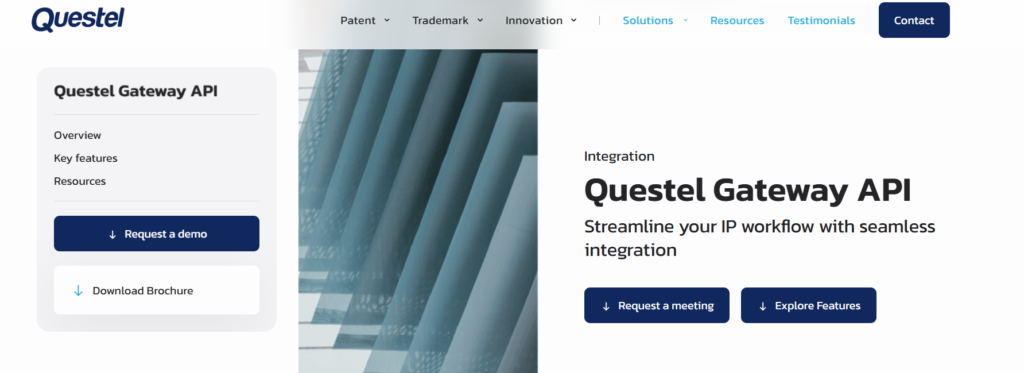
The RESTful API is built for enterprise use. It supports JSON and XML data formats, along with CSV and Excel exports, in addition to standard HTTP methods for working with API endpoints.
Questel stands out most on the workflow and operations side. If the priority is to connect patent-related services such as filing, translation, renewals, project tracking, and prior art searches into existing docketing or IP management systems, Questel has a strong case.
Its positioning is clearly built around helping organizations reduce manual work and manage IP processes more smoothly through integration.
PatSnap is easier to evaluate if your priority is a broader patent-search and patent-data API. Questel’s Gateway API is more tightly tied to workflow and service integration.
Questel does not offer pricing. You can contact their team for more details.
Minesoft comes into this conversation from a different angle. Its Patent Data API is positioned around getting patent data into the systems where decisions are already being made. That could mean dashboards, analytics workflows, internal applications, or AI models.

On its API page, Minesoft highlights 179M records, 150-country coverage, and daily updates. The API can support real-time queries as well as bulk feeds, which is important if patent data needs to move into business systems at scale.
Beyond basic records, there is also coverage across patent families, legal status, citations, chemical structures, and MESH disease data. Minesoft also ties the API directly to enterprise tools like Power BI, Tableau, Snowflake, and Databricks.
Minesoft stands out most on the data infrastructure side. If the priority is to move patent data into business dashboards, data lakes, BI tools, or AI and ML pipelines, Minesoft has a strong case. Its positioning is clearly built around making patent data easier to use across the wider organization, not just inside IP teams.
Moreover, it also offers integration with tools like Power BI, Tableau, Snowflake, and Databricks. This makes the API easier to place in real business and analytics workflows
PatSnap offers a broader set of APIs across different use cases. Whereas Minesoft’s API is tighter and more data-delivery focused.
Minesoft does not list public pricing. They offer a free trial, and you can contact their team for more details.
The Lens was built as a public resource for global patent and scholarly knowledge. Its API gives access to both the patent corpus and the scholarly corpus through a REST API. That makes it useful for organizations that do not want only patent records, but also want research-linked search and analysis.
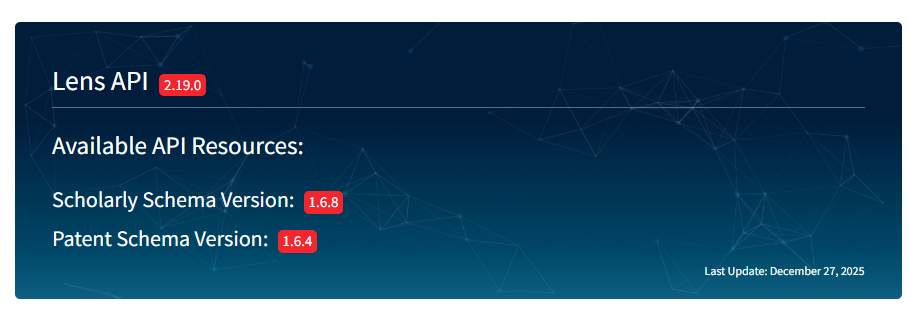
The API supports bulk data access and token-based API use after approval. That gives it a broader research angle than a plain patent search API.
Lens stands out for its openness, research orientation, and patent-plus-scholarly access. If the requirement is not just patent search, but also linking patents with papers and wider knowledge discovery, Lens has a strong case.
It also offers a clearer path for trial access and custom API plans for different use cases.
PatSnap is easier to place as a broader commercial patent intelligence platform. Its API packaging is more visibly built around enterprise patent workflows, AI enrichment, and platform-style integration. Lens feels more open and research-led by comparison.
Lens offers API trial access for evaluation and non-commercial use only, and commercial API access is handled through custom access plans based on use case, attribution, API volume, and speed requirements.
They offer an institutional subscription plan for API access. You can reach out to their team for more details.
If you are comparing PatSnap with other enterprise-ready API options, the differences show up pretty quickly. Some APIs are built around patent search and semantic retrieval. While others are built around curated patent data. Let’s compare them side by side now.
| API | Data access | Endpoint style | Output / delivery | Pricing visibility |
| PQAI API | Focused on US patent data, along with patent data retrieval, drawings, vectors, CPC suggestions, and similarity-style search routes. | Clean, route-based API with clearly documented endpoints such as semantic search, prior-art combinations, patent retrieval, and drawings. | Mostly JSON, with image output for drawing routes. | It offers transparent API pricing, with the Developer plan starting at $199/month and the Enterprise plan starting at $700/month. |
| Clarivate IP Data API | Access to 162M+ global patent records, 65M+ invention families, and 77 full-text jurisdictions, with Derwent data layered underneath. | Patent search, analytics, and document retrieval through Clarivate’s IP Data API, with Derwent feeds and APIs also positioned separately. | API access plus XML feeds and remote delivery options. | No standard public API pricing. Access is contract-based and reviewed against use case. |
| Questel Gateway API | Framed less as a standalone patent-data API and more as access to Questel’s service workflows, including prior-art search, filing, translation, fee management, renewals, and project tracking. | RESTful API with endpoints for translation, filing, and project management. | Supports JSON, XML, CSV, and Excel outputs. | No public pricing shown |
| Minesoft Patent Data API | Built around 179M records, 150-country coverage, daily updates, and broader coverage across patent families, legal status, citations, chemical structures, and MESH disease data. | Enterprise patent-data API tied to dashboards, workflows, and AI models, with PatBase sitting behind the broader data story. | Supports real-time queries and bulk-style data delivery into BI and analytics systems. | No public price listed, though a free trial is offered. |
| The Lens API | Access to both the patent corpus and the scholarly corpus, which gives it a wider research angle than a plain patent API. | REST API with documented patent and scholarly access, plus token-based access after approval. | API access plus bulk data options for larger use cases. | Trial access is non-commercial. Commercial API access is custom. |
This quick comparison already shows the split in the market. API like PQAI is the most focused and transparent of the group. Whereas Clarivate is stronger on curated patent data. Questel leans more toward IP workflow integration.
Minesoft is strongest when patent data needs to move into business systems. The Lens stands out when patent and scholarly access need to work together. That is also why PatSnap sits in the middle of a broader conversation rather than having one single like-for-like replacement.
Each API has its own strengths. However, there’s one API that stands out from the rest.
PatSnap is broader. But that breadth is not always what every buyer needs.
If your real need is semantic prior-art search, easier developer access, and faster integration, PQAI is the better fit. It gives you the core patent search API capabilities most products and internal workflows actually need, without forcing you into a much larger platform story.
That focus is the advantage. It gives you a cleaner API layer that is easier to understand, test, and start with.
If you want a patent search API that is easier to plug into real workflows, start with PQAI’s Developer plan.
If you need higher usage, commercial deployment, platform integration, or deeper support, you can move up to the Enterprise plan. If you are ready to make the switch, reach out to our team to get API access today.
Disclaimer: This article is based on information available in publicly accessible sources, including official product pages, API documentation, pricing pages, and related public materials available at the time of writing. All product names, company names, logos, trademarks, and brand assets mentioned or shown belong to their respective owners and are used here for identification and comparison purposes only. We do not claim ownership over any third-party brands, images, or trademarks referenced in this article.

At PQAI, we bring clarity to the world of patents. Through storytelling and insight, we simplify inventions so innovators, researchers, and businesses can learn from the past and build the future.
In one of our earlier articles, we shared how PQAI can be used for invalidity searches. A little before that, we had also conducted a

PQAI is a popular tool among inventors for conducting novelty searches. You can describe an invention in plain language, and its semantic search capabilities can
People ask us a version of the same question all the time. How good is PQAI, really? It is a fair question, and a hard