
How Often Does PQAI Surface Prior Art in Invalidity Searches? A Benchmarking Study
In one of our earlier articles, we shared how PQAI can be used for invalidity searches. A little before that, we had also conducted a


In innovation-driven organizations, teams are often encouraged to share ideas early and often. Employees are expected to think creatively and explore new concepts or improvements to existing ones.
These ideas are then shared with IP teams to quickly identify which innovations may be worth advancing toward patenting or other forms of IP protection.
Over time, however, this creates a familiar tension. There are simply too many ideas for IP teams to review, redirect, or advance in a timely manner.
As a result, many ideas remain in a pending state, with no clear next step. Employees begin to lose momentum when they do not know what happened to their earlier submissions or whether their ideas were ever evaluated.
This is the exact challenge one large, research-driven organization faced when they approached us. They needed a secure, internal system that could help bridge the gap between early idea submission and IP evaluation, without overloading their IP teams or slowing down innovation across the organization.
To address the gap between idea generation and IP evaluation, the organization initially relied on formal invention disclosure processes. These systems were designed to capture detailed technical information upfront, so IP teams could assess ideas efficiently.
In practice, the approach worked against its own intent. The language on the forms was legal-heavy, the forms were long, and the process assumed a level of IP fluency that most employees did not have.
As a result, many early-stage ideas never made it into the system at all. Employees delayed submissions until concepts felt complete, or never hit the submit button.
In one instance, an engineer chose not to submit an early idea because the process felt too involved for a concept that was still evolving. A few months later, a competitor filed a patent covering a closely related approach in the rapidly emerging technology area. This was not an isolated case, this happened earlier too.
In response, the company tried to simplify its internal idea intake process. They made the forms shorter, reduced legal framing, and encouraged employees to share ideas as soon as they emerged.
As a result, participation increased, but the IP team now faced a surge of loosely defined ideas, many lacking context about existing technologies or prior solutions. Evaluation became difficult, and the review backlog continued to grow.
The organization also explored encouraging engineers to run searches before submitting ideas to the IP team. The idea was to introduce early context and reduced downstream evaluation effort.
However, it had its own challenges:
The organization worked with some highly sensitive ideas, and could not risk exposing them.

They wanted a single, trusted system that made early prior art awareness part of the workflow, thus supporting innovation without introducing new risk.
Recommended Read: 3 Ways Inventors Can Leverage Prior Art to Fine-Tune Their Ideas
As part of early experimentation, their teams explored several AI patent search tools. Many discovered PQAI during this process and used it to run exploratory searches, with positive feedback on relevance and coverage.
However, due to the earlier pointed challenges, their leadership was not looking to introduce another standalone tool into the workflow.
While PQAI is fully secure, we also offer private deployment options for organizations so they can retain full control. This addressed confidentiality concerns; however, it still resulted in a separate system that engineers had to consciously opt into.
It did not solve the core issue for our client.
By this point, the organization was clear about what they wanted to fix.
They did not want employees to use a separate search tool or decide on their own how and where to check prior art. They wanted early awareness of existing technologies to become part of the same system where ideas were already being shared and discussed.
The goal was simple. When an employee submitted an idea in the internal platform, there needed to be a way to check whether ideas already existed. If relevant prior art surfaced, engineers could refine the scope of their idea, take a different technical route, or clearly document how their approach differed.
This helped in two ways:
To achieve this, prior art search had to be built into the workflow itself. That requirement made an API-based approach the most practical option.
The organization had already experimented with PQAI tool during earlier exploration and were satisfied with the quality of prior art surfaced. When the organization evaluated how to operationalize this capability internally, the API model aligned well with their needs.
Using the PQAI Patent Search API allowed them to keep their own interface and internal workflows unchanged.
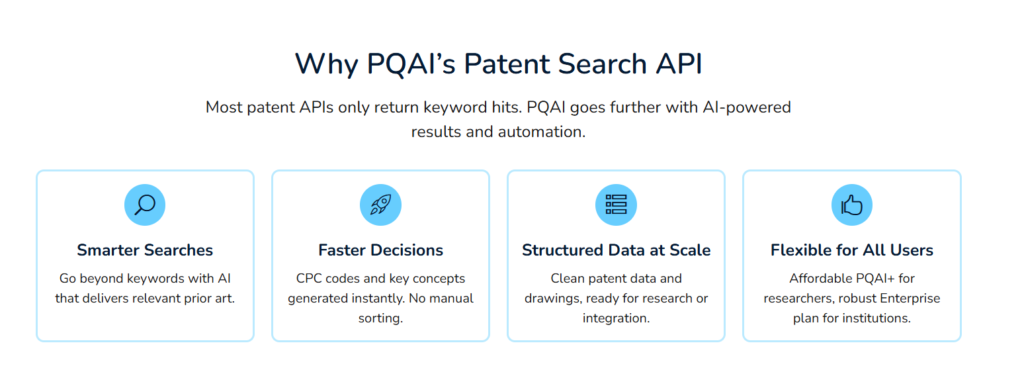
From an implementation standpoint, the API supported what they needed without forcing them to build search infrastructure themselves. In particular, it provided:
With this setup, prior art awareness became part of the innovation process by default.
Employees did not have to decide whether to search, where to search, or how to interpret results in isolation. The system handled that step, and the IP team received ideas with clearer technical grounding.
Once prior art search became part of the internal innovation workflow, the organization saw clear, practical changes.
Because search was embedded directly into the platform, employees no longer skipped the step. When submitting ideas, they could immediately see whether similar technologies already existed. This helped teams refine the scope of their idea early, adjust their approach, or document how their ideas differed from known solutions.
As a result, ideas continued to progress rather than stall.
For the IP team, incoming submissions were more usable than ever. Ideas arrived with required technical context already in place, reducing the amount of initial analysis required and shortening review cycles.
Within the first 6 months of deploying the embedded prior art search capability, the organization reported a 40% increase in patent filings compared with the previous period. At the same time, the company reduced the risk of unknowingly infringing any existing IP by introducing awareness earlier in the process.
Most importantly, innovation momentum improved across teams. Employees had greater confidence in how their ideas fit into the broader technology landscape, and the handoff to IP became smoother and more predictable.
This case highlights a broader shift in how research-driven organizations are approaching innovation management. Prior art search no longer works as a separate activity performed late in the process. It delivers the most value when it is embedded early, governed centrally, and integrated into the systems teams already use.
PQAI’s Patent Search API is designed to support this approach. Whether you are looking to embed semantic prior art search into an internal innovation platform, or explore controlled deployment options that align with your security requirements, we can help you evaluate what fits your workflow.
If you are exploring ways to make prior art awareness a natural part of your innovation process, reach out to us here to further discuss the best option for your organization.

At PQAI, we bring clarity to the world of patents. Through storytelling and insight, we simplify inventions so innovators, researchers, and businesses can learn from the past and build the future.
In one of our earlier articles, we shared how PQAI can be used for invalidity searches. A little before that, we had also conducted a

PQAI is a popular tool among inventors for conducting novelty searches. You can describe an invention in plain language, and its semantic search capabilities can
People ask us a version of the same question all the time. How good is PQAI, really? It is a fair question, and a hard