How Often Does PQAI Surface Prior Art in Invalidity Searches? A Benchmarking Study
In one of our earlier articles, we shared how PQAI can be used for invalidity searches. A little before that, we had also conducted a


The invention management tools we use today are designed to remove friction from early idea capture. Guided templates, AI-assisted prompts, and structured workflows make it easier than ever for inventors to document what they are building and share it with IP teams before ideas get lost or forgotten.
But there is a natural gap in this process.
Once an invention is disclosed, IP teams still need to assess novelty, understand the existing technical landscape, and determine whether an idea is worth patenting. That work often happens later, in separate tools, and sometimes involves patent attorneys or external experts.
What if some of that context could be introduced earlier, directly inside the invention workflow?
Because when done right, prior art search does not reject ideas or slow disclosure. It adds early technical awareness. It helps inventors refine concepts, understand what already exists, and articulate what is truly new, resulting in stronger disclosures.
As a result, IP teams receive higher-quality submissions that are easier to evaluate and more likely to be patent-worthy.
How do you add this capability to invention management and disclosure workflows without creating friction or slowing participation? That is what we will explore in this article.
| What we mean by Invention Management Tools? Invention management tools are software platforms used by organizations to capture, document, and evaluate inventions early, before formal patent filing begins. These tools typically support: +Invention disclosure workflows and structured submission forms +Collaboration between inventors, IP teams, and reviewers +Early-stage evaluation of ideas before decisions on patenting, filing, or further development This article focuses specifically on invention disclosure and early invention evaluation workflows, where adding prior art search can improve decision quality without adding friction. |
In invention workflows, there is often one key goal: encourage people to share ideas early and often. Low participation can be as damaging as poor-quality disclosures. So any capability that feels like a gate, a verdict, or a legal filter too soon risks reducing participation.
That is why prior art search must be positioned carefully. When embedded correctly, it supports inventors as they share their ideas. Here is where it fits best in the disclosure workflow:
During idea or invention submission: At the point of disclosure, prior art search works best as optional background context. It helps inventors see related approaches, terminology, or problem spaces while they are describing their idea. This does not determine patentability. Instead, it helps inventors articulate what is different, clarify assumptions, and describe their contribution more clearly.
During internal review and early triage: For IP teams, embedded prior art context reduces interpretation effort without changing the workflow. Reviewers can gain faster technical orientation and can group, compare, or prioritize disclosures more effectively.
Before escalation to patent attorneys or external experts: Prior art context at this stage acts as preliminary technical grounding. IP teams can forward disclosures that are already better framed, reducing exploratory work for attorneys and allowing external experts to focus on strategy rather than orientation. This reduces review costs and accelerates decision-making without filtering ideas earlier in the process.
Across the workflow, prior art search works best when it is passive and non-blocking. It should never prevent submission or signal rejection. Its role is to enrich understanding, not to judge outcomes.
When used this way, prior art search strengthens invention pipelines. Participation stays high, disclosures improve in quality, and downstream evaluation becomes more efficient, without changing the collaborative spirit that invention management tools are designed to protect.
How do you add prior art search capabilities inside invention disclosure or invention management workflows without creating operational drag?
We can all agree that building search capabilities in-house is rarely viable for invention tools. It demands continuous data ingestion, relevance tuning, and system upkeep. This work quickly becomes core infrastructure rather than a supporting feature.
On the other hand, relying on standalone search tools breaks flow, pulls users out of the disclosure process, and more often than not introduces enough complexity that inventors abandon the search process altogether.
This is where API-based embedding becomes the most practical approach. An API allows prior art search to run behind existing workflows, preserving user experience while delivering the technical depth IP teams need.
The product remains focused on invention capture and collaboration, while search capability is added as supporting infrastructure rather than a separate system.
Now that the right approach is clear, let’s look at the best patent search API built to support it.
The PQAI Patent Search API is built for teams that want to add the power of natural language-based prior art search inside invention disclosure and evaluation workflows, without the hassle of owning search infrastructure.
Most patent search APIs stop at keyword matching. PQAI goes further by applying AI to understand semantic relevance, allowing teams to surface relevant prior art even when inventors describe ideas informally or without precise patent language. This makes the API particularly well-suited for early-stage invention disclosure tools, where clarity and structure are still evolving.
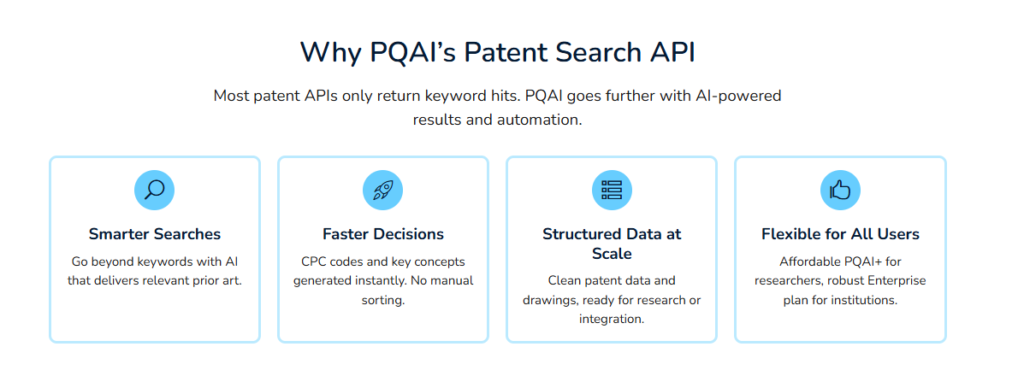
Taken together, these capabilities enable better disclosures, faster internal evaluation, and stronger downstream IP decisions, without slowing participation or increasing operational burden.

Invention management tools work best when they help ideas move forward, not when they slow disclosure or add complexity. Embedded prior art search capabilities should do the same.
The PQAI Patent Search API is built for exactly this need. It allows teams to introduce technical awareness in invention workflows, helping inventors frame stronger disclosures and enabling IP teams to evaluate ideas more efficiently.
The result is clearer, better-prepared disclosures and a faster path to patent-ready decisions.
Because the API is open-source at its core, teams gain transparency into how search works and confidence that it fits their workflows long term. At the same time, security and confidentiality are built in, with authenticated access and private deployment options when required.
While invention management is a strong use case, it is only one of many ways teams embed the PQAI API across IP and R&D systems.
If you are exploring ways to fit prior art search into your invention workflows, get in touch with our team to discuss more.
Read Next: How to Integrate the PQAI Patent Search API Into Your Tools And Systems?
No. Embedded prior art search is not a substitute for legal review. Its role in invention workflows is to provide early technical context, helping inventors and IP teams understand what already exists and frame disclosures more clearly. Final patentability assessments, claim strategy, and filing decisions still sit with IP professionals and patent attorneys.
Confidentiality is built in by design. All API requests are authenticated, and search queries are not exposed publicly or reused. For organizations with stricter data or compliance requirements, private server deployments are available, ensuring sensitive invention data remains fully controlled within the organization’s environment.

At PQAI, we bring clarity to the world of patents. Through storytelling and insight, we simplify inventions so innovators, researchers, and businesses can learn from the past and build the future.
In one of our earlier articles, we shared how PQAI can be used for invalidity searches. A little before that, we had also conducted a

PQAI is a popular tool among inventors for conducting novelty searches. You can describe an invention in plain language, and its semantic search capabilities can
People ask us a version of the same question all the time. How good is PQAI, really? It is a fair question, and a hard