Waste Recycling Innovation Trends: 4 Signals Emerging from Patent Filings
Mention waste recycling, and the first picture that comes to mind is the tricolor dustbins. Segregate your waste based on the category, reuse and recycle

| “I like to think of synthetic biology as liquid alchemy, only instead of transmuting precious metals, you’re synthesizing new biological functionality inside very small channels.” Neri Oxman |
When you hear the term synthetic biology, the first thing that often comes to mind is creating life in the lab or making organisms do unnatural things.
That framing can make the field seem distant, complex, and even a little speculative.
However, when you look at recent innovation activity in the area, the picture becomes much more tangible.
Inventors around the globe are building systems that can program cells, sense biological signals, test engineered tissues, and even automate parts of biological experimentation.
This engineering discipline has witnessed tremendous activity in the last couple of years. And we wanted to understand where exactly innovation in this space is heading in the coming time.
Since patent filings often offer one of the clearest early signals, we turned to PQAI to explore the landscape. This article breaks down our findings.
To understand where synthetic biology innovation is heading, we started with one broad query:
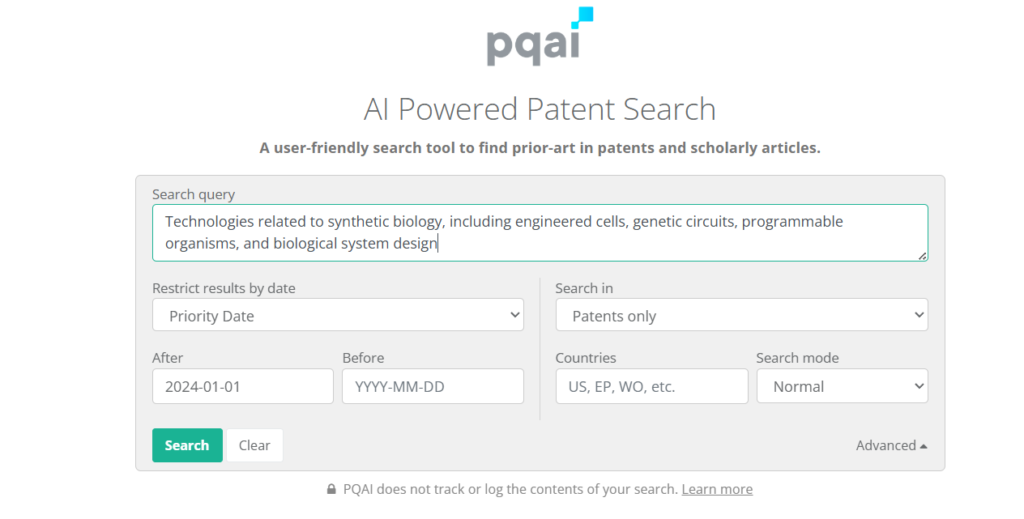
Source – PQAI
However, upon running it, we realized that the result set was somewhat limited and lying only in one direction. So, we created a few more queries to better understand the innovation space. The idea was to explore a broader set of directions and capture different layers of the field.
These included queries around:
We took this approach because synthetic biology is not a single product category. It sits at the intersection of multiple disciplines, and a single query would have captured only one slice of the landscape.
When we looked across the combined patent sets, a few patterns became clear, which we will look at next.
When we looked at the patents, one thing became very clear. There was a significant amount of recent inventive activity happening around cell engineering, monitoring, and the broader biological workflow infrastructure.
That does not mean synthetic biology begins and ends there. But these were the areas where the signals appeared most consistently across the patent sets we analyzed. So instead of stretching the scope further, we chose to probe deeper into the clusters that surfaced most clearly. Here’s what we found.
People often associate gene editing as a core area in synthetic biology. And while it is an important area, there is also significant work happening toward a more targeted direction. That is, designing cells that can survive and function better in therapeutic settings.
For instance, US2025290042A1, filed by BlueRock Therapeutics, focuses on genetically modified cells designed to better escape immune attack during allogeneic therapies, where donor-derived cells are given to a patient.
One of the biggest challenges in such therapies is that the patient’s immune system may recognize those cells as foreign and destroy them too quickly. This patent seeks to solve that by engineering the cells to resist the attack and remain effective for longer.
Another notable patent we saw was US2025262300A1, which covers engineered T cells used in combination with CD38-targeting compounds as a therapeutic approach, which are also used in the treatment of certain tumors and cancer.
You see, the CD38-targeting compound can help reduce natural killer cells, which are one of the reasons donor-derived T-cell therapies get rejected. But at the same time, those compounds can also damage the therapeutic T cells themselves. This patent addresses that problem by modifying the engineered T cells so they can better withstand the treatment.
There is increased activity around making cells last longer, face less immune rejection, and perform better once they are inside the patient’s body.
When we checked further, another interesting pattern appeared. Inventors were increasingly working on making cell therapies more reliable and easier to scale.
A notable example is US2025222598A1, which describes a system and apparatus for the automated manufacture of cell therapy. What makes this patent stand out is that it treats cell therapy production as a series of organized, modular steps rather than a mostly manual lab process.
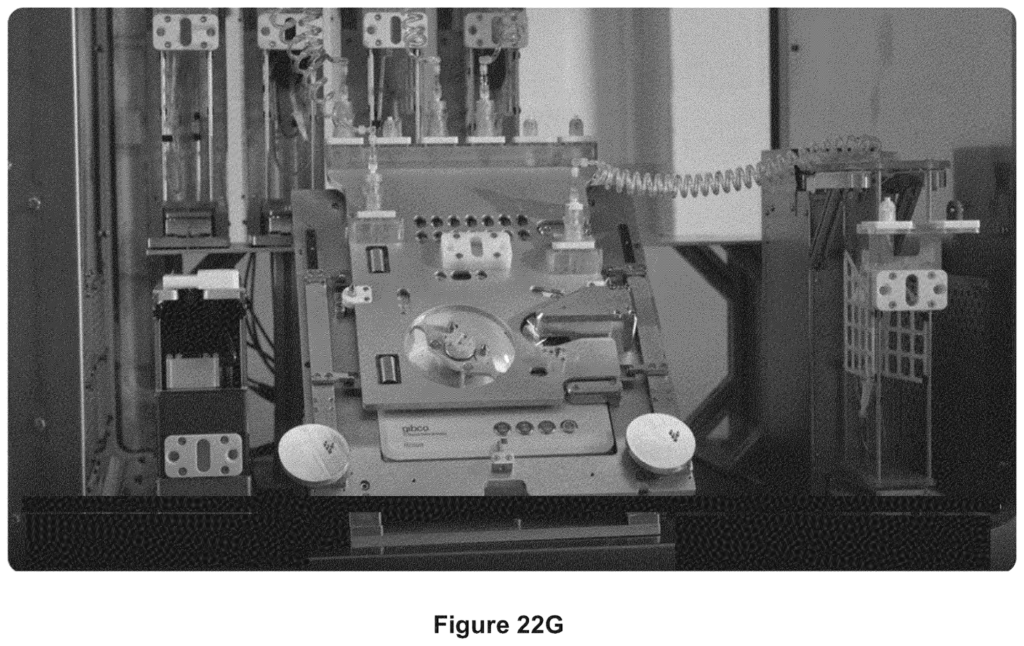
Source – US2025222598A1
Another filing in a similar direction is US2025304905A1, which covers a point-of-care system for automatically processing cells to support therapeutic production.
What’s notable is that this patent application highlights a very practical problem: current manufacturing systems can take days or even weeks, depend on multiple instruments, and add significant cost and complexity to the process. The system described is trying to do that more efficiently with fewer moving parts.
You see, that’s a meaningful shift. Synthetic biology is often discussed in terms of invention at the biological level.
But the patent data shows that an equally important battleground is now manufacturing infrastructure. The field is moving from “Can we engineer the cell?” to “Can we actually produce engineered cells in a reliable and scalable way?”
And that is a very different stage of maturity.
Another interesting direction we noticed was the innovation around observing and interpreting what living cells were doing in real time.
That is an important shift. Instead of growing cells and checking the result only at the end, inventors are building systems that can monitor what those cells are doing in real time.
One of the clearest examples is US2025136960A1, which covers cell data recorders. Here, cells are being treated as systems that can register, store, or reveal information about their own state or environment.
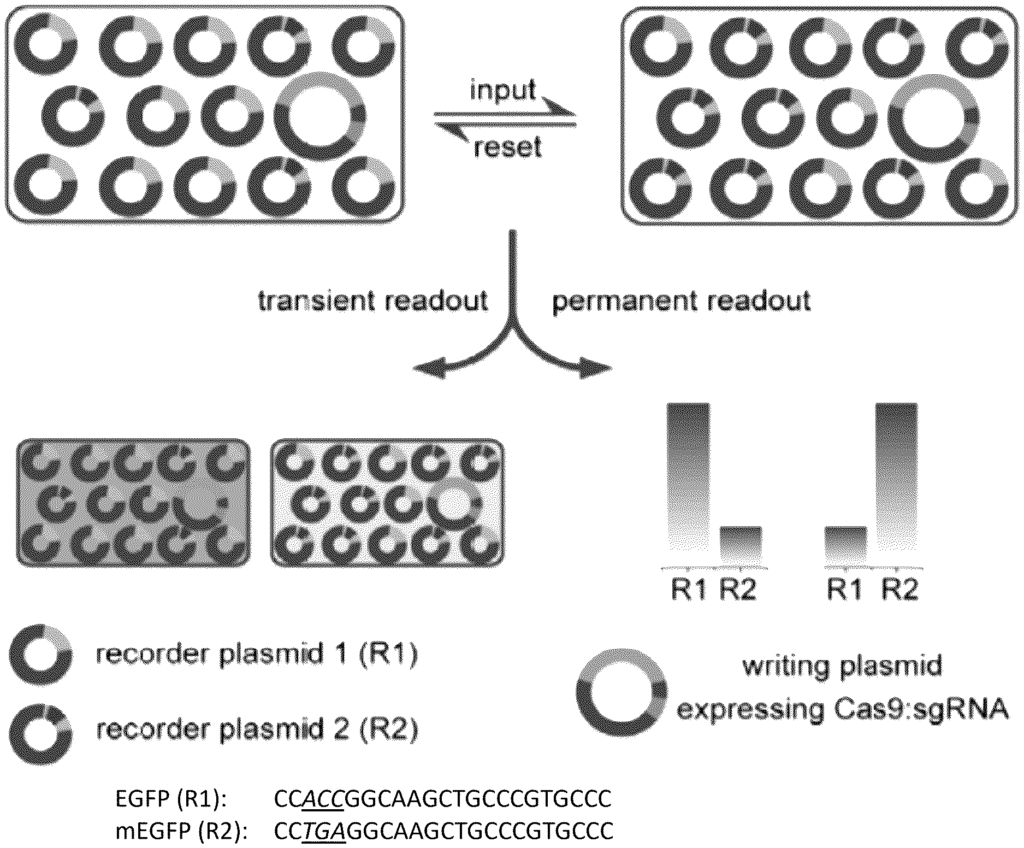
Source – US2025136960A1
Another notable filing is US2025237605A1, which focuses on living biosensors. This filing by the Broad Institute points to a future in which engineered biological systems can sense their surroundings and respond in measurable, useful ways.
We also observed supporting activity in this area through filings such as US2025116628A1, which describes cell analysis using ChemFET sensor array-based systems.
These filings, including CN118146927A, suggest that cells are now increasingly being integrated into systems of sensing, recording, and analysis.
This is a crucial insight, because once biology becomes something you can continuously monitor and interpret, it becomes far more engineerable.
As we further progressed through the datasets, we realized that synthetic biology is not only advancing through engineered cells or molecular systems. It is also advancing by improving how those systems are tested.
This is where organoids, organ-on-chip platforms, and other lab-grown biological models come into the picture.
For example, US2025223533A1 focuses on a method and apparatus for constructing a microfluidic bone organoid-on-chip.
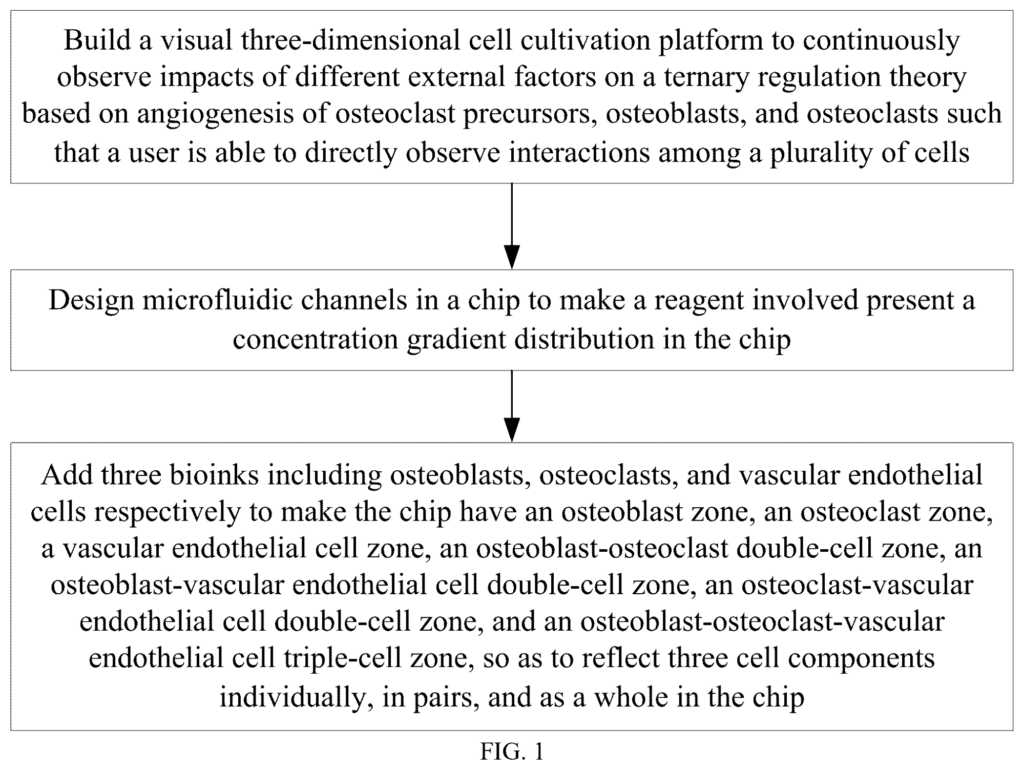
Source – US2025223533A1
The filing discusses a lab-grown system that behaves more like real human tissue, making it easier to study how cells behave in a more realistic setting.
Similarly, US2025122456A1 covers a micro-physiological platform for immune response modeling. Again, the significance here is not just the platform itself. It is what that platform enables. That is, a better way to study how biological systems respond under more life-like conditions.
We also saw adjacent support from filings like US2025101358A1, which describes a system for modeling a human vascularized integrated organ system.
This trend matters because engineered biology gets harder to evaluate as it becomes more sophisticated.
If the field wants better predictions, clearer safety signals, and more reliable performance data, it needs test systems that are closer to how the body actually works.
And that is exactly what these filings are building.
AI is becoming a significant part of almost every technical field right now. But in the synthetic biology patent sets we reviewed, the signal was even more specific than that.
AI and automation are no longer on the sidelines of biological research. They are beginning to shape the core workflow itself. That is, they are beginning to shape how biological experiments are planned, run, and tested.
One strong filing here is US2025283027A1, assigned to MitoAI Inc, which describes an AI-manipulated automated cell culturing system. What makes this notable is that the system is not just automating repetitive lab work. It is also using AI to make decisions around culture conditions and protocols, helping reduce manual judgment, improve consistency, and make cell culture workflows easier to scale.
Even more notable is US2025307658A1, assigned to Princeton University and Leland Stanford Junior University, which covers a large language model agent for automated design of gene-editing experiments.
Here, instead of merely executing lab tasks, the AI agent helps researchers plan experiments by breaking requests into steps, pulling in relevant information, and generating recommendations for designing a gene-editing study.
We also saw related support in filings like US2025259715A1, which adds another layer to the trend. It suggests that AI can also be used to model cellular behavior, simulate biological interactions, and support better decision-making before or alongside real-world experimentation.
For years, synthetic biology has been described as an engineering discipline. But the filings suggest it is now even behaving like one, with software, automation, workflow orchestration, and modeling becoming more central to how biological systems are designed and tested.
That brings us to an important point.
If you only look at high-level discussions of synthetic biology, the field can seem impossibly broad. It includes everything from gene editing and agricultural engineering to sustainable materials and microbial production.
But when we looked at the patent results surfaced through these queries, the center of gravity was much clearer.
A large share of inventive activity appears to be clustering around the trends discussed above.
However, that does not mean other parts of synthetic biology are unimportant. It simply means that in the patent datasets we surfaced, these were the areas where the signals were strongest. And that matters, because patent landscapes do not just show what people are talking about. They often show what people are actively trying to build.
That said, if you are working in this space, whether in gene editing, biosensing systems, cell therapy, or lab automation infrastructure, it is worth studying the patent landscape more closely. It gives you a clearer sense of where activity is concentrating and where white spaces may still exist.
And the good news is that you do not need to write highly technical queries or have knowledge of Boolean operators to start exploring.
With PQAI, you can describe what you are looking for in plain English and surface relevant patents much more quickly.
For example, you could explore follow-up queries like:
That can help you move from a broad topic like synthetic biology to the specific technical directions that are actually gaining momentum.
If you want to understand where synthetic biology innovation is heading, PQAI is a very good place to start. You can get started for free here.

At PQAI, we bring clarity to the world of patents. Through storytelling and insight, we simplify inventions so innovators, researchers, and businesses can learn from the past and build the future.
Mention waste recycling, and the first picture that comes to mind is the tricolor dustbins. Segregate your waste based on the category, reuse and recycle
A bioprinter can now lay down living material one precise layer at a time, turning a droplet of bioink into something biological: a steak, a
For research-intensive enterprises that constantly innovate, operating in fast-moving technology domains, patenting is not a one-time event. It is an ongoing process that unfolds alongside