
How Often Does PQAI Surface Prior Art in Invalidity Searches? A Benchmarking Study
In one of our earlier articles, we shared how PQAI can be used for invalidity searches. A little before that, we had also conducted a

When you hear the term climate monitoring, the picture that usually comes to mind is a network of satellites and machines deployed globally. You imagine dashboards, weather maps, and screens tracking trends in temperature, rainfall, and air quality from control rooms around the world.
That picture is not wrong. But it is incomplete.
The recent patent activity suggests that there is a lot of work happening in the domain.
Inventors are building systems that track emissions at the source, connect data from multiple monitoring layers, and trace pollutants across cities. And that is only a small part of what is emerging in this space.
We wanted to understand where innovation was actually heading next. So we turned to PQAI to study the patent landscape. This article covers a set of recurring signals that indicate where the field might be heading.
To understand where climate monitoring innovation is headed, we created a query to determine systems and methods for monitoring atmospheric changes, greenhouse gas emissions, and climate-related environmental conditions.
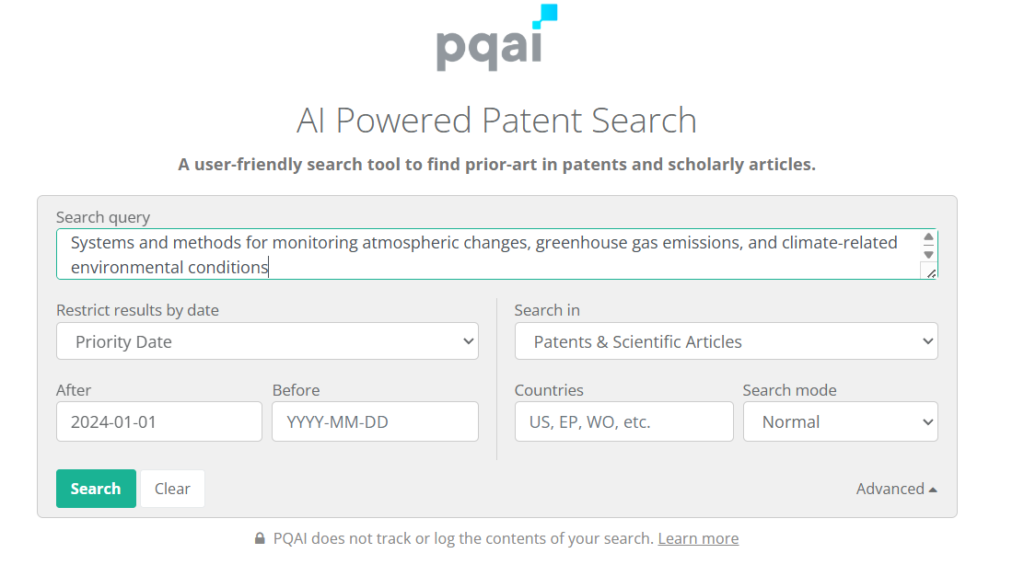
The query surfaced a broad result set, with innovation activity appearing across multiple directions. There was work happening around atmospheric monitoring, ecological monitoring, remote sensing, and early warning systems.
As we went through the results, some very clear directions began to appear, which we will cover in the next section.
Upon looking at the patent results, one thing became clear. There is a lot happening at once.
Some filings focus on making emissions tracking more precise. Others are pushing climate monitoring toward prediction and early warning. We also saw inventive activity expanding into areas like pollution intelligence, rivers, wetlands, and ecological systems.
A few directions appeared more consistently than the rest, and those are the ones we cover below.
Earlier, climate monitoring often worked at a very high level. You could measure emissions across a city, a region, or an industrial zone.
However, there was always a major question left unanswered: where exactly is the problem coming from?
The good thing is that inventors are trying to find answers to this question. Instead of treating climate monitoring as a broad environmental exercise, they are making it far more location-specific.
There is a lot of Chinese patent activity in the area.
For example, CN118518820A focuses on carbon emission monitoring for buildings. What makes this interesting is not just that it measures emissions. It also helps identify emission patterns within a building, so users can understand the emissions of a particular building rather than treating the whole region as a single source.
CN118311199B, takes a similar direction, albeit focuses on monitoring carbon emissions from commercial vehicles. Assigned to the Research Institute of Highway Ministry of Transport, the patent helps narrow down the sources to one particular class.
We also saw CN118536923A, which focuses on carbon accounting and management in industrial parks, and CN119294670A, which looks at monitoring carbon pollution at enterprise sewage outlets.
That last example may sound narrow, but that is exactly the point. Climate monitoring is becoming more useful because it is becoming more precise.
This matters because once monitoring becomes source-specific, it becomes easier to answer the question that most climate systems eventually have to answer: where should action happen first?
There was another clear direction that emerged in the filings. Inventors were now building systems where different monitoring methods work together. Different stacks working in coordination and supporting one another for more comprehensive data.
CN118294593A is one good example, which describes a satellite-ground coordinated regional greenhouse gas monitoring system. Here, satellite data provides broader visibility, while ground-based systems add local validation and detail. The result is a more complete monitoring system.
We saw a similar direction in CN119000551A, which covers a ground carbon emission monitoring system based on a multi-source data interactive network. What is interesting about this patent is that it first uses remote sensing satellites and radar to identify abnormal areas for emission , and then uses a mobile monitoring device to inspect those areas more precisely. In other words, the system does not just monitor. It narrows down the problem step by step.
This layered logic also appears in CN117892952A, an atmospheric environment monitoring system based on the Internet of Things. The system combines pollutant monitoring, emissions analysis, alarms, and quota management, making monitoring more operational.
This trend also has an important supporting layer: data quality. A connected system is only useful if the data can be trusted. That is where filings like CN117829557A and CN117760998A come in, showing that inventors are also paying more attention to site selection and data quality.
These patents address a very real problem. If the monitoring setup is weak, the decisions built on top of it become weak too.
The larger shift here is clear. Climate monitoring is moving toward coordinated monitoring stacks, where different sensing layers work together to produce a more precise and useful picture.
While going through the results, we came across a set of patents that were pointing to an important adjacent direction.
We also saw a clear cluster of patents around urban atmospheric monitoring, pollutant tracing, particulate monitoring, and air-quality forecasting. That makes sense, because cities are often where pollution shows up most clearly and where monitoring becomes most necessary.
Here are some notable patents in the area:
CN118940067B, covers a real-time monitoring system based on urban atmospheric pollutants. The interesting part here is not just that it monitors pollutant levels. It also helps with source tracking, trend analysis, and early warning.
CN118464119A, focuses on tracing atmospheric pollutants across multiple monitoring points. In simple terms, it moves beyond observation and into identifying likely sources.
There were other notable patents too. Like CN119334838A, which covers atmospheric particulate monitoring, and CN119375985A, which uses grid monitoring to improve medium- and long-term air quality forecasting.
What these patents suggest is that the broader environmental monitoring landscape is becoming much more grounded in real places and real atmospheric systems. It is not only about broad environmental indicators anymore. It is also about sharper, more operational environmental intelligence close to where people and infrastructure actually are.
In some of the filings, we noticed a very distinct pattern. Monitoring is not being treated only as a way to record what is happening, but also to forecast what may happen next or to trigger earlier intervention.
One example is CN118469142A, which describes a community carbon emission monitoring and prediction system based on IoT and AI. The system first collects emission data across different community zones. It then uses that data to predict carbon emission patterns, making the monitoring output more useful for planning and response.
We saw a similar logic in CN119246772A, which combines emission-source data, monitoring nodes, and environmental data to build a dynamic carbon distribution model. This data can be used to help estimate how emissions may spread or behave under different conditions.
The broader signal is hard to miss. Climate monitoring systems are becoming less like dashboards and more like decision-support tools. That is a meaningful change, because prediction and early warning are often what turn monitoring into action.
A lot of people still imagine climate monitoring as something that mainly happens in the air. That is understandable. Public discussion usually focuses on greenhouse gases and atmospheric conditions.
But climate systems do not operate only in the atmosphere.
Rivers release gases. Water bodies exchange carbon with the air. Ecosystems absorb carbon in some places and release it in others. If monitoring stays too air-centric, it misses a large part of the real picture.
That is why this final signal is so interesting. And inventors are working to capture data from these systems as well.
CN119375425A, for example, enables a precise way to observe gas exchange in aquatic systems, which are often undermeasured relative to industrial or urban sources.
Similarly, CN118839973B covers a river greenhouse gas emission evaluation system based on IoT. This pushes climate monitoring into river systems rather than keeping it confined to factories, buildings, and transport.
We also saw CN118730954A, which focuses on a full-component greenhouse gas collection system for ecological systems.Whereas CN119003679B focuses on remote sensing-based ecological carbon sink monitoring.
That last one is especially interesting because it shifts the question from “where are emissions increasing?” to “how much carbon are different ecological regions absorbing?”
That is an important expansion of the field. Climate monitoring is no longer only about measuring emissions and damage. It is also becoming a tool for understanding ecological behavior.
If we step back from the individual filings, one thing becomes clear.
Climate monitoring is becoming more precise, connected, and useful in real-world settings. There is ongoing work on systems that track emissions closer to the source, connect multiple monitoring layers, support forecasting, and expand monitoring beyond the atmosphere into rivers, ecosystems, and carbon sinks.
That is what makes this space worth paying attention to. Climate monitoring is no longer just about collecting environmental data in the background. It is becoming an intelligence layer that can help people understand where change is happening, what is driving it, and where action may be needed next.
If you are working in this area, capturing these signals early matters. And that is exactly where PQAI can help you explore the landscape further.
If you are working in greenhouse gas sensing, emissions intelligence, atmospheric analysis, ecological monitoring, or climate software, it is worth studying this landscape more closely. Patent filings can reveal where inventors are concentrating their efforts and where white spaces may still exist.
And the good thing is that you do not need to build complicated Boolean strings to get started. With PQAI, you can search a concept in plain English and then refine based on what the result set gives you.
For example, you could explore follow-up directions like:
That is often where the real insight begins. You start with a broad question, and then follow the technical signals that surface most clearly.
If you want to understand where climate monitoring innovation is further heading, PQAI can help surface relevant patents and non-patent literature in the domain.
What’s the wait? Try the tool today!

At PQAI, we bring clarity to the world of patents. Through storytelling and insight, we simplify inventions so innovators, researchers, and businesses can learn from the past and build the future.
In one of our earlier articles, we shared how PQAI can be used for invalidity searches. A little before that, we had also conducted a

PQAI is a popular tool among inventors for conducting novelty searches. You can describe an invention in plain language, and its semantic search capabilities can

People ask us a version of the same question all the time. How good is PQAI, really? It is a fair question, and a hard